
Posted by Toby Wilkinson on May 12th, 2022
One hundred years ago, on 26 November 1922, at 4 o’clock in the afternoon, the English archaeologist, Howard Carter, stood at the end of a corridor cut into the bedrock of Egypt’s Valley of the Kings. With him were three companions: his aristocratic patron, Lord Carnarvon, and Carnarvon’s daughter, Lady Evelyn Herbert, both recently arrived from England; and an engineer friend, Arthur Callender. In front of them stood a blocked up doorway, its face plastered and covered with impressions from the seal of the ancient Egyptian royal necropolis. Several of them named an obscure and ephemeral king, Tutankhamun.
The discovery of his tomb made him the most famous pharaoh of them all. The West’s long fascination with ancient Egypt turned into something of an obsession. Tutankhamun’s name and image have become global brands. Exhibitions of his treasures have attracted millions of visitors – vastly more than the entire population of pharaonic Egypt. But the rediscovery of his tomb and its treasures has also prompted complex questions: about modern Egypt’s relationship with its ancient past, and with the West; about the ownership and custodianship of antiquities; about the tensions between scientific enquiry and the popular imagination. Tutankhamun’s legacy is as contested as it is enduring. One of the reasons why the discovery of Tutankhamun’s tomb created such a stir around the world was the series of stunning black-and-white photographs, taken by Harry Burton. The staff photographer of the Metropolitan Museum of Art in New York, Burton was a master of his art; his images are striking for their large format, fine detail, and dramatic lighting. Among the hundreds of Burton images from the time of the discovery is one of a young Egyptian boy, aged between nine and twelve, wearing a plain white linen galabeya and head-cloth. Suspended around the boy’s neck, standing out against the pale background, is one of the most lavish and dramatic pieces of jewellery buried with Tutankhamun: a heavy pectoral, chain and counterpoise featuring a series of large scarab beetles carved from lapis lazuli. Why should such an important object have been given to a young Egyptian boy to model? The answer, omitted from Carter’s account, is that the boy in question, Hussein Abdel Rassul, was the actual person who discovered Tutankhamun’s tomb.
Throughout the excavation, Carter kept a detailed diary and journal. However, he was not immune to gilding his narrative, or even re-writing history, when it suited him. Nowhere, for example, does he give credit to the Egyptian labourers who carried out the back-breaking clearance – over six long seasons – of the 200,000 tons of rubble and limestone chippings that overlay the tomb. Carter’s account of the discovery itself – ‘Hardly had I arrived on the work next morning (November 4th) than the unusual silence, due to the stoppage of the work, made me realize that something out of the ordinary had happened, and I was greeted by the announcement that a step cut in the rock had been discovered’ – reveals an aspect of the dig that is generally overlooked: it was the habit of Carter’s Egyptian workmen to begin work as soon as the sun had risen, before the archaeologist himself arrived to oversee operations. The discovery of that crucial first step was made by one of the workers, not by Carter.
Hussein Abdel Rassul was employed by Carter as a water boy, responsible for bringing water by donkey from the Nile to the dig site in the Valley of the Kings. The water jars had pointed bases, so shallow holes had to be dug in the ground to support the jars when they were set down. It was when digging just such a hole, on the early morning of 4 November 1922, that Hussein revealed a flat stone step in the floor of the Valley. And the rest is history.
The whitewashing of an Egyptian water boy from the account of the discovery exemplifies the almost total invisibility of the Nile Valley’s own inhabitants from the annals of Egyptology. Generation after generation of Western archaeologists were happy to take the credit for a succession of great discoveries, while barely acknowledging the indigenous labourers who made it all possible. This centenary year, much credit will be given to the two Englishmen at the centre of the story: the brilliant archaeologist Howard Carter and his aristocratic patron, Lord Carnarvon. But we should not forget the young Egyptian boy who discovered the tomb of another Egyptian boy, albeit a pharaoh buried 3,300 years ago.
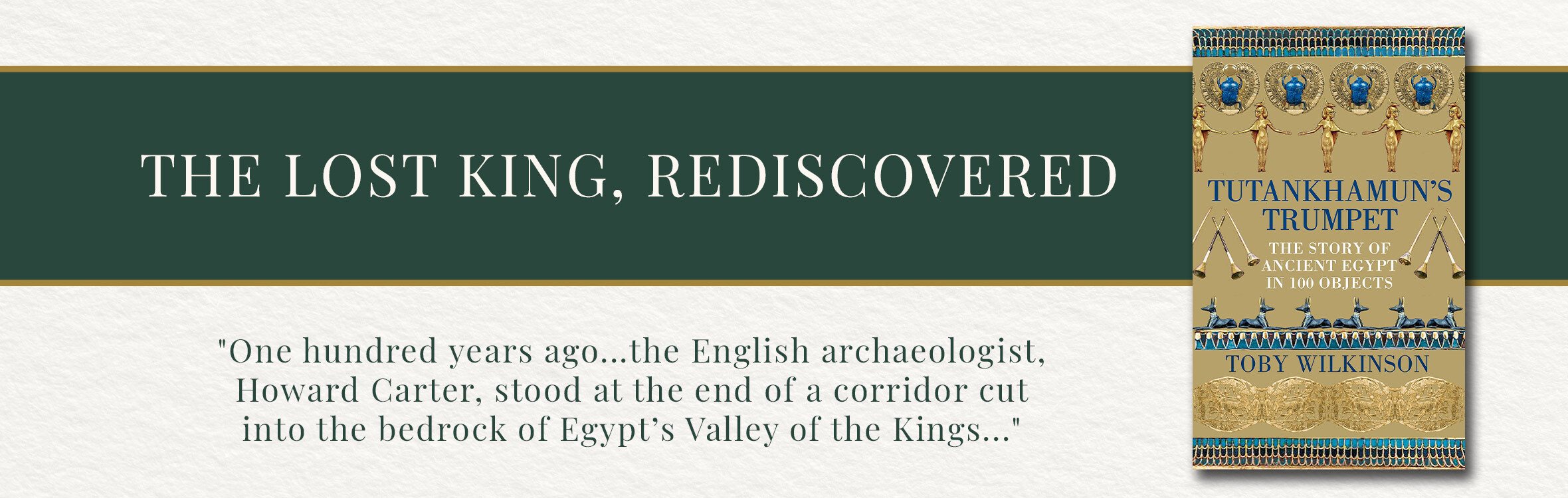
Tutankhamun's Trumpet: The Story of Ancient Egypt in 100 Objects, by Toby Wilkinson, is published by Picador on 12 May.