Posted by Jonathan Healey on February 3rd, 2023
Seventeenth century England is a murky place. When we peer at it from the distance of our own, twenty-first century viewpoint, it glares back: daring us to try our best to understand it, to grasp its intricate weirdness.
It was a time when people thought differently to us. Very differently.
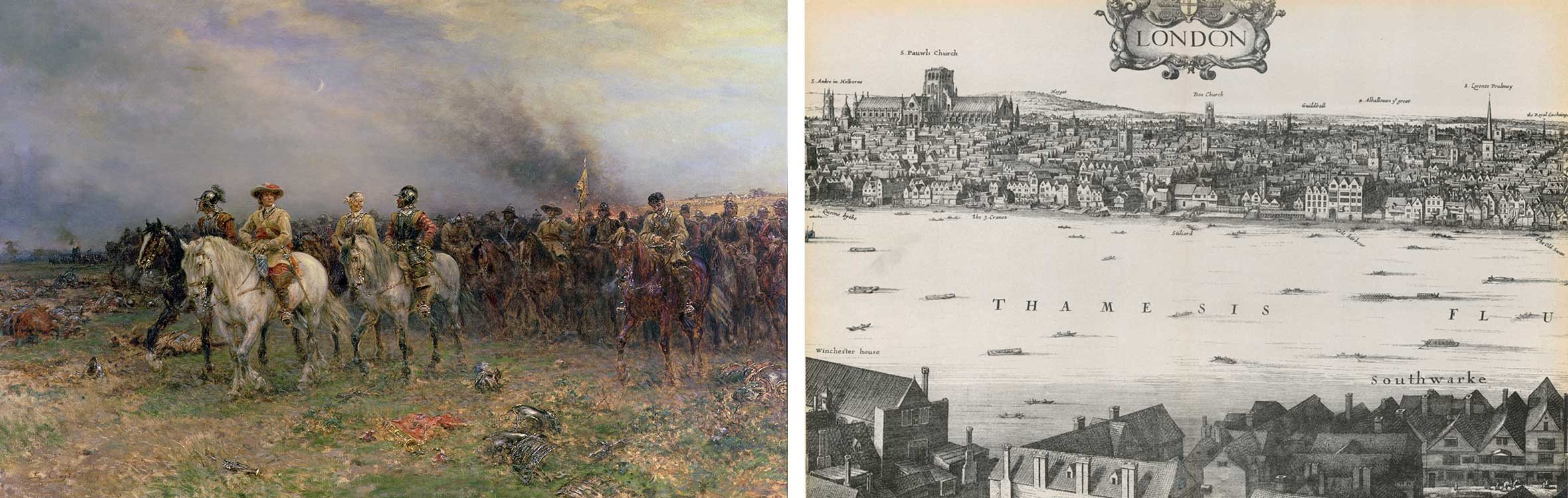
Image 1: Oliver Cromwell leading cavalry at Marston Moor, in a nineteenth-century painting. The battle was as much a Scottish victory as one for the English Parliamentarians, but it also marked a key moment in the rise of the East Anglian farmer who would become head of state in the 1650s. Image 2: London in 1647, from an engraving by Wenceslaus Hollar. The old medieval city was growing fast and spilling out from the old walls. One of the fastest growing areas was Southwark, south of the river.
The precise positioning of church furniture, or the question of what sports you could play on a Sunday were things that people might fight and die for. Most lived in the countryside, in small villages; they knew their neighbours like family. They paid deference to those above them in the social hierarchy – the royals and aristocrats – though that submissiveness might be flecked with bitter humour and irony that we, looking back, find it hard to appreciate.
As a historian, I’ve always been attracted to strange worlds. Seeking them out should be the first purpose of our trade. If we only look at places and times that seem familiar, we deny ourselves of the chance to glimpse the wonderous and turbulent diversity of the human experience.
It’s this that drew me to the seventeenth century, and to the experience of England in that age of iron and fire.
For all life is there: politicians and people; men, women and children; rebels and conservatives – and many a conservative rebel. Faith was contested and the cost of living was soaring. London was growing and the ‘middle sort of people’ were thriving and becoming literate. The press was maturing into a world of newspapers and clever propaganda.
And the state imploded: England’s monarchy fell, Civil War was followed by revolution. A republic was tried, as were such oddities as written constitutions, inalienable rights and freedoms, and radical electoral reform. New religious groups sprung up, like the Quakers, and there were advocates for democracy, communism, free love, and even referendums.
And if England’s Freedom had been curtailed by the end of the century – if the more staid, careful world of the Georgians might seem to turn the clock back – then what a story this had been. What a tempestuous journey. One, you might argue, that isn’t quite over yet.