Posted by Romy Gill on April 14th, 2022
Whenever I have travelled, I have always connected with people through their food – it’s the only rule I ever follow when visiting somewhere new. I meet with the locals, listening to their stories and joining them in their kitchens where I can.
It’s what I did when I travelled to Kashmir and Ladakh, carrying out research for my new book so that I could share the region’s stories, food and landscapes with a wider audience. It was an incredible journey filled with amazing people who opened their doors to me, and who I now call friends.
Through them, I learned how the story of Kashmiri cuisine began. I learned which combinations of spices play a starring role in Kashmiri dishes. I was introduced to the lavish Kashmiri wazwan feast, joining the wazas (chefs) in their kitchens to learn their recipes and techniques.
I met the people who grow Kashmiri saffron. I experienced an incredible vegetarian feast. I enjoyed the floating market on Dal Lake, where we bought delights such as greens and lotus stems to cook.
In Ladakh, I tried chhurpi (a local yak cheese) and the native nettles which are used in zathuk soup. I learned about many exciting regional dishes, from the Yarkandi pulao (rice with meat, vegetables and whole spices, garnished with nuts and raisins) to the delicacy that is butter tea.
On The Himalayan Trail is my way of sharing the landscapes, the stories and, of course, the food of this beautiful region – one that I had wanted to visit since I was a little girl. All of the recipes I have brought back with me can be recreated in your own home kitchen, with ingredients that you’ll easily find: join me on my journey through this lesser-known part of India.
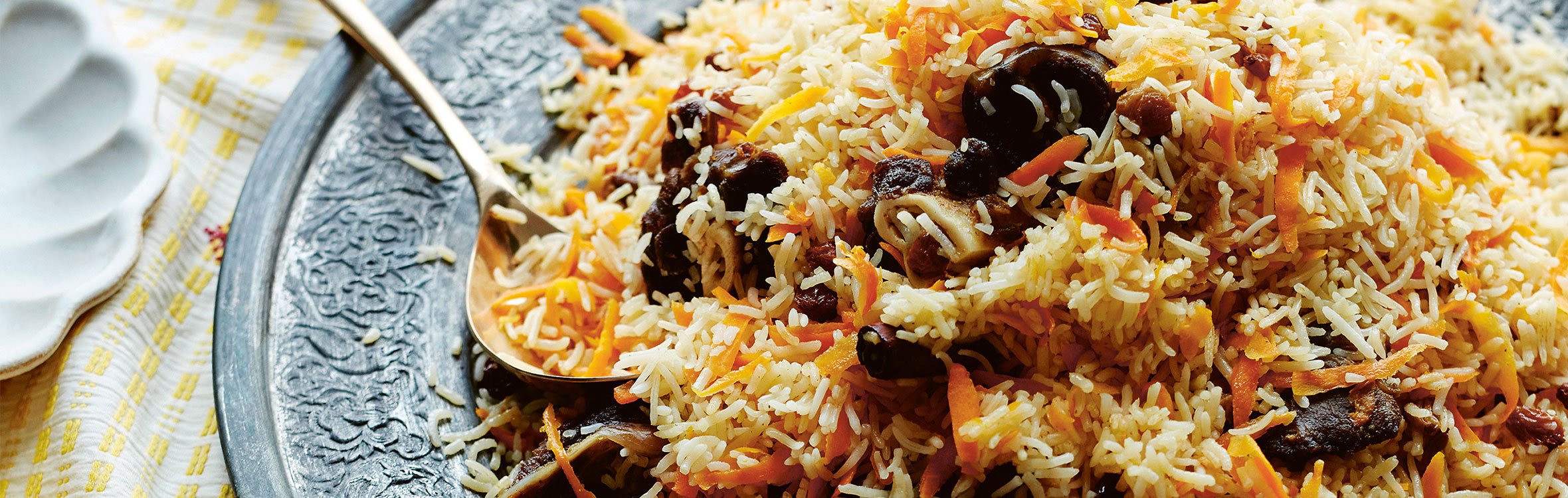
Yarkhandi Pulao Rice with carrots, fruit and meat Serves 8
I had this pulao at Kunzes and at Nilza places in Leh and loved the sweetness of the dried fruits with the fatty lamb.This dish travelled all the way from Yarkhand to Ladakh along the southern tributaries of the ancient Silk Road, and was a novelty decades ago before rice was commonly available. The rice is cooked with big chunks of meat with plenty of fat, julienned local baby carrots (preserved in a root cellar), slivers of fried onion and aromatic whole spices. It’s dressed with roasted nuts and black raisins. It is most similar to Afghani and Mongolian pilafs. The carrots not only give sweetness to the pulao, but also lend a beautiful pale orange colour to the rice.
Ingredients
1.5 litres (50 fl oz/6 cups) water 750g (1lb 10 oz) fatty lamb on the bone, cut into bite-sized pieces 2 teaspoons salt 500g (1lb 2oz/2 1/2 cups) basmati rice 4 teaspoons ghee 8cm (3 in) cinnamon stick 4 green cardamom pods 4 black cardamom pods 8 black peppercorns 2 bay leaves 300g (10 1/2 oz) carrots, peeled and grated 100g (31/2 oz/generous 1/2 cup) dried apricots 100g (31/2 oz/generous 3/4 cup) raisins
Method
1) Pour the water into a large pan over a high heat, add the lamb along with 1 teaspoon of the salt, and boil for 20–25 minutes until the meat is half cooked. Skim off and discard any scum that rises to the surface. Remove from the heat, strain the cooking water into a jug and set the meat aside. 2) Meanwhile, about 10 minutes into the lamb’s cooking time, place the rice in a separate saucepan. Add the remaining 1 teaspoon of salt and cover with water. Bring to the boil and cook for 3 minutes. Drain, then spread the rice on a dish towel or paper towels to dry out. 3) Heat the ghee in a separate large saucepan with a lid over a medium heat. Add all the whole spices and the bay leaves and fry for 1 minute, then add the part-cooked lamb and cook for 3–4 minutes until the meat is browned all over. 4) Add the grated carrots, dried apricots and raisins and cook for another 2 minutes. 5) Reduce the heat to low, then layer the part-cooked rice on top of the meat and pour over 100 ml (31/2 fl oz/scant 1/2 cup) of the reserved cooking stock. Cover the pan with a tight lid and cook for 15–20 minutes. Serve hot.