

Reviews: We Do Not Part (52)
“Latest translation of the Nobel Prize Winner - a perfect place to start engaging with her work.”
(Hardback)
The latest (to be translated into English novel) by the 2024 winner of the Nobel Prize in Literature – due to be published later in 2025.
Overall I would say that this might be the perfect place to start with the Nobel Laureate as it is a perfect (and it has to be said deliberate) combination of her two strongest other translated novels – the austere, white dominated imagery of “The White Book” and the traumatic investigation into South Korea’s dark post war history of military massacres (something perhaps which will appear much less at discard with the world of K-Pop and bao buns with events in late 2024) which featured in “Human Acts”.
The novel in fact opens with its narrator Kyungha haunted by a dream of black tree trunks (which she sense are graves or possibly even people) dusted in snow on a dark shoreline – a recurring dream she initially traces to her own authorship of a novel which is effectively “Human Acts” (and a dream which Han Kang herself also experienced).
We learn that over time (time like reality versus dreams is a fluid concept in the novel) she had discussed with a close friend Inseon (they initially met with Inseon as photographer to Kyungha’s artistic writing) – who lives with her mother on the volcanic holiday Island of Jeju and has largely given up her art documentary film career to be a carpenter – a joint project to recreate Kyungha’s dream.
In the present day – when Kyungha has largely abandoned her idea – she is urgently summoned by Inseon to a Seoul hospital where Inseon is receiving critical treatment for two severed finger tips (finger tips and blood are one of a number of recurring images): Inseon was medevac’d to the mainland after her accident and wants Kyungha to travel urgently to her home on Jeju where she fears her budgie may be dying.
The rest of the first part of the novel is perhaps the strongest of the book in a literary/figurative – documenting Kyungha’s increasingly difficult and ultimately it seems unsuccessful trip across a snowbound Jeju to Inseon’s home.
Part II changes the novel significantly and is perhaps best explained by the author herself in her Nobel lecture: “If the first part is a horizontal journey that follows 9 the narrator, Kyungha, from Seoul to her friend Inseon’s home in the Jeju uplands through heavy snow towards the pet bird she has been tasked with saving, then the second part follows a vertical path that leads Kyungha and Inseon down to one of humanity’s darkest nights — to the winter of 1948 when civilians on Jeju were slaughtered — and into the ocean’s depths”
Kyungha wakes in Inseon’s house – only to find that both the bird (who she remembers burying) and Inseon (who should be in hospital) are present. She has already realised that Inseon has been -unbeknownst to her – carrying on with their aborted project and that her injury was connected with her cutting and shaling of the black tree trunks. At the same time, we learn via Inseon’s memories of her mother (often with her mother addressing us directly) of her mother’s involvement in tracing the covered-up and suppressed history of the Jeju 4:3 massacres including various direct family involvements.
This second part is very powerful indeed although I perhaps have two criticisms: firstly there are rather too many heavy handed early references to effectively “is this a dream”/”is this real” which are not really necessary when a novel is so obviously blurring images, dreams and reality; secondly at times the exposition of Jeju’s troubled history can be a little too heavy – I would have preferred more left to my own research.
A brief third part – where Inseon and Kyungha complete their act of remembrance ends this excellent (if slightly flawed) novel strongly.
“As stark and beautiful as the winter snow”
(Hardback)
This beautiful book is not an ‘easy’ read, requiring the reader (or this reader) to slowly absorb the meaning behind the words, but it is absolutely immersive. Opening this book takes you into a stark world of snow, with a repeated image of a bird, either as a shadow or a small creature. Within the snow are blackened tree stumps. There is the feel of a dream world, where the narrator may be feverish and having visions that may not be there. The narrator has nightmares of the violence of war that leave them drained and depressed.
The writing is lyrical and poetic, making me think about the skill of the translators (E. Yaewon and Paige Anita Morris) who have not only translated the Korean into English, but captured its essence. The text is divided into extracts, each with their own subtitle that captures the feel of the section - this makes it easy to dip into, and out again when I needed to catch my breath and think about what I had read. This is a book that not only mesmerises with its skill and the surreal nature of the text, but also holds stark lessons about the effects of war, and documents some of the appalling experiences of the Jeju civilians.
Devastating and beautiful, this is one that will stay with me, slowly drifting through my mind. Published in February - many thanks @penguinhuddlebooks for this thought provoking read.
“An incredible and moving story”
(Hardback)
Having read and been moved by The Vegetarian I couldn't wait to read this book. I was not disappointed.. It is so emotional yet tranquil in its telling. Reading descriptions of snow falling is akin to meditating,Unbelievable. The grit of the story for me was the telling of the Jeju massacre and its profound effect on Inseon and her family Their are so many themes within this story about friendship,loyalty,resilience and above all love. An incredible book
“Novel set on JEJU and in SEOUL”
(Hardback)
The author wrote The Vegetarian, which was the first Korean language novel to win the International Booker Prize (2016). She is also the recipient of the Nobel Prize for Literature 2024 for her “intense poetic prose that confronts historical traumas and exposes the fragility of human life”.
The prose in We Do Not Part is indeed mesmerising and quite compelling in a subtle, yet excoriating way. This is the story of Kyungha, who visits her friend Inseon in hospital. Inseon has suffered a trauma to her hand. She will be bedridden for a while, as she has to undergo a procedure that happens every few minutes in order to preserve the nerves in her fingers. She requests that Kyungha flies over to Jeju to see if she can save her remaining caged bird, Ama, from imminent death. Given the unexpected stay in hospital, the bird will have insufficient food and water, and because birds are such fragile creatures, they easily keel over and die. Part of the tense trajectory of the novel early on is whether Kyungha will reach the bird in time.
The pathos rises as she undertakes an epic journey and then fights her way through driving snow to Inseon’s place.
Whilst on Jeju, she happens discover photos of atrocities during the fight against the Communists, that have in some way marked all their lives, and this story is as much about saving a bird as it is about the ripple effect of traumatic events on subsequent generations. It is an exploration of what governments can do their people and that cruelty is part of the human psyche, balanced by more positive human attributes that ultimately (hopefully) win out.
There are dream sequences and nightmares, visions of parents and previous generations submitting to terrible death. A plan is forged by the two young women to work together on an installation, that somehow will be a monument. All the themes move around and interweave to create a legacy of the “Forgotten War”.
Miss Smilla’s Feeling For Snow must, surely, have been an inspiration at some level for the sumptuous descriptions of snow and flakes and the ice and the cold, perhaps a little overdone, but it is a reminder that people are at the mercy of the elements, as well as Realpolitik. A novel to ponder but it can drift a little – much like snow drifts – and at times the story hovers and then again finds its thrust.
“Friendship and loss”
(Hardback)
Han Kang was awarded the Nobel Prize for Literature last year so I thought perhaps that her writing might be difficult to approach; I couldn’t have been more wrong: it’s straightforward at the sentence level but rich in its descriptions and the emotions it evokes.
When we meet Kyungha, she is slowly making her way out of a deep crisis, following family separation and bereavement during which she isolated herself almost completely from the world. When her friend and former colleague Inseon is hospitalised in Seoul following an accident for which Kyungha feels some responsibility, she feels obliged to meet Inseon’s urgent request to rescue her budgerigar. She travels to Inseon’s home on the island of Jeju, south of the South Korean mainland, by plane, bus and foot in a snowstorm, racing the onset of one of her flooring migraines. I found beauty in the detail of Kyungha’s journey and days spent cut off from the world, echoing her earlier state but this time literal, in a rural house with no water or power after the storm. The weather is ever-present: wind, cold and – chiefly – snow in all its myriad glory.
She recalls previous visits to the house, Inseon’s stories of her childhood in Gwangju, and the documentary films she made about the uprising there and in Jeju, and the wars in Vietnam and Manchuria. Walking in the snow in Seoul and by candlelight in the hills of Jeju, Inseon tells her own family’s story from the Jeju uprising and associated massacres. Over the years the two had worked and travelled together, they had discussed a project Kyungha had envisioned in a dream: black tree trunks like grave markers in a flood tide that reminded her of people huddling in the snow.
Just as I was thinking there was no supernatural element to the story (as there is in Han Kang’s most famous work, The Vegetarian, and the short story from which it grew), in Part Two a seed of doubt is sown – what has Kyungha really experienced and what has she dreamt? Is she seeing ghosts? Or are we witnessing another possible reality? It’s not clear what is reality, what is dreamed and what is ghostly; no matter, as it’s compelling. Brava too to the translators e. yaewon and Paige Aniyah Morris.
Thanks to Penguin/Viking for providing this book for review consideration via NetGalley.
Page of 11
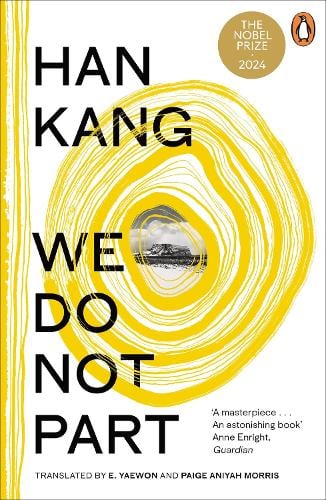
We Do Not Part
Fiction, General Fiction
Han Kang (author) , e. yaewon (translator) , Paige Morris (translator)
Paperback Published on: 05/03/2026
Price: £9.99