

Reviews: We Do Not Part (52)
“Emotional and heartbreaking”
(Hardback)
I began this story with pretty low expectations because of the strange, dreamlike nature of the beginning. I'm not one for poetic and dreamlike prose. It begins with Kyunghaya, an author, trying to deal with her dreams and thoughts as she struggles to write the book we are reading.
It's an interesting device to write a version of yourself to explain the difficulties of writing an emotive novel.
The next part deals with the author's collaboration with a sculptor who has become her friend.
We Do Not Part deals mainly with the story of the sculptor's family and the massacre of hundreds of thousands of Koreans. It is not an easy read, but it will pull you in. The descriptions of the sculptor, her home and her family are beautiful and heartbreaking.
I may have started out with some reserve but by the end I struggled to put the book down.
Thankyou to Netgalley and Penguin General UK for the advance review copy. My love for Han Kang's work continues.
“Like freshly fallen snow that becomes an avalanche”
(Hardback)
In spare and precise prose, the novel is a mosaic of stories, dreams and impressions, nothing ever quite what it is and nothing ever fully in sight. Set in a winter snowstorm on the southern island of Jeju, Kyungha is far from her own comforts, and her comfort zone itself a distant memory. In an unfamiliar place, her friend Inseon’s house, where Kyungha has pledged to look after Inseon’s budgie, Kyungha is met with ghosts of her own trauma and of a historical trauma, the massacre of 30,000 civilians as part of the lead up to the Korean War.
Like snowflakes settling, each piece of the novel lands to build a eulogy and a reckoning with history, and for Kyungha, breakdown and catharsis. Always wary of her incipient migraines, Kyungha is a classic Han narrator, unreliable even when narrating to herself, and threatened from all sides, but making her way regardless, her human spirit unconsciously undaunted in direct contradiction to her spoken desires.
This is, in short, a masterpiece, and evidence of why Han is a Nobel laureate. If I could, I would give this six stars.
Six stars, rounded down to five.
“Haunting masterpiece”
(Hardback)
Han Kang’s We Do Not Part is an atmospheric and haunting novel that has stayed with me after reading.
The novel follows Kyungha, a writer struggling with debilitating migraines, depression and isolation. Her hospitalised friend, Inseon, begs her to journey through a brutal snowstorm to Jeju Island to rescue her pet bird. From Kyungha’s arrival in Jeju things start to get dream-like and ghostly.
In the second and third parts of the novel, Kyungha confronts the history of Inseon’s family. It brings together personal trauma with national tragedy, particularly the repressed horrors of the Jeju Uprising. Snow, not just the weather setting in the background, becomes a character- obscuring and revealing, bringing pain and comfort.
Han’s prose is beautiful yet restrained, and the translation by e. yaewon and Paige Aniyah Morris is incredible - capturing both the eerie beauty and emotional depth of the story.
Many thanks to NetGalley for the ARC.
“A lot”
(Hardback)
Kyungha has been working on creative projects that examine the history of atrocities in Korea. Haunted by nightmares, she invites her friend, Inseon to help create a film based on one particular dream that she cannot shake. The project falters and eventually Kyungha believes she no longer needs it. When Inseon contacts her to say that she has sustained a terrible injury in attempting to make the work, Kyungha feels indebted to her. So when Inseon requests that Kyungha travel to Jeju Island and save her pet bird while she is in hospital, she feels obliged to help, even when the weather becomes dangerously problematic. At this point Kyungha's journey becomes something wilder and stranger. A snowy fever dream of a novel this is strange and unsettling, shot through with horror and a shifting sense of unease and confusion. For a short book where not much actually happens, it's very tense and at times I found it too much and had to put it down and come back to it later. It's brilliant but I'm not sure I'd read another book by Han Kang. I don't think my nerves could stand it.
“Beautifully written and compelling”
(Hardback)
Published 6 February. A novel almost in two parts but both parts are beautifully written and compelling. Han Kang herself in her lecture given when she received her NobelPrize tell us that the novel started with a dream that she had of thousands of black tree stumps. The main character, Kyungha, a writer, at the beginning has a recurring dream of black tree stumps and together with her friend Inseon, they plan to recreate the dream, to create a sort of art installation of hundreds of blackened tree trunks - something that keeps being put off and put off. Then she receives an urgent phone call from Inseon who has severed two fingertips and is now receiving critical care. She asks Kyungha to travel to her home on the volcanic island of Jeju to feed her bird which will die if left too long without water. And so we have the first part of the novel - Kyungha’a journey to Jeju, which Han Kang describes as being on a horizontal path, in a heavy snowstorm and the writing with its imagery, the lack of light, the cold and the fragile snowflakes t is breath-taking and there is a tension there as well. You worry for this bird that has been left alone and worry that Kyumgha might be too late to save it. And then we come to the second part which is darker and heavier. In Inseon’s house she finds the testimonies that Inseon’s mother has collected from the survivors of the massacre that occurred on Jeju after WW2 when hundreds of thousands were executed. There is a surreal, dreamlike quality to this part as Inseon seems to have joined Kyungha, and Inseon’s late mother also gives testimony. Han Kang herself in the lecture that I mention, describes this part as being on a vertical path to ‘one of humanity’s darkest nights – to the winter of 1948 when civilians on Jeju were slaughtered ‘ There is so much darkness and pain in this novel - it is tempting to look away, but I couldn’t. The novel is about question of love and that the very act of looking at these awful memories, of remembering if the power of love. A book that left me moved. Rounded up to 5*
Page of 11
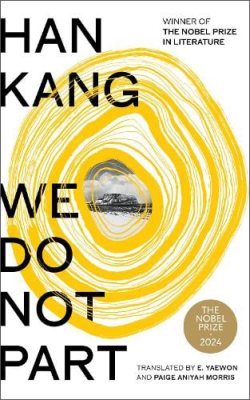
We Do Not Part
Fiction, General Fiction
Han Kang (author) , e. yaewon (translator) , Paige Morris (translator)
Hardback Published on: 06/02/2025
Price: £18.99