

Reviews: Thinking, Fast and Slow (7)
“Thinking, Fast and Slow”
(Paperback)
I loved reading this book, as I decided not to do Psychology as an AS I've decided to read books on the subject that would help me in my life. This book has opened up my mind and I've been able to apply many theories in this book to my everyday life and I've enjoyed learning about the theories involved. The explanation and examples make the points easier to understand and allow you to take in more information.
Moreover, the use of the "characters" System 1 and System 2 allows the reader to fully understand the way people think and how people think overall, as well as being able to apply the traits to your own behavior - especially when Kahneman questions the reader and invites them to take part in their own experiment.
I would recommend this to my friends and to those who are preparing for psychology at any level, as it mentions many psychological experiments within the book.
“Not what I expected - but well worth while”
(Paperback)
This book was mentioned during an online conversation with some colleagues on the subject of what's "natural" and what's "familiar", so I was expecting the book to be related to that. It turns out that it deals with how and why statistics are more reliable in making decisions than raw human judgement. It's very interesting, and extremely well written, but not for the faint-hearted. I don't recommend it for bedtime browsing. Make sure you're wide awake - and keep a dictionary to hand. If you want your mental processes to be challenged, in more ways than one, then this book is for you.
“What you see is not all there is”
(Paperback)
The important premise of this thought provoking book is that the human mind is far less rational than we are led to believe. This is partly due to evolutionary pressures and the dichotomy that exists within the way we think. This conclusion Kahneman proceeds to assert represents a major challenge to well excepted models of human behaviour such as the rational agent theory of decision making, and the expected utility theory of economics.
Kahneman argues that far from being rational and consistent, the human mind is prone to biases and heuristics (short cuts) in the manner in which it thinks about and creates models of the world. He proceeds to attempt to create a lexicon of such faults in our thinking with the worthy aim of creating a meta language which can be used to recognise, discuss and ultimately limit the effect of such biases and heuristics in the decision making processes of individuals, institutions and societies.
Thus the reader is introduced to many labels for concepts with which they are familiar or have had experience of without previously having the vocabulary to adequately think about and discuss them. Without a common language to label and discuss the mind’s shortcomings, it is impossible to effectively identify inconsistencies in thinking and seek ways of overcoming them. Notions of ‘substitution’, ‘cognitive ease’, ‘accessibility’, associative memory,’ ‘loss aversion’, ‘peak end effect’, ‘duration neglect’ and ‘priming’ may initially sound arcane but are brilliantly elicited from the reader’s own experiences, compelling them to question their own beliefs and the internal consistencies of their values. Crucially, Kahneman suggests ways of overcoming mental biases and heuristics e.g. the use of the ‘outside view’ to overcome the ‘planning fallacy’ and self imposed regression to the mean when predicting financial or performance success.
Concepts are introduced and revisited throughout the book, being expertly cross referenced to new ideas thus consolidating and deepening the reader’s understanding. Particularly effective in this respect is the use of reflective questions and humorous sound bites at the end of each chapter. Perhaps the only fault of this book is the lack of a glossary to which the reader can continually refer.
Whilst the contribution of Prospect Theory to economics and decision making is self evident, Kahneman interestingly raises many political and philosophical considerations towards the end of the book. Perhaps most notable in this is his notion of the ‘experiencing self ‘versus ‘the remembering self’ and the implications for medical practices for instance.
The break down in the rational agent model also has major implications for politicians, notably those in favour of a free market approach to economic growth and welfare provision. This book has much to advice politicians and public servants on such diverse issues as: how to encourage saving for old age, organ donation and on how to frame questions in referendums.
“A Brief Summary and Review”
(Paperback)
*A full executive summary of this book is available at newbooksinbrief dot com.
The adage ‘you are what you eat’ is no doubt literally true, but when it comes to getting at the heart of what we are it is certainly more accurate to say ‘you are what you think’; for our identity emerges out of the life of the mind, and our decisions and actions (including what we eat) is determined by our thoughts. An exploration of how we think therefore cuts to the core of what we are, and offers a clear path to gaining a better understanding of ourselves and why we behave as we do. In addition, while many of us are fairly happy with how our mind works, few of us would say that we could not afford to improve here at least in some respects; and therefore, an exploration of how we think also promises to point the way towards fruitful self-improvement (which stands to help us both in our personal and professional lives). While thinking about thinking was traditionally a speculative practice (embarked upon by philosophers and economists) it has recently received a more empirical treatment through the disciplines of psychology and neuroscience. It is from the latter angle that the Nobel Prize winning psychologist Daniel Kahneman approaches the subject in his new book 'Thinking, Fast and Slow'.
As the title would suggest, Kahneman breaks down thinking into 2 modes or systems. Slow thinking is the system that we normally think of as thought in the strictest sense. It is deliberate and conscious, and we naturally feel as though we are in control of it (Kahneman refers to it as system 2). System 2 is in play when we actively consider what we want to have for dinner tonight, or when we choose what stocks to buy, or when we perform a mathematical calculation. System 1, by contrast, is automatic and unconscious, and hums along continuously in the background. It constantly surveys the environment, and processes the incoming stimuli with razor speed.
System 1 is informed by natural drives and instincts but is also capable of learning, which it does by way of association (that is, connecting up novel stimuli with known stimuli according to shared characteristics, contiguity in time and place, or causality). The system is designed to give us an impression of our environment as quickly as possible, thus allowing us to respond to it immediately, which is especially important in times of danger. In order to do so, system 1 relies on general rules and guidelines (called heuristics). These heuristics are primarily geared to help us in the moment and are tilted towards protecting us from danger, and in this respect they are mostly very useful. Still, mistakes can be made, and the system was specifically designed to work in the environment in which we evolved, which is quite different from our current one, so this adds to its errors.
Over and above this, the impressions that system 1 forms are also fed up to system 2. Indeed, whenever system 1 senses something out of the ordinary or dangerous, system 2 is automatically mobilized to help out with the situation. And even when system 2 is not mobilized specifically out of danger, it is constantly being fed suggestions by system 1. Now, while the impressions of system 1 are fairly effective in protecting us from moment to moment, they are much less effective in long-term planning; and therefore, they are much more problematic here. Of course, system 2 is capable of overriding the impressions of system 1, and of avoiding the errors. However, as Kahneman points out, system 2 is often completely unaware that it is being influenced (and misled) by system 1; and therefore, is not naturally well-equipped to catch the errors. Much of the book is spent exploring the activities and biases of system 1, in order to make us more aware of how this system works and how it influences (and often misleads) system 2.
This is only half the battle, though, for while system 2 may be naturally poorly equipped to catch the errors of system 1, it is also often poorly equipped to correct these errors. Indeed, Kahneman argues that system 2 is simply not a paragon of rationality (as is often assumed in economics), and could stand to use a good deal of help in this regard. The most glaring deficiency of system 2, according to Kahneman, is that it is naturally very poor with probabilities and statistics. Fortunately, system 2 can be trained to improve here, and this is another major concern of the book.
Kahneman does a very good job of breaking down the workings of the mind, and presenting his findings in a very readable way. My only objection to the book is that the arguments are sometimes drawn out much more than needed, and there is a fair bit of repetition. A full executive summary of the book is available at newbooksinbrief dot com; a podcast discussion of the book will be available shortly thereafter.
“Thinking, fast and slow”
(Paperback)
Kahneman's book is accessible, but best read slow to let a lot of counter-intuitive ideas sink in. It's tempting to read fast, as it is engaging.
Page of 2
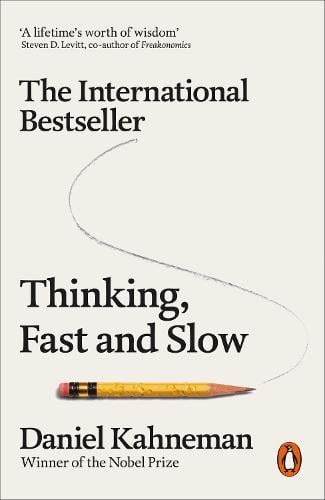
Thinking, Fast and Slow
Non-Fiction, Science, Study & Work, Smart Thinking
Daniel Kahneman (author)
Paperback Published on: 22/02/2024
Price: £16.99