

Reviews: The Undertaking (8)
“The Undertaking”
(Hardback)
wow... so I'm not sure how comfortable I am saying that I liked this book.... Liked really isn't a word I would use to describe my feelings while reading it, or now I'm done. I couldn't stop reading it, and finished it essentially in one sitting, but at no point was it a happy or comfortable experience. The book focuses on Peter and Katherina who marry despite never having met. He is doing it simply to get some 'honeymoon leave' away from the eastern front; and she simply wasn't to do her duty marry a good German soldier, produce German children and if necessary be sure of a widow's pension at the end of the war. The novel cuts between Peter's experiences at the front, which result in his capture by the Russians at Stalingrad; and Katherina's experiences as a Nazi wife and mother back in Berlin, resulting in the death of her child, and her gang rape at the hands of victorious Russian troops. We then see the aftermath of war and the conclusion of the deal they struck when they married. Do not expect a moment's respite in this novel, we have the full horrors of the eastern front as well as having to digest the vile, warped opinions and reasonings of the main characters. This pulls no punches, and noone comes off well by the end of the story. However, it is very well written and manages to encapsulate the horrors brilliantly.
“Thought-provoking”
(Paperback)
I thoroughly enjoyed reading The Undertaking. I read it very quickly, partly because of the uncomplicated language but also because I was swept along with the fates of the two main characters in their different locations and wanted to know what would happen next. I don’t think I had previously read a WW2 based story from the perspective of German people and I found it very thought-provoking and engaging. I would definitely recommend this book.
“Stunning Debut Novel”
(Hardback)
For German soldiers, serving on the Eastern Front, the opportunity of marrying a girl back home gives them 'honeymoon' leave. For the girl he marries - a war pension should her new husband die whilst serving his country. Peter Faber and Katharina Spinell enter into this contract of marriage, never having met each other, but both eager to gain the benefits of an unlikely union. Peter is an ordinary man, a teacher in a small town. Katharina has been encouraged to marry by her parents; a couple who make no secret of their determination to be part of the powerful set, led by Dr Weinart, a leading Nazi doctor, and his wife.
Peter takes his honeymoon leave, and he and Katharina meet for the first time, despite the unorthodox start to their relationship, they find that they are attracted to one another, and by the end of their short time together, they are in love.
Peter returns to war, taking part in the German offensive against Stalingrad, whilst Katharina remains in Berlin; pregnant with their child and looking forward to the time that they can be a real family, in a strong and victorious Germany. Both of them have no doubt that Peter will return a hero, having helped Germany to win the war.
The contrast between Peter's horrendous experiences fighting against the Russians and Katharina's life of parties and fine food with high-ranking Nazi officers could not be starker. Peter and his fellow soldiers are starving, they are lice-ridden, they are freezing. They lose toe nails, they lose toes, they lose lives. The soldiers battle on, convinced at the beginning that they are on the winning side, but as the weeks pass and their conditions worsen, seeds of doubt set in. But still, they remain faithful to The Fuhrer. Katharina, on the other hand only has to worry about how she should eat an oyster, or arranging the best party for her small son's birthday, and where can she find a pretty dress.
Katharina and her family are reminded of what is really happening when her brother Johannes returns from the front. He is a broken man, with no sight of the young, enthusiastic man who left Berlin.
The Undertaking is a brutal, no-holds barred story that will shock and stun the reader. Audrey Magee is a writer of outstanding talent who has portrayed the realism of the battlefields of the Eastern Front with ease. The story is told largely in dialogue which only adds to the brutality and truth of this novel, the reader is thrust immediately into the action, with not a word wasted.
The Undertaking is not an easy read by any means, it can be very uncomfortable at times and not just because of the hardship and deprivation that is portrayed. No, there is a feeling of despair for the characters, and yes, a twinge of disloyalty too, for caring about these German soldiers. We, the readers, know the outcome of the war, and it is this that can provoke the feelings of discomfort. These soldiers gave everything, they suffered terrors that are almost unbearable to read about, but they continued as they believed that Germany would be the victor.
This is a novel that deals with loyalty and hope, with bravery and at times with cowardice. It is also a love story in the most unconventional way. It is a unrelenting story, Audrey Magee is an extremely gifted author, her dialogue-led style of writing coupled with her depth of human understanding is outstanding.
“harrowing and horrific in equal measures”
(Hardback)
The novel begins and ends with a marriage of convenience: Peter Faber marries a woman he has never met to allow him leave from the army for a ‘honeymoon’ and Katharina Spinell, his new wife, will receive a pension in the event of her husband’s death. The novel ends with the German people living alongside their Russian conquerors in their homeland of East Berlin.
It is 1941 and German army are fighting on the eastern front on Russia soil. They are raping, stealing and killing their way through the Russian land unknowingly toward what has been described as ‘one of the bloodiest battles in the history of warfare’; the siege of Stalingrad and what would ultimately be the beginning of the end for Germany and Hitler.
As Peter Faber struggles through Russia and its ferocious winter, back in Berlin Katharina’s life is improving thanks to her father carrying out the orders of the sinister Dr Weinart. Dr Weinart has the ear of the upper echelons in the Nazi party and one of his tasks is to recruit men to persecute the Jewish people.
While Katharina and her family enjoy a new home, the former Jewish owners having been dragged from their homes in the middle of the night, sumptuous dinners laid on by Dr Weinart, where they raise glasses of champagne in salute to the brave German soldiers who are fighting on Russian soil, Peter and his infantry are beset by freezing temperatures, bloody battles, starvation, dehydration, disease and frost bite.
Though the novel travels a road already travelled by many authors, Germany’s Russian campaign, the author Audrey Magee manages to resurface that road with sublime prose and dialogue. Audrey Magee’s first novel is a testament to her commanding authorial talent and will have established authors stand up, take notice and realise they will have to work harder on their next novel if they are to match or better The Undertaking.
The Undertaking is dialogue heavy but this doesn’t upset the balance of the novel. The dialogue, not the prose, is what drives the novel along. The dialogue is where we learn about the characters not through the easy option of a third person omniscient narrator. Dr. Weinart is a character who is ninety-nine percent detailed and fully drawn only through his dialogue. Thankfully, the dialogue is crisp, realistic and lucid.
(While Peter is on his ‘honeymoon’, Dr. Weinart asks him to help out with a nightly task)
“’There’s nobody home.’
‘They’re in there Faber.’
‘Yes, Sir.’
‘Maybe they’ve gone out, Dr Weinart.’
‘There’s nowhere for them to go, Faber.’
‘We could come back later.’
‘Get in there, Faber.’
‘How?’
‘Jesus Christ, you’re a soldier, aren’t you?’
‘Not this kind of soldier.’
‘Move, or I’ll ship you out with those fucking Jews.’”
It is to the author’s credit and writing skills that the reader’s feelings for Peter and Katharina fluctuate between distaste and sympathy. Peter’s plight, as he struggles relentlessly through Russia’s infamous harsh winters, watching his friends die while surviving by eating rats as his toes turn black with frost bite, is harrowing and horrific in equal measures. There are times when you forget some of Peter’s previous actions,
“he had to...drag snivelling children from attics and cellars. He shouted and screamed at them, struck their legs and backs with the butt of his gun, slapped them across the face when they took too long moving down the stairs, more comfortable with howls of hatred than pleas of mercy...he took a wide band of wedding gold from an old woman. Later he slipped it on his wife’s finger.”
The Undertaking is a pragmatic and understated story filled with believable characters. It will rattle the windows of your soul with its engaging prose and skilful dialogue. All this and the novel’s masterful sense of time and historical clarity belie the epithet of ‘a first novel’.
First Line – “He dragged barbed wire away from the post, clearing a space on the parched earth, and took a photograph from the pocket of his tunic.”
Memorable Line – “The facts are that I am starving and freezing to death thousands of miles from home. For what? For a bigger, stronger Germany free of communist Jews. Those are the facts. That’s why I’m here.”
Number of Pages – 287
Sex Scenes – Yes
Profanity – Yes
Genre - fiction
“learning the hard way”
(Paperback)
An austere novel, dealing with loyalty to country and ‘Führer’ and loyalty to family and friends. Unfortunately family and friends are most frequently losers in The Undertaking. The war is all consuming, it takes first place always. Main protagonist Katharina has to learn the hard way that loyalty given to country and war is not necessarily the right priority. She loses her brother, son and husband to the war. Initially accepting the advantages that come with living close to Nazi officials, she starts to doubt towards the end of the war. Her husband Peter goes through the same process in Russia: he is to spend many bitterly cold day and night as a soldier and as a prisoner. Magee makes it very clear that it is not the high ranking officers or the Nazi officials who suffer the hardships, it is the loyal soldier who is used for their purposes and has to suffer for it. There are no heroes in The Undertaking, just plain civilians who do as they are told.
Page of 2
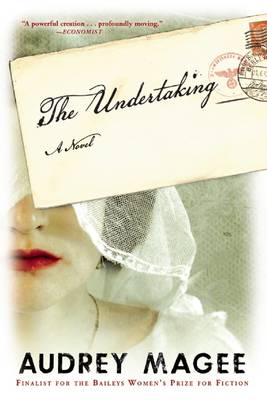
The Undertaking
Fiction, General Fiction
Audrey Magee (author)
Paperback Published on: 15/09/2015
Price: £12.99