

Reviews: The Language Puzzle (3)
“Tracing our first words from grunts to global chatter”
(Paperback)
Steven Mithen guides you through nearly two million years of human speech, starting with ape-like calls and ending with the flourish of agriculture, metaphor, and civilisation. He pieces together language’s tangled emergence from a patchwork of archaeology, linguistics, genetics, anthropology, neuroscience and psychology, and does so with rare clarity and patience. What keeps this from feeling like a textbook is Mithen’s careful attention to narrative: each fragment slowly snaps into place, rewardingly complex, with real momentum behind the theory that our words made us human.
He argues that proto-language began in our ancestors roughly 1.6 million years ago, progressing through cognitive shifts, iconic sounds evolving into symbols, and the spark of metaphor that reshaped societies. By the final chapters, you see language not as a quirk of our species, but as its pulse—the spark that turned survival into story, speech into civilisation.
This is not lightweight reading. It asks you to sit with questions that won’t neatly resolve, to consider that despite new discoveries, the mystery of our voices remains partly unspoken. But Mithen never overwhelms. He unpacks hard ideas carefully, with warmth and wonder intact.
Five stars for a monumental work that feels like holding the epic of human communication in your hands.
“A history of language”
(Hardback)
Beginning with a brief history of humankind, and concluding with the evolution of language with everything else on between, this is a detailed analysis of how language has changed and developed over time.
While there is far too much content to go into detail here, it is one of the best books on language I have read so far and does indeed seem to connect fragments of information together to make a more complete picture of language throughout history. I was fortunate enough to be sent a reading copy by the publisher.
Using examples of the International Phonetic Alphabet (IPA) demonstrates spoken English. I found this particularly interesting, having previously studied it as part of a Masters module, but I was pleased to discover that the Mithen’s clear explanation of how the IPA works is accessible to all. However, there were various sections that took some time to digest and understand, which is expected from a text of this academic level.
The chapter on language, perception and thought did spark several questions during reading, which I think was due to the range of subjectivity.
A range of relevant and informative diagrams are used, from key hominin species to the human auditory pathway to the inner workings of the brain.
This is definitely a book I will be referring back to in the future and will appeal to not only linguists, anthropologists and historians alike, but also to a wider range of people who have an interest in how language has grown and been shaped into existence in the modern world.
“Hardly surprising”
(Paperback)
This is a very well researched text. I would suggest its not for a general reader without a good science background. I am sure if you are a biologist or paleontologist you'll lap this up like a cat with cream (I couldn't resist using metaphor). The argument for physically achieving speech seems to an amateur like myself on this area of research to be quite well understood with quite a few resets to my preconceived ideas on human or homo physiology.
I must admit to being unconvinced on the synesthesia route to achieving language ability. Developing a vocabulary on functional means certainly makes sense which isn't that different from the argument on how early writing developed. I will say its a difficult book to read and you certainly wouldn't take it on holiday.
Well written but quite heavy going.
Page of 1
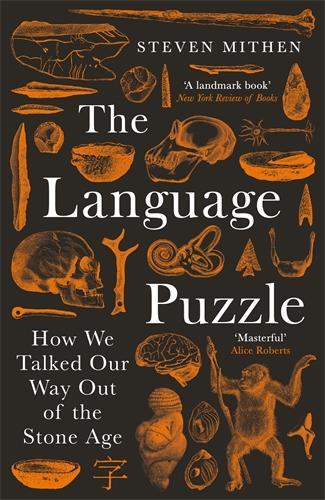
The Language Puzzle: How We Talked Our Way Out of the Stone Age
Non-Fiction, Language & Reference, Language Usage & Writing Guides, Language: History & General Works
Steven Mithen (author)
Paperback Published on: 06/02/2025
Price: £12.99