

Reviews: The Constant Rabbit (43)
“A genially weird look at some very serious issues”
(Hardback)
I'm grateful to Hodder for an advance copy of The Constant Rabbit to consider for review.
A new Jasper Fforde novel is always an Event and I was very pleased to have a chance to read this one ahead of time. It's a stand-alone book, set in an alternate present very like our own - a present suffering from many of the same problems as we do, in particular a resentment at difference. Fforde has personified this in the national response to anthropomorphised rabbits. Some fifty years before the events of the novel, an Event gave a small number of rabbits human traits, including size, the ability to speak and vaguely human physiology. Rabbits doing what rabbits do, there is now a large population of them, drawn from three distinct strains of rabbit: lab, pet, and wild. The nature of the Event is never precisely explained, although its purpose is discussed several times and in a self-referential moment is described as possibly being satirical:
"'It's further evidence of satire being the engine of the Event,' said Connie, 'although if that's true, we're not sure for whose benefit.'
'Certainly not humans', said Finkle, since satire is meant to highlight faults in a humorous way to achieve betterment, and if anything, the presence of rabbits has actually made humans worse.'"
Anyway, humanity being what humanity is, there is a lot of resentment in some quarters at the rabbits and wild talk of a "litter bomb", an explosion of breeding that will overwhelm the island. Anti-rabbit laws have been passed at the behest of the powerful "UK Anti-Rabbit Party" (UKARP) and its leader Mr Nigel Smethwick, and persecution is stirring. Rabbits have even been "jugged" by the goons of Two Legs Good, a gammony sort of direct action movement, and the Rabbit Compliance Taskforce (RabCoT) established to police where rabbits can live and what they can do.
It's against this background that our protagonist, Peter Knox, and his daughter Pippa, see a family of rabbits - actress Connie (the inspiration behind the rabbit in the Cadbury's Caramel ads), her husband, war hero Doc and their children Bobby and Kent - arrive at the vacant house next door. Much Hemlock is a quiet, inward looking Middle English village where the most exciting things that ever happen are Speed Librarianing and the annual Spick and Span contest. It's also, naturally, a bastion of anti-rabbit prejudice so the rabbits aren't welcome, and Peter is approached to offer them money to leave - with an unspoken threat that if they won't, 2LG may step in. For Peter it's a complication too many as he actually works undercover for RabCoT as a spotter (most humans can't tell one rabbit from another, but Peter is the rare exception). The pressure from his neighbours puts him in an awkward position personally (he has nothing against rabbits) and professionally (it may blow his cover: spotters, once outed, have been targets for rabbit sympathisers).
Fforde develops the central concept well, giving the rabbits a well-realised, if baroque, culture focussed on adultery, duelling and hallucinogenic carrots with their own religion and prophet (the "Bunty") and integrating events closely with actual history. The background of discriminatory law, unequal wages and exploitation is also consistent and convincing with a sinister plan to relocate the rabbit population to a "MegaWarren" complete with barbed wire fence, workshops and its own rail spur. The story that then reveals itself to us is essentially a thriller, with the rabbits menaced by various nasties (but with plans for resistance of their own) and Peter caught between his job and pressure from his neighbours on the one hand and his guilt and what's going on - and desire for Mrs Connie Rabbit (an old friend) on the other.
It's all very well done, and has the characteristic Fforde humour and sense of the bizarre. I don't know of any other writer who is as good at making the frankly incongruous seem plausible. Perhaps it's the footnotes or the the way that everything which isn't incongruous is so, well, naturalistic. In the case of this book, all of that gets an extra dose of credibility as a poke at the attitudes behind Brexit (with the odd sideswipe at other modern villains such as Donald Trump). All very entertaining.
And yet. The concept did make me uneasy at times. Perhaps it's the idea of satirising racial prejudice, prejudice against people - for surely that's what this is - by setting up a society of animals, albeit talking, thinking animals, as the victims of discrimination. And the associations the MegaWarren conjures up...
I found myself wondering whether the whole concept actually helped make a point about prejudice and the way that a minority can be persecuted, or whether it actually got in the way of that point?
Maybe it's the timing, which couldn't have been foreseen - a summer of Black Lives Matter protests making the same point in a much more vivid and compelling way than any fiction, however satirical, could achieve and possibly making a treatment like this seem as though it's trivialising the issue which I'm sure isn't the intention?
Perhaps I am overthinking. The Constant Rabbit is, if nothing else, thought provoking. And it is firmly engaged with contemporary life. It's often funny, contains a number of well-spun mystery threads, and the ending was for me genuinely poignant. In addition to all that the book does something with one character which almost literally took my breath away. I can't tell you much about it because this is one occasion when knowing what's going will absolutely ruin the point but if you read the book, you will realise gradually that there are things you're not being told... directly. And when you do you'll agree, I hope, that you didn't need to be and that the story and the characters actually work better without. It's very impressive both for how Fforde does what he does and for the fact that he does it.
But I'm babbling now. You'll have to read the book for yourself for this to make any sense, I'm saying no more.
“A bunny pot-boiler?”
(Paperback)
Imagine a world where a mysterious event (the Inexplicable Anthropomorphising Event) led to a small number of animals becoming human-sized, able to speak in human languages and live alongside us as equals. Of course, not all humans see this as a good thing - some people are so bothered by otherness - and a political movement has arisen to supress the right of rabbit-kind. Peter Knox works as a 'rabbit spotter' for the Rabbit Compliance Taskforce since he is one of the few humans who can tell individual rabbits apart (they have the same problem with humans) but his rather dull life starts to change (at some speed) when a rabbit from his own past moves in next door.
This is, on the surface, an amusing story about talking bunnies but satire is lurking nanometres below the surface. How do we react to those who we think are different to us? How violently do some people hate those they feel threaten the way of life they cherish? How far can you oppress a group before they fight back and what form should that fight take? The parallels with the modern political situation are pretty obvious. But still funny, obviously, because I'm fairly sure Jasper Fforde doesn't have any other way to be...
“Satire/human sized rabbits/political shenanigans”
(Hardback)
In 1965, when for no explainable reason, rabbits became human sized and walked, talked and drove cars, the world was at first tolerant. But it is now 2020, and in the middling village of Much Hemlock, the residents are, in the majority, up in arms about the arrival of a rabbit family. Connie, her husband Major and their two children, find their only friends in Peter Knox and his daughter Pippa. But Peter is a Spotter for the Rabbit Compliance Taskforce (RabCoT) and he feels uncomfortable knowing that he plays a part in endangering the rabbit population.
The UKARP (UK Anti Rabbit Party) want to forcibly remove all rabbits to a MegaWarren in Wales, and as Peter becomes more and more enamoured with Connie, he confesses all and helps her and her family escape the clutches of those who want them eradicated.
This is not in all honesty the type of genre I particularly enjoy. But I can appreciate the satire, and behind the wit, is a serious message about tolerance, xenophobia, and the best and worst of humanity.
“A wonderfully witty and satirical”
(Hardback)
The Constant Rabbit is a wonderfully witty, satirical novel. I found myself laughing out loud at some parts of the story, mostly at anything to do with governing bodies, financing and structures within organisations. The novel opens on a military-like strategy of the local villagers to borrow and return library books during the six minutes the library is allowed to be open, due to cuts, whilst two Library Compliance Officers time to make sure there are no infringements. I thoroughly enjoyed this beginning.
The novel has more important themes, than just government cuts and spending. The village Peter lives in is the stereotypical, idyllic English village but with a hidden darkness. The locals are appalled at the ‘outsiders’ coming to their village. They try to buy and push the Rabbits out, at village and at government level, as they try to move all Rabbits into a compound of their creation where they will be put to work, all the while stating it is “for their own good”. The racial connotations to this novel are highlighted in a brilliant way. It asks questions about reparation and unconscious racism and bias and ridicules those who have such extreme beliefs.
Peter Knox narrates this story, and there’s a sense of confusion to the way the story is told, as he is pushed into a situation he tries to avoid. I liked his character, as well as the Rabbits who tried to show him a different point of view.
I did find that it was not an easy book to first get into but once I got used to the world and the language I flew through the book.
Thank you to NetGalley and Hodder & Stoughton for an advanced reading copy of this book.
“Not a book I enjoyed”
(Hardback)
I hadn't read a Jasper Fforde book before, but always heard great things about him so was looking forward to reading this. However I think this will be the only one I read as I found it fairly obvious in the targets it was satirising and, although well written, I did find it quite dull in parts and wanting to be too clever.
Thank you to netgalley and Hodder and Stoughton for an advance copy of this book
Page of 9
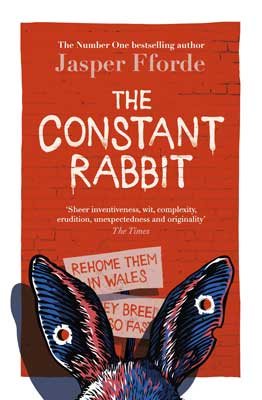
The Constant Rabbit
Fiction, Science Fiction, Fantasy & Horror , Science Fiction & Fantasy
Jasper Fforde (author)
Hardback Published on: 02/07/2020
Price: £20.00