

Reviews: The Celts (1)
“Interesting stuff, but with poor layout and editing”
(Paperback)
Over the course of 11 chapters, Collis a) gives us the background of how the Celts have been seen by various people over various times, eg the ancient Greeks thought very little of them, b) shows the various theories about how the Celts spread across Europe, and where that centre of origin might be, c) looks at the major finds, how they can be interpreted and what they tell us, and d) looks at how the Celts have been appropriated since Victorian times by various groups wanting to make political capital out of them (New Agers and the anti-English take note here), all of which is presented in a well-produced volume with a clear typeface and high-quality paper.
The layout is not brilliant. Diagram references are highlighted in bold type - one is expected to grasp this intuitively - and the first / most common reference(s) are not necessarily near the diagram, so there’s a lot of page flicking to be done. On page 198 there is a reference back to an important point made earlier, but rather than giving us the exact page number, we’re just told it’s in Chapter 5. In terms of the diagrams, the photos, and the general graphic design, it looks more like a book from 1971 not 2001 ! High-quality glossy paper, but black and white throughout, oh come on.
Personally, I found chapters 7 and 8, where the archaeology is reviewed, the least interesting and bit like eating several Shredded What / Weetabix with no milk. These really needed more diagrams / tables and to be split up: 12 to 16 pages is a good chapter length for most people. This is a shame, because the preceding chapter, on locating the Celts, is extremely interesting and along with Chapter 3, on people and languages, rather stuffs the idea that there was one homogenous mass called “the Celts” who magically just appeared in history and lived very nicely until those horrible murderous, mongrel, immigrant Anglo-Saxons came along and ruined it.
While the Celts’ own genocidal tendencies are overlooked, there is no straightforward linear history here, the rest of the ‘Celts good, Anglo-Saxons bad’ ideology gets a good bashing, both from the first-order evidence, and then at the end in the last three chapters when ideological interpretations of the evidence are analysed. Throughout the book, eg Chapters 3 and 6, simplistic positivistic hermeneutics are demolished as Collis valuably shows how the same data set can be legitimately interpreted to come to various conclusions, eg p54-6, where language development may be seen as a straight, liner progression, a tree, or Venn diagram blobs. As an aside, is there any way this can be rammed into the heads of the positivist, materialist, reductionist, mechanist atheists so into ‘Scientism’ and get them to understand that the interpretational methodology of the data set is not necessarily contained within the data set, and that the interpretation may be ideologically coloured ?
Speaking of ideology, it is mildly problematic that Collis admits to being left-wing in his politics, and therefore finds himself incapable of acknowledging ideologies / interpretations that he himself does not agree with. He is fine when it is other archaeologists, except the Nazi aberration of historical interpretation but no-one really wants to defend that, when he can graciously present and critique other people’s views, but not so hot on contemporary British right-wing politics: there’s a bit too much of the “we all used to be Celts once upon a time, so the EU is wonderful” simplistic, false syllogistic propaganda.
On the other hand, eg p29, it is helpful that he admits that he presents himself as ‘English’ first, and that one can be proud of one’s own country without being a racist, neo-Nazi BNP type. The distinctions he makes, and they are very useful ones, are a) in the basis of that pride, and b) its manifestation, ie the racists have a warped sense of identity that doesn’t necessarily face up to reality, consider themselves better and the other people inferior, and then proceed to pick on the other people. If only more on the left-wing of politics could make these distinctions: that patriotism and nationalism are not co-terminus, and that there are degrees of right-wing politics.
Such are the discussions in the last three chapters that are based upon what has gone before, especially the interesting conclusions on p266-7 about the unfortunate racist implications of PC and Equal Opportunities forms, where Collis points out the problems of ‘Black’ and ‘Asian’ being sub-divided, but White isn’t ! Given the many, many different types of Celt, and that they did not all get on, this lumping together is not accurate or helpful. Further, Collis asks if race is genuinely unimportant in someone’s application, why is it asked so often ?
I doubt this book will be read by those who need it most: ‘Guardianista’ neo-hippies with josticks, a magpie, ‘culture-vulture’ attitude to other people’s ways of life, and an anti-Anglo-Saxon axe to grind: the Celts too are an immigrant people, who cross-bred with other people, and who killed off / displaced those who got here before them. Can we now knock off the ‘patriot = far-right’ twaddle and be concerned about how little people know / care about English folk culture before it dies out ?
Page of 1
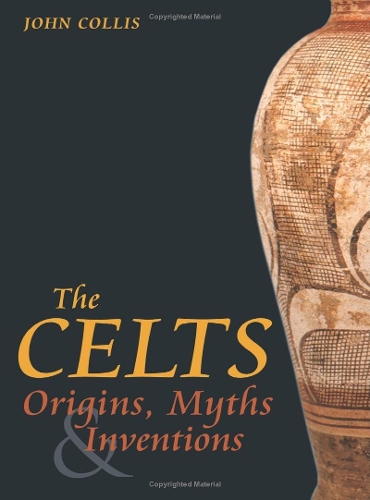
The Celts: Origins, Myths and Inventions
Non-Fiction, History , European History, Celtic Europe
John Collis (author)
Paperback Published on: 01/10/2003
Price: £19.99