

Reviews: The Aftermath (29)
“Brilliant”
(Paperback)
I read this novel as a Book Club choice. The book’s cover gives an inkling of what is to come, but the first chapter is disconcerting as removes any expectations. The story takes in the readjustment of the German peoples to life after the Second World War, when allied forces requisitioned German houses in the aftermath. Based on two families; one English and the other German, living in the same house but separated quarters. This is a heartbreaking tale of the sufferings of the alien world of the feral children, struggling to survive by whatever means, but equally of loss, love and loyalty. It exposes corrupt officials who take advantage of their situation to the detriment of the German peoples. Distanced during the war, the English parents struggled to regain their equilibrium of past times. Their son, Edmund, filled a void between ‘them and us’ and reminded me of The Boy in the Striped Pyjamas, befriending the feral children in Hamburg.
Excellent- loved it.
“Engaging!”
(Paperback)
An engaging story, inspired by the author's family.
A side of life for people after the war in Germany that until now I had not given much thought too.
A fantastic read which I will certainly be recommending.
“worthwhile change”
(Hardback)
I was given this book to review, I must admit it wouldn't be a book that I would have chosen to read otherwise as I don't usually read war books, so started off thinking that I wouldn't like it. So for the first chapter I didn't really get into it, but then found that it was getting quite interesting so had to go back and read the first chapter again in order to remember who everyone was, then as it went along it became even more interesting and I found I was learning things as well as it was from the perspective of Germany after the war, whereas previously I only thought of war mostly from how it affected our country.
It is about Colonel Lewis Morgan who is meeting his wife and son after a long while and they are coming to live with him in a posh German house owned by Herr Lubert and his teenage daughter Freda whos wife died in the war.
Instead of sending them away Lewis allows them to live on the top floor. Rachel and Lewis's other son died in the war also. In Germany at that time there were children scavenging and there was devastation and rubble all around. It was 1946 the aftermath.Rachel and Lewis have become distant, and every one coping with loss in their own way.....anyway I won't spoil it for you by giving anything away, all I can say is if I someone that's not at all interested in reading war books found it so gripping, imagine how hooked you will be.
“Grab a copy of this book to read on holiday”
(Paperback)
This book rattles along with the satisfying speed of a light read, but at the same time deftly explores the best and worst of human nature. Postwar Hamburg, freezing and starving in the terrible winter of 1946, is a melting pot of tensions, both political and personal. Multiple points of view cleverly portray conflicting insecurities and motivations as oppression and repression take their toll on all the main players. Brook’s detached tone offers no judgement, and the book is quietly, simmeringly brilliant.
“Disarmingly good and quite thought provoking”
(Hardback)
This is a disarmingly good piece of writing. 1946, Hamburg, a city virtually destroyed by allied bombing. Into this world comes the allied forces, tasked with re-educating the German people and getting the country on its feet again. Colonel Morgan, overseeing the rebuilding of Hamburg, has requisitioned a large house for him and his family to live in. But instead of sentencing the house’s owner to camp life, Lewis makes a radical proposal: to share it, thus setting up a small, close-set reflection of the social and environmental tensions taking place in the country as a whole.
Brook’s writing conjures the tragedies of a country brought to its knees. Not just the rubble, broken houses and broken people, orphans living in the ruins, but one of the biggest problems, Brook quickly makes clear, is the tension and communication between the two ‘sides’. Each stereotypes the other, making sweeping statements and criticisms. Into this world steps Morgan’s son Edmund and his grieving wife Rachel, a woman who holds the Germans responsible for all the ills of the world. And now she must share a house with two of them, Lubert and his strange daughter Frieda. What consequences, exactly, will this unusual arrangement lead to? Can Lubert – and Frieda, who has grown up knowing only Nazi rhetoric – be trusted?
Brook packs his pages with metaphor and tension, telling his story through various eyes as he flips from side to side with his point of view – Colonel Morgan, Lubert, Rachel, Frieda, Edmund, the feral Ozi. The story takes all sorts of twists and turns, deception and betrayal not least among them, as Rachel, Morgan, Lubert and Frieda try to step their way into a future they either want to believe in or escape from. But what stands out for me is the background setting, the political and the social tension that runs through everything that happens. Rhidian Brook summons this dark world with astonishing and devastating clarity and made me think hard about how we got from there to here – after all, on VE day and VJ day, while the war was over the fight certainly wasn’t, something I hadn’t really though about before.
Page of 6
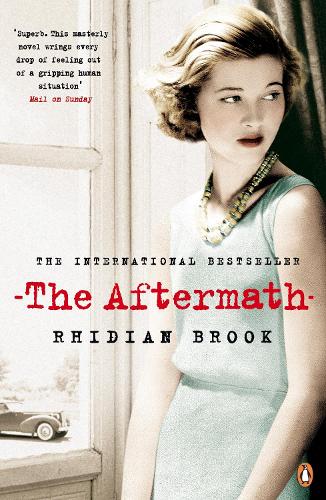
The Aftermath
Fiction, General Fiction
Rhidian Brook (author)
Paperback Published on: 31/07/2014
Price: £16.99