

Reviews: Tell (4)
“Recommended for fans of unreliable narrators, and fiction that feels like fact”
(Paperback)
Tell is comprised entirely of a series of one-sided interview transcripts, with a woman who worked as a gardener for a wealthy businessman. As the woman tries to make sense of her employer, and of what happened to him, the reader begins to build up their own picture of Curtis and the people in his life.
I couldn’t resist the premise of a book comprised of interview transcripts, and this one didn’t disappoint. Tell is a story about telling stories, with a plot that drives the book but that also revolves around the theme of its title. We don’t know what questions the narrator is asked, and we only have a vague idea of who is interviewing her and why. And we never get to hear anyone else’s side of the story. Tell takes the idea of the unreliable narrator - a trope I love - somewhere new, with its musings on the unreliability of memory, and the way people see the same things differently. This was one of those books where I found myself rereading certain phrases and lines, because the author just captures something so perfectly. And yet, I was also fully immersed in the fictional world of the author creates, almost able to see and hear the narrator thanks to the beautifully crafted writing style.
I love a metaliterary book, and Tell is one of my new favourites. Although this one doesn’t pretend to be a true story, the characters and settings in this book are so realistic that I could easily believe it is all based on the truth. Tell didn’t quite have that extra wow-factor that makes me want to give a book those elusive five stars, but this is a really interesting, engaging, and smart read. I want to reread it already.
“Succession meets Hernan Diaz's 'Trust'”
(Paperback)
The premise of 'Tell' is deceptively simple. A gardener in the employ of a wealthy textile businessman and art collector is recalling the events leading up to his disappearance, a 200 page monologue delivered to an unseen, unspeaking audience who is apparently compiling accounts of the life of the exorbitantly wealthy Curtis Doyle. But Buckley masterfully makes the work considerably more unsettling. The title says it all: this is not simply a narrator 'telling' her story, but also telling on herself; 'tell' is, of course, also a poker term, a tic, a behavioural characteristic which might reveal a clue otherwise concealed. This is a novel of speculation, gossip, of things revealed which ought not to be--and a protagonist who says more about herself than the employer she seems to be gossiping about.
To say the protagonist of 'Tell' is unreliable does not do Buckley's writing justice. The narrator is frequently contradictory, heavily biased, reliably judgemental, snobbish, a dreadful gossip, and likes the sound of her own voice--her interlocutor is never seen, and their only dialogue is recorded as 'indistinct' or 'inaudible'; when the narrator blithely couches her incessant rumour spreading by saying 'if you ask me', one feels like saying 'but who? who asked you?'. One facet of the narrator I found so deliciously unpleasant to read was her apparent disdain and dislike for other women, an internalised misogyny--a jealousy, a snobbishness, a pick-me-ism, at times a seemingly homoerotic infatuation--which leads her to introduce every woman in the novel in quite the same way. She'll detail their connection to Curtis; report how stunningly beautiful they are; knowingly point out their privilege and wealth; next she makes some slight on their character, often that they're too haughty and cold; and finally she'll suggest some inappropriate relation with Curtis, every woman in the novel--be it Curtis' art dealer, his daughter in law, his step-daughter's girlfriend, his biographer--is implicated in some supposed affair, turned into idle gossip by the shifty narrator who seems to talk about everything and anyone, except for the thing we are all dying to hear her reveal. That is, just what happened to her boss. I found this intense jealousy and tearing down of the glamorous, wealthy, beautiful and successful women just outside of the narrator's purview--or earshot, if we choose to doubt the authenticity of her claims; just how much can a gardener be expected to know about her billionaire boss inner life--to read exceptionally realistically, an inverted snobbery which reminds us that, like Gosford Park, this is both a mystery and an upstairs/downstairs story. There's a wonderful moment late in the book when the protagonist, speculating again about the role of the biographer in Curtis's life, states that 'Lara wasn't staff', closing ranks against the outsider and with a characteristic inverted snobbery sniffily suggesting that the 'downstairs' has some high ground in their closeness to the boss which the artistic pretender--who, importantly, is not herself 'upstairs', someone slippery and neither employee nor employer, under contract but not on the payroll--cannot claim.
The connection to Hernan Diaz's Trust should be obvious (both are accounts of wealthy men whose lives are being documented, canonised by a biographical storytelling project but one which is undermined by rumour, speculation, and the suggestion of something more sinister. Likewise, there are definite parallels to Succession--a wealthy father whose business empire could go to any one of his wayward children, his life managed by a series of apparently cutthroat, beautiful women (one incidentally also called Karolina). It's a fun book, pithy, smart, and hurries by very quickly. For a book whose two protagonists are a gardener and an art collector, I would've loved some more descriptions of gardens and art, but I suppose the neurotic obsession--the rising above ones station, to intrude into the boss's inner life, abandoning ones post--is part of why the novel works so well.
Thank you to Fitzcarraldo for the advance copy!
“Not what I’d expected!”
(Paperback)
Having read various reviews of "Tell" by Jonathan Buckley, I was very keen to read this novel. It was not at all as I had expected. I found the writing style - the direct speech used in the transcripts - quite hard work, although the plot itself was quite gripping.
“mercifully short”
(Paperback)
Tell is a novel by British author, Jonathan Buckley. Self-made multi-millionaire and art collector, Curtis Doyle has disappeared, the blurb tells us, and we are being told about his life by the gardener on his Scottish estate. It’s a bystander’s perspective, an unfiltered ramble that offers opinions and anecdotes, her own and the hearsay and gossip of others who surrounded the wealthy businessman, describing a generous if somewhat quirky employer.
The gardener lists members of his extended family, friends, business associates, employees, office staff, lovers, an art curator, and a biographer, quite a large cast, and describes their relationships and interactions with the man. From snippets and scant mentions, we learn how Curtis made his fortune, married, fathered two sons, was widowed, had a debilitating accident. We hear a bit about birth parents and foster parents, all of it second- or third-hand.
The reader might wonder, with all the detail the gardener provides, when she actually had time to garden. She often refers to Lara, a journalist writing a memoir about Curtis. Can we rely on her narrative? Is there anyone with whom the reader can connect, about whom the reader might care?
That this is an interview with someone preparing to make a film about Curtis is only mentioned in the last fifteen percent of the tale, while the mystery of his disappearance and unknown fate doesn’t even get a mention until the story is ninety-five percent done.
While the format is a little different, this doesn’t detract, but this novel suffers from a bad case of blurbitis, where the blurb creates expectations in the reader that are either unrealised, or presages an event that, frustratingly for the reader, doesn’t occur until the final pages. Only that it is mercifully short saves it from being a DNF, but readers may still wonder about the point of it.
This unbiased review is from an uncorrected proof copy provided by NetGalley and Fitzcarraldo Editions.
Page of 1
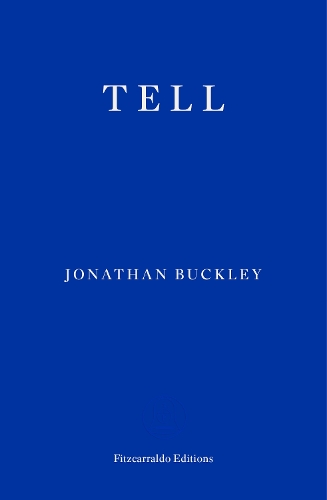
Tell
Fiction, General Fiction
Jonathan Buckley (author)
Paperback Published on: 28/03/2024
Price: £14.99