

Reviews: Smarter (2)
“You Would Be Daft Not To Read This!”
(Hardback)
Dan Hurley is a science journo so he is by nature a bit of a sceptic and wanted to find out if all the recent claims of brain training etc that can make you more intelligent really worked.
So he investigated the top theories such as learning an instrument, physical fitness, computer games amongst others, complied a list of possibles and decided he would try them all and by measuring his IQ and scanning his brain before and after he tries them.
So what happens- well you will just have to read the book to find out.
I promise you it will inspire you to try some of the techniques and even if you don't then just by reading the book you will feel smarter!
“A Brief Summary and Review”
(Hardback)
*A full executive summary of this book will be available at newbooksinbrief dot com on Tuesday, January 14.
The main argument: The idea that we can pump up our brain power through interventions of various kinds has been around a long time. Over the years, numerous drugs, diets and other practices (including everything from physical exercise to meditation to even zapping the brain with electrodes) have been purported to boost our mental powers. And lately, a new practice has been added to this list: brain training games and exercises. Indeed, in the past decade a whole new industry has emerged around brain training programs. Built on the premise that specific types of mental activities can strengthen our mental skills and add to general intelligence, companies such as Luminosity and LearningRx have convinced millions of paying customers that their product will give them an edge in the brains department.
The more skeptical among us, however, may find ourselves wondering just what the scientific basis is for all these brain games and other interventions. It was just this thought that occurred to science writer Dan Hurley; and so, following his skeptical sense, Hurley decided to investigate the matter for himself. What Hurley found was a scientific field that, though young, is bustling with activity (and controversy).
The new science of building brain power may be said to have truly kicked off in 2002. In that year, Swedish psychologist Torkel Klingberg performed a study wherein he found that subjects diagnosed with ADHD improved in both general intelligence and attention span after undergoing a brain training program that involved working-memory exercises (it was this very study that kick-started the brain training industry).
The finding flew in the face of the long-accepted belief that intelligence simply could not be enhanced through training; and therefore, it sparked a great deal of interest in the scientific community. Eager to test the new finding, scientists from all over the world launched their own studies. While not all of the studies replicated the results that Klingberg found, many did; and enough promising results were found to draw even more interest into the field (while those who found negative results began setting up a staunch opposition to the research).
Despite the minority opposition, the long-held belief in immovable intelligence was rocked, and scientists began testing other kinds of interventions as well (including all of those mentioned above). While most of the interventions tested were found to have no effect on cognitive functioning, some did, and thus the new field gained even more momentum.
Wanting very much to get to the bottom of the matter (and the controversy), Hurley decided to check out the studies himself, and also to interview the major researchers in the field (on both sides of the debate). Based on this investigation (which is explored at length in the book), Hurley launched his own brain training experiment--on himself. Specifically, Hurley took all of those interventions which he felt had the best evidence behind them and incorporated them into a grand brain training program to see whether he could improve his intelligence.
The routine included the following: A boot camp program (that included both aerobic and resistance training); Luminosity; learning a new musical instrument; mindful meditation; a nicotine patch; coffee; and transcranial direct-current stimulation (tDCS). The result of the experiment? It was mixed.
Hurley's exploration of the new field of building brain power (as well as his own experiment on himself) is fascinating (and often hilarious). One of the strong points of the book is how much detail Hurley gives regarding the experiments that he investigates. However, there is one detail that Hurley often leaves out that would be nice to have: rather than specifying exactly how much a given intervention improved intelligence in terms of percentages, Hurley often confines himself to mentioning whether the improvement was statistically significant or not (which leaves us without a good indication of exactly how well a given intervention worked). Still, Hurley's book is very well researched, and both highly interesting and entertaining. A great resource for those who are interested in getting past the hype of brain boosting, and investigating the actual science. A full executive summary of the book will be available at newbooksinbrief dot com on Tuesday, January 14; a podcast discussion of the book will be available shortly thereafter.
Page of 1
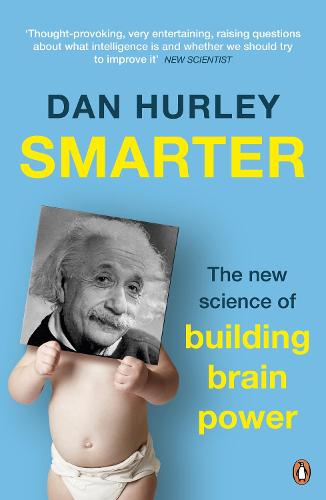
Smarter: The New Science of Building Brain Power
Non-Fiction, Health & Lifestyle , Popular Psychology, Self-Help and Personal Development
Dan Hurley (author)
Paperback Published on: 02/04/2015
Price: £9.99