

Reviews: Shunga (7)
“Interesting and beautiful”
(Hardback)
A beautiful and extremely interesting book which has vivid and often colourful erotic artwork whose detail is breathtaking. Not for the faint of heart as this is at times extremely explicit but a truly great book providing a never before seen view of history, sexuality and art.
“Simply stunning”
(Hardback)
This is a big, beautiful, ground breaking book of unexpurgated examples of Shunga. The paintings and woodblock prints reproduced here are explicit, yet not offensive; they are frequently quite funny and tender, which is why they are also known as 'laughter' pictures. The detail and colour is truly exquisite, and I would dearly love to visit The British Museum's current exhibition to compare the reality with what I have seen on the page. The book does, of course, allow you more time to study the artwork.
The chapters address different periods of Shunga art: with academic essays on the topic which explore various aspects of the artwork, including attitudes towards sexuality, both in the present and the past; a detailed commentary accompanies each illustration. I came to read this not as an artist or art critic but as someone who has been fascinated by Japanese culture for over 30 years.
The sheer quality of this book, quantity of illustrations and the detailed text means it demands to be re-read over and again. In return you will learn a great deal about Japanese art and society. Don't be shy: buy it and enjoy, as it was meant to be!
“Good book”
(Hardback)
Bought it for laughs. Very enjoyable
“A great insight into Japanese cultural history.”
(Hardback)
This is a truly remarkable book. Long suppressed in Japan, these images and their accompanying stories were strictly for personal viewing. Dating from around 1600 to 1900, they give an insight into Japanese culture throughout that period. The pictures depict sexual pleasure in its many diverse forms, often with links to
literature and the theatre. There are sometimes snippets of conversation included, often humorous. Much of this humour is still relevant in today's world.
If you have no qualms about the subject matter then you will really appreciate the art form. Its influence can still be seen in some modern artwork. I have postcards depicting very similar stylised images of Japanese life.
The artwork itself is beautiful, the colours exquisite. Every minute detail is depicted; you can almost feel the textures. There are full-page fold-out friezes that really bring the pictures to life.
The pictures are worthy of publishing in their own right, but the detailed analysis, both of the works and their historical context is absolutely fascinating. The language is straightforward, no artistic knowledge is required.
I know that I will be dipping into this book for a long time. It
will certainly be on display where friends can see it.
The British Museum can be proud of its publication.
“***Blush***”
(Hardback)
After the initial shock and embarrassment of the explicit illustrations, I found this to be a very informative and beautiful book that enriches the appreciation of sex. Over the centuries there have been many authors and artists devoted to creatively expressing the grace and beauty of sex and erotica. This book is an anthology of a major exhibition at the British Museum, featuring over 400 images from public and private collections. Leading experts explore the importance of ‘Shunga’ in the Japanese historical, social and cultural contexts of painted and printed erotic images produced during the Edo period (1600-1868) and early Meiji era (1868-1912). Many of the works are presented for the first time due to heavy suppression in Japan from the 1870s onwards. ‘Shunga’ has been regarded as ‘vulgar’, ‘obscene’ and ‘unsuitable for public display’. There is a fine line between pornographic and ‘high art’ and ‘Shunga’ really pushes the boundaries …
‘Shunga’ or ‘spring pictures’ were frequently designed by highly accomplished ‘great’ artists and master craftspeople, and issued by leading publishers who were working to exact standards. Created in formats such as beautifully crafted painted scrolls and printed books, and designed to be discreetly enjoyed with intimate friends and sexual partners, they are distinctive in terms of mood, style, setting and explicit scenarios. ‘Shunga’ is designed to depict sexual pleasure (for all) with depth, humour and humanity. Typically the illustration presents both the facial expressions of bliss and the enlarged and enhanced sexual ‘engines’ or ‘organs’ of those sensations. The couples are surrounded, adorned and framed by colourful textiles, discarded garments, tangled bedding, opulent material wealth and occasionally humorous dialogue.
People from all social classes are shown enjoying the pleasures of lovemaking in a witty and erotic way. ‘Shunga’ is a direct reflection of the sex lives of the ordinary Japanese of the Edo period (a feudal, status-based society controlled by the samurai). Early modern Japan had a large and exploitative commercial sex industry but tension existed between the highly and rigorously regulated public surface of society and an independent ‘private sphere’. This ‘underworld’ involved escapism and creative self-expression where ordinary people who were governed in their daily lives under the pressure of strict official Confucian-based morality and ethics depict a fantasy world of sex. It is said that women, as well as men, were fans of ‘Shunga’ and no bridal trousseau was complete without ‘Shunga’.
All this ‘wordiness’ completely fails to depict what is, essentially, a huge book full of fascinating historical information and explicit images. Will you find the images offensive? It’s certainly not for the faint-hearted, the prudish or those reticent about sexual matters and it’s all a matter of perception. Each perceiver has a different perception of the perceived.
Page of 2
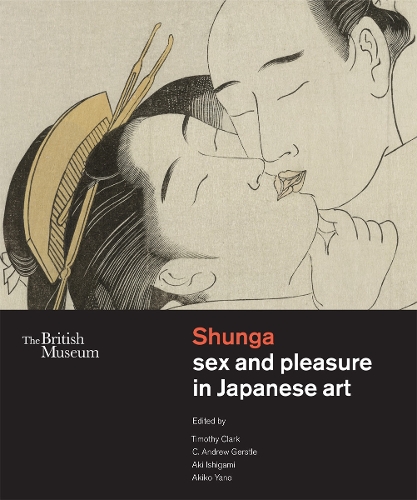
Shunga: Sex and Pleasure in Japanese Art
Non-Fiction, Art & Design , Art & Design Styles , Design , Entertainment
Timothy Clark (editor) , C. Andrew Gerstle (author) , Aki Ishigami (author) , Akiko Yano (author)
Hardback Published on: 14/10/2013
Price: £60.00