

Reviews: Second City (1)
“Brum, Brum, Brum.”
(Hardback)
In the 15th-16th centuries Aston Hall had a garden which is where Villa Park, the home of Aston Villa Football Club, now stands. The Holte End, a steep, spacious terrace, one renowned for its voice as lively, energetic and awesome as Manchester City’s Kippax, was demolished in the 1990s, perhaps in the wake of the Taylor Report. It’s named after the former sixteenth/seventeenth century landowner James Holte. Several families have made significant contributions to the birth, development and life of Birmingham. They include Cadbury, Colmore (remembered by a city centre road named Colmore Row), Chamberlain, one of whom became Prime Minister, and Austin who formed the motorcar company that bore his name. Second City is a tome that traces centuries of human endeavour in the Middle of England in an engaging, revealing, informative, well researched and captivating history of a nucleated settlement that became a city in 1889. Birmingham is best remembered for its industry, from the construction of Spitfires in the 1940s to the production of the motor car in the 1950s and 1960s. Full employment during the latter two decades cited meant living conditions for the white working class were better than ever. The Conservative government under Margaret Thatcher witnessed industrial decline in the city, unemployment reaching a record high in the early 1980s. While government training schemes for the teenagers of 1981 tried to revive the city economy, well paid jobs were rare for the young. The decline of the car making factory at Longbridge (finally closing in 2005), during that period of time meant a job for life, particularly for those living in large working class housing estates, was no longer available. Much of Birmingham was destroyed in the 1939-45 World War, due to the Birmingham Blitz (1940-1943). From 1948 onwards successive British governments welcomed immigration from the Commonwealth, particularly people of colour from India, Pakistan or Jamaica. Race relations progressively worsened from the Windrush influx of the 1950s to the inner city riots of 1981 and 1985, both taking place in the immigrant community of Handsworth. Race, and questions around race, are set to continue with regular reports of racism in the media casting a shadow over the white population who are a minority in some Birmingham neighbourhoods. Culture in Birmingham is rarified over the centuries; there are no great artists, classical music composers or significant writers. Contemporary culture, albeit some years ago, consisted of music bands such as Black Sabbath, UB40 and Duran Duran. Second City reveals much about the development of human life in one part of the United Kingdom though Manchester now takes the role of England’s second city by dint of its larger population.
Page of 1
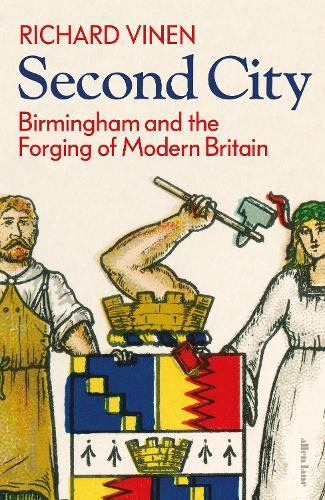
Second City: Birmingham and the Forging of Modern Britain
Non-Fiction, History , British History
Richard Vinen (author)
Hardback Published on: 01/09/2022
Price: £25.00