

Reviews: Realizations (1)
“Numinous”
(Paperback)
These thirteen sermons, which Newman himself regarded as his finest, transmit to posterity so vivid an impression of his lambent charisma, his shining sincerity, his absolute mastery of the written word, that we may readily appreciate, in this book more than any other, the singular hold he exercised in the 1830s over a generation of Oxford undergraduates. To read it is almost to hear again the voice that Matthew Arnold described as ‘a religious music - subtle, sweet, mournful’.
What is most notable about these sermons, especially when one considers their composition at the height of the Oxford Movement, is their strikingly ecumenical nature: no Popes, no Councils, and only the briefest of references to the Blessed Virgin. Indeed, with their frequent appeals to gospel authority, there is little here to which an honest evangelical could take exception. He preached, of course, as an Anglican, albeit one who deplored the comfortable compromises of Establishment. Newman’s own path led him, eventually, to Rome. But to see Newman in these years as a kind of Papist fellow-traveller is hugely to misunderstand his ministry, and the message of the Oxford Movement as a whole. It was, above all things, a call for the Church of England to return to the simplicity and fervour of the Apostolic Age. Time after time, he insists on the need for a genuine and heartfelt faith: ‘Our professions, our creeds, our teaching must henceforth be sincere, or, to use an expressive word, must be real’.
Newman’s style as a preacher was deliberately low-key. He rarely looked up from his text, preferring to let the words themselves take root and grow in his listeners’, and now his readers’ hearts. It is startling to discover, as one progresses through ‘Realizations’, that the doubts and hesitations which beset Christians of our own times are so similar to those of 1839. It is a question not so much of what to believe, as how. In the sermon entitled ‘Waiting for Christ’, he draws a brilliant parallel which Chesterton would have been proud of: ‘I do not see why it is reasonable to expect the overthrow of religion still, after so many failures; and yet unreasonable, because of previous disappointments, to expect the coming of Christ … The Christian has said, “All looks so full of tumult, that the world is coming to an end”; and the unbeliever has said, “All is so full of tumult, that the Church is coming to an end”; and there is nothing, surely, more superstitious in the one opinion than in the other’. Put that in your Bunsen burner and smoke it, Richard Dawkins!
There cannot be many in 2010, even among the Faithful, whose hearts leap at the prospect of reading a collection of nineteenth century sermons. And it is true that this is not a book to be tackled in one go. But as Muriel Spark says in her introduction, we do not read Newman’s sermons because they are sermons. We read them because they are his.
Page of 1
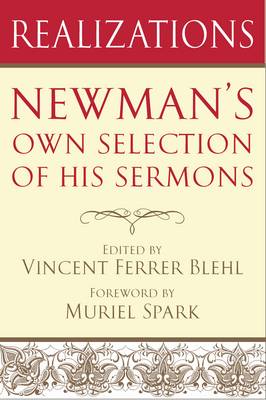
Realizations: Newman's Own Selection of His Sermons
Non-Fiction, Religion, Christianity
Vincent Ferrer Blehl (editor)
Paperback Published on: 01/08/2009
Price: £12.95