

Reviews: Reality is Broken (2)
“Who says games are a waste of time?”
(Paperback)
This is a very interesting read about how video games and play are a crucial part of human existance and how the games industry is slowly changing to allow global problems like climate change to be played out in the spirit of mass collaboration to find solutions.
“An interesting theory”
(Paperback)
I had been interested in reading this book for a long time; an attempt to show that we can improve the real world we all live in by applying lessons learned through the study of how video games affect those that play them. Can looking at why millions of people the world over pour hours of every day into completing quests in World of Warcraft, shooting aliens in Halo or fighting fascism in Call of Duty really lead to real world benefits or is it just the wishful thinking of an academic hoping to find significant meaning in a medium that not only struggles to find acceptance as an art form, but fails to be recognised as anything other than one of the lowest entertainments, peddling in base instincts such as violence and sex?
McGonigal begins by taking a surprisingly long view, rather than beginning with talk of computers and Xboxes we are treated to talk of Herodotus’ writings on the Lydian’s surviving an eighteen year famine by alternating their attempts to deal with their famine crisis with playing games such as dice. McGonigal asks whether - true or not - this history hides the solution to many of the Western world’s problems. It quickly becomes apparent that McGonigal isn’t considering video games as a unique entity but rather as the most recent manifestation of our species ability to play and engage with each other in playful ways. By breaking down the psychological reasons that we play and the benefits we gain from this unique interaction it becomes clear that she is not asking us to accept video game logic in our everyday lives but suggesting that the aspects of the hobby that make gaming such a tempting past time for so many can be translated and applied to everyday life to make it more engaging. If every time we performed a necessary but mundane task we got the same positive feedback that players get every time they perform a mundane task in a virtual world - an act unnecessary to their lives - could these tasks be as readily and eagerly completed as repetitively scanning for resources in the Mass Effect series?
McGonigal takes this philosophy and applies it to many of the problems our society faces, from the idea of simply creating more happiness and satisfaction in peoples lives to connecting more people in the physical world and ultimately to raising awareness of global issues and discovering solution to problems that the world will be facing very soon. She expounds upon how existing games can make life better as well as suggesting the types of games that may do so in the future. She presents her lofty vision of games in the future with very succinct and convincing arguments that make it very easy to share her desire for this world in which everything is fun and connecting people is as simple as offering to play together; it is after all a very tempting vision to buy into.
McGonigal’s argument, from what I understand of it is very simple: wouldn’t the world be nicer if everything could be more fun and rewarding? This however, seems to be fairly self evident. The methods that McGonigal suggests could work to bring this about, but one issue that she sidesteps is the moral implication of her ideals. Is it not emotionally manipulative to remove people from the world they are interacting with and to impose a virtual game reality over the top where people only do good things because of the rewards that they hope to accrue from their acts? Do the ends justify the means? Does this just isolate people further, forcing them to interact with a game system rather than another person?
Whilst these questions remain unanswered the book is still a compelling read, suggesting a world that the author genuinely believes is better and this belief imbues the book with an inspirational quality that means I must heartily recommend reading it, whether you’re a gamer or not.
Page of 1
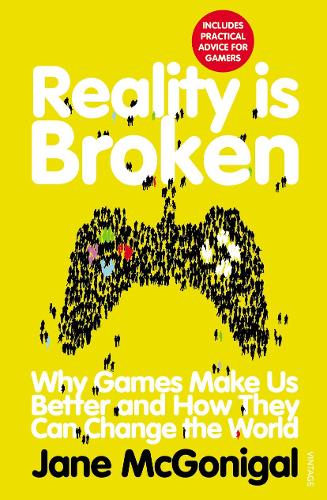
Reality is Broken: Why Games Make Us Better and How They Can Change the World
Non-Fiction, Science, Study & Work, Smart Thinking
Jane McGonigal (author)
Paperback Published on: 05/04/2012
Price: £12.99