

Reviews: Our Evenings (36)
“A truly beautiful novel of love, adversity and triumph”
(Hardback)
Alan Hollinghurst is the consummate storyteller; for over a quarter of a century he has written some of the most beautifully powerful and moving novels- Our Evenings is another classic.
Our Evenings- those special times at the end of a day when we spend times with those we love
This is the story of Dave Win- his life, his loves, his successes and challenges- covering the period from his teens up until his seventies. The story takes us through key moments in his life and his encounters with key individuals who figured briefly in his world or over many years.
From life in public school through a scholarship, his formative years at Oxford and through his career on stage and screen, Dave Win bares his soul and observations about society - subtly referencing the racism across 'class divides' and the English landscape over the decades, connecting us intimately with his mother and her partner ( the unspoken relationship of two women in a small community) and the ever present bond with Mark and Cara , the wealthy couple, who supported his steps into education and remained friends through his career.
Alan Hollinghurst has created a very poignant and at times heart-rending tale of survival in a world where Dave Win never fully is accepted or fits in. With a nod to right wing politics and the pretension of a wealthy elite, he cuts certain characters down to size especially the odious Giles( son of Mark and Cara) who is an ever present figure through his rise in national politics.
The first chapter or so felt as though this was to be novel about the rivalry between the class divide and the violence and abuse of life in a public school but the story panned more widely and broadened into a truly exquisite read about the wider obstacles and triumphs encountered by Dave Win. The chapters exploring the love between Dave and his mother, Avril, are charmingly tender; the recollections of life in the theatre and daily life are wonderful.
This is a brilliant novel -the creation of Dave Win is a literary gem- a story that will be savoured for a long time.
Thank you to PAN MACMILLAN for the ARC
“An unremarkable life filled with some remarkable people.”
(Hardback)
Centred around David Win’s life story, this novel persistently, but often gently, raises questions about race, class, politics, personal freedom, and the role of culture within society. Ranging from the 1960s through to the 2020s, the story presents a quiet but effective examination of prejudice, perceptions of family, the meaning of home, and what we view as success.
A thoroughly engaging and emotive story highlighting both the sadness and joy that others can bring to our lives. The life of David Win seemed unremarkable in many ways, by contrast many of the people he encounters during his lifetime, those who offer him unquestioning support and/or solace, came across as extraordinary.
A beautifully told story filled with achingly poignant moments.
“Alan Holinghurst, Our Evenings”
(Paperback)
Always a delight to return to Holinghurst's prose: intense melancholia and sharp irony. Such a deep understanding of power dynamics and social class subtle mechanisms. Most rewarding read!
“Alan Hollinghurst's best novel yet”
(Hardback)
Many thanks to the author, @netgalley, and Pan Macmillan for the ARC of Our Evenings, which was released in the UK and Ireland on 3 October. I've been a fan of Hollinghurst's books ever since I read The Swimming Pool Library two decades ago, and this one, an eleagaic tale of an actor's memoirs that has a 'state of the nation' feel to it, is probably his very best work.
The novel recounts the life of David Wyn, opening with the summer holiday he spends with the Hadlows, a wealthy family who have endowed a scholarship David has won. Mark and Cara are gracious and generous hosts who wear their extensive philanthropy lightly; unfortunately, their son Giles is a racist bully. The opening might lead to an expectation that the Hadlows will play a larger role in the novel than they perhaps do. Mark and Cara become like found family for David in adult life, but they're definitely there as secondary characters. Giles, meanwhile, flits in and out of the story (as a prominent Tory politician, awareness of him is unavoidable).
The novel is Hollinghurst's most explicitly political. David is half-Burmese, and experiences racism throughout his life, from the derogatory language of the youthful Giles to repeated assumptions that he's an immigrant because he's mixed race. The novel shows how racism mutates over the passage of time: people don't feel comfortable openly insulting David with racist epithets as society moves on, but they feel it's perfectly OK to say that there are too many immigrants in the country. Similarly, Giles' overt racism changes into "intellectual" arguments for leaving the EU. And Hollinghurst shows how popular such arguments are: when David appears at a literary festival at a luxury house, he speaks to a dozen people and gets a free mug. Giles, meanwhile is feted by the owner, a Duke, and speaks to hundreds. There's a sly humour here, too, though – Giles' treatise on leaving has a German name, and David laughs openly when he hears the stupid Giles described as a leading thinker in the Tory party.
There's so much more I could say about this wonderful book. As ever, Hollinghurst manages to capture moments or thoughts that you'll recognise but haven't fully formed, and puts them so precisely and so much more elegantly than anyone else can manage. I also felt that David had more warmth and appeal than any of the author's other narrators, who can sometimes seem a little cold or unsympathetic. It's a slow, luxurious, moving read, perfect for anyone who likes serious literary fiction.
“Alan Hollilnghurst's Best Novel In 20 Years”
(Hardback)
I have always included Alan Hollinghurst when asked my favourite authors and that’s due to the strength of three out of his first four novels, the astonishing debut “The Swimming Pool Library” (1988), “The Folding Star” (1994) and one of the best choices of the Booker panel “The Line Of Beauty” (2004). Since then our relationship soured a little, especially with his last novel “The Sparsholt Affair” (2017) which I felt too dry and mannered, a criticism I also applied to his previous book “A Stranger’s Child”(2011). However, this 36 year association (I read his first book in the year it was published) means that for me the anticipation towards a new work was huge. “Our Evenings” is Alan Hollinghurst’s best novel in 20 years.
Once the excitement of the opening pages were passed I admit I did feel a little concerned. For an author with such longevity and such a sporadic publishing career Alan Hollinghurst doesn’t deviate greatly in terms of the feel of his novels. In my review of “The Sparsholt Affair” I said; “He’s found his groove and has stuck with it” and with the main character having an older more affluent man in his background acting as a kind of patron and with the structure of touching in at points in the characters' lives over decades I was concerned that it would be wearingly familiar.
But on this occasion he’s got it right. I cared more for the characters and the world he creates feelsmore convincing and after the initial wobble I really began to appreciate the merits of this book. There are very few writers out there writing like Alan Hollinghurst. His books are classy (and often occupied by class), they are learned and rich in cultural and political references, they proceed at a gentle pace - all things which might be deemed slightly unfashionable in the modern publishing world and yet this fits in with the very strongest titles published this year. It is often understated and there’s an air of quiet which surprisingly pervades the work. Scenes are set up with great dramatic potential for characters to react explosively but they rarely do and that oddly, makes it feel convincingly like real life. I found myself anticipating interactions that never actually occur. There’s a calmness implied even in the title and that is reflected throughout most of the novel.
David Win is an Anglo-Burmese actor. We meet him initially in 2016 when he is in his mid-sixties facing up to the death of 94 year old philanthropist Mark Hadlow, who had sponsored David with a public school scholarship which brought him into the orbit of Hadlow’s son, Giles, a school bully who inevitably becomes a government minister. A summer stay with the Hadlows because of this scholarship cements their future associations.
In a first-person narrative David tells his own story of gaining success as an actor with the limitations caused by his skin colour, of his relationships with men and his family consisting of a father he resembles but has never met and a mother who finds her own happiness away from the perceived social norms of the time. For me, the novel really takes off when a fourteen year old David holidays in a hotel in Devon with his mother and her new friend, Esme, in episodes which really reflect what an adolescent who feels an outsider in terms of appearance and sexuality would feel in all its crushing mixture of emotions. The novel’s structure does make it feel episodic with a need to fill in the gaps and some episodes work better than others throughout the novel but towards the end I felt quite moved how invested I had become in these lives and how well they had been depicted. This book will join the three I mentioned above, I feel, in being re-read and enjoyed by myself on future occasions.
Page of 8
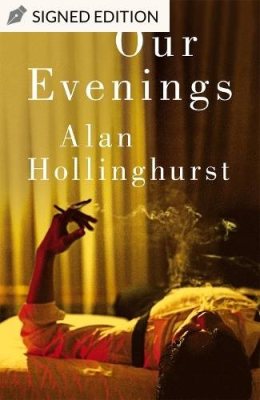
Our Evenings: Signed Edition
Fiction, General Fiction
Alan Hollinghurst (author)
Hardback Published on: 03/10/2024
Price: £22.00