

Reviews: Oligarchy (6)
“Funny, shocking, genius.”
(Paperback)
When Tash, daughter of a Russian oligarch, is sent to an English boarding school, she is quickly introduced to a world of eating disorders and teenage angst. When one of the girls turns up dead in the school’s lake, supposedly due to her severe anorexia, the routines and rituals of her schoolmates take on a darker tinge.
I don’t really know how to describe this book. There is very little in the way of a plot, with the main focus being on the incredibly messed up attitudes towards food and dieting shared by the girls at this school. For the most part, it all seems completely mental – at one point, in an attempt to tackle the eating problems, the school arranges for an influencer to come and speak to the girls who proceeds to show them what searches to put into social media to find other ‘thinspiration’ influencers and images – but there is a dark undertone which eventually develops into the mystery element of the plot.
It is, in my opinion, really well done. The characters are brilliant and hysterically funny, but warped by their terrible environment. The general hectic-ness of the girls and their obsessive dieting overshadows the true plot, which rather snuck up on me, and I feel was very true-to-life in the mind of a teenage girl. Oligarchy is funny, shocking, and pretty genius.
I received a copy of this book from the publisher in exchange for an honest review.
This reviewer received a free of charge product for review.
“Twisted school story”
(Hardback)
I'm grateful to Canongate for a free advance e-copy of Oligarchy via Netgalley, to consider for review. (Quotes below come from that copy, and may not reflect the final text).
'Sometimes she also prays for peace, and joy, and to be thin. Sometimes she even prays for the villagers, that they might become thin too.'
The thing - one of many things - I like about Scarlett Thomas's books is that they always give something unexpected. There is no "just" to them. They are all recognisably hers, but they are also all very different and they all confound one's assumptions.
So Oligarchy is a book about a group of schoolgirls, with a mystery element, but little detection - and at the same time it's a book about the pressures modern society imposes on young women - and at the same time, a book about friendship and abuse. It's also funny, sad and truthful.
As I started the book - with Russian oligarch's daughter Natalya ('but at home they call her Natasha') coming to a scuzzy English boarding school in the Midlands - I thought it might take a fantastic turn. The village boys howl like dogs outside the school gates at night. This is not a metaphor, but it's not pursued (which boys? why?) There's also a distinctly gothic twist in the girls' mythology of the school, involving a drowning Princess, a Sultan and a diamond. The story hovers behind the action, inspiring various events and being embroidered in various ways but as with those howling boys there is no "official" explanation.
Later, with deaths occurring, and an interesting sounding detective (DI Amaryllis Archer, in her jeans and high-heeled boots) appearing on the scene, I wondered about the mystery element - but while it's there and is, eventually, resolved (kind of) that's not central either at least not in detail.
Central, rather, are the lives of the girls and the caustic, pressured expectations on them in modern society. Tash, arriving from Russia, the recently discovered daughter of an oligarch who has plucked her from obscurity and stored her away for safekeeping, is our way into the group, whose members deform almost before our eyes under the weight of those expectations. There is Bianca ('She doesn't tell anyone about the sadness and the failure and the light inside her that is a bright white colour but is never bright or white enough'). Tiffanie, who plans her funeral 'which will have a botanical theme' and who is 'too lazy, too French and frankly too fucking cool to learn English pronunciation' and whose usage of 'Ange' for English 'ing' becomes a meme among the girls. There is Becky 'with the bad hair', the would-be Head Girl.
Thomas's eye for character here is so sharp, getting right inside (Tash's Aunt Sonya 'looks like money rather than sex or love') and it's the way her ensemble of memorable, real people - most of them young women - reacts to the stresses on them that makes this book come alive and forms the gothic heart of the novel (with the oft-quoted story of Princess Augusta the topping, perhaps). There's an atmosphere of confinement, or abandonment, to this group in their strange school and of a breakdown of their sense of identity as they try to be - something. All manner of fake science, folk wisdom and wishful thinking swill around concerning what one should and should not eat, what one should be and not be. The the urge to thinness becomes almost a contagion in itself, with its own heroes and victims.
There is no restraint, no voice of reason, and a palpable sense of the girls being alone - this seems to be a singularly ill-run school where there is no help, typified by an episode where a vomiting bug has broken out and they are simply left alone, in a dormitory, to wait it out - but also very much exposed to the ill winds of social media, to the expectations of teaches, gym trainers and shifty DJs in provincial basement nightclubs. The paradoxes of teenage life - of innocence and experience ('at fifteen you have to practice everything you plan to do') - are played out here as in countless other novels, but with I think a rare sharpness of observation and deftness of portrayal ('Suze likes drinking in a pub called the Marionette ("drinking in" not "going to")')
Behind all this there are Tash's memories of home, of her mother, her boyfriend. Behind it are her doubts about her place in England, her place in the world, above all, about her place in her father's orbit. Having 'found' her he is elusive. Aunt Sonya seems to have been given the job of looking after Tash. Possibly her father wants to marry her off to the son of a business associate (there's a strange episode where she's helicoptered out to a party in a remote castle, but like many scenes in this book Thomas gives only glimpses of this, returning to it, though, several times to draw out different aspects). The run-down, dangerous feeling school doesn't feel like a good place to be trying to resolve these issues, without support or guidance - but maybe the slightly fantastical, out of this world bubble universe, the intense relationship and teenage concerns are a good balance for those family concerns?
Oligarchy is a fascinating, provoking, book, a deeply human book and I think shows Thomas on top form. I strongly recommend it.
“Delightfully twisty school story”
(Hardback)
'Sometimes she also prays for peace, and joy, and to be thin. Sometimes she even prays for the villagers, that they might become thin too.'
The thing - one of many things - I like about Scarlett Thomas's books is that they always give something unexpected. There is no "just" to them. They are all recognisably hers, but they are also all very different and they all confound one's assumptions.
Scarlett Thomas and Francis Bickmore
So Oligarchy is a book about a group of schoolgirls, with a mystery element, but little detection - and at the same time it's a book about the pressures modern society imposes on young women - and at the same time, a book about friendship and abuse. It's also funny, sad and truthful.
As I started the book - with Russian oligarch's daughter Natalya ('but at home they call her Natasha') coming to a scuzzy English boarding school in the Midlands - I thought it might take a fantastic turn. The village boys howl like dogs outside the school gates at night. This is not a metaphor, but it's not pursued (which boys? why?) There's also a distinctly gothic twist in the girls' mythology of the school, involving a drowning Princess, a Sultan and a diamond. The story hovers behind the action, inspiring various events and being embroidered in various ways but as with those howling boys there is no "official" explanation.
Later, with deaths occurring, and an interesting sounding detective (DI Amaryllis Archer, in her jeans and high-heeled boots) appearing on the scene, I wondered about the mystery element - but while it's there and is, eventually, resolved (kind of) that's not central either at least not in detail.
Central, rather, are the lives of the girls and the caustic, pressured expectations on them in modern society. Tash, arriving from Russia, the recently discovered daughter of an oligarch who has plucked her from obscurity and stored her away for safekeeping, is our way into the group, whose members deform almost before our eyes under the weight of those expectations. There is Bianca ('She doesn't tell anyone about the sadness and the failure and the light inside her that is a bright white colour but is never bright or white enough'). Tiffanie, who plans her funeral 'which will have a botanical theme' and who is 'too lazy, too French and frankly too f*****g cool to learn English pronunciation' and whose usage of 'Ange' for English 'ing' becomes a meme among the girls. There is Becky 'with the bad hair', the would-be Head Girl.
Thomas's eye for character here is so sharp, getting right inside (Tash's Aunt Sonya 'looks like money rather than sex or love') and it's the way her ensemble of memorable, real people - most of them young women - reacts to the stresses on them that makes this book come alive and forms the gothic heart of the novel (with the oft-quoted story of Princess Augusta the topping, perhaps). There's an atmosphere of confinement, or abandonment, to this group in their strange school and of a breakdown of their sense of identity as they try to be - something. All manner of fake science, folk wisdom and wishful thinking swill around concerning what one should and should not eat, what one should be and not be. The the urge to thinness becomes almost a contagion in itself, with its own heroes and victims.
There is no restraint, no voice of reason, and a palpable sense of the girls being alone - this seems to be a singularly ill-run school where there is no help, typified by an episode where a vomiting bug has broken out and they are simply left alone, in a dormitory, to wait it out - but also very much exposed to the ill winds of social media, to the expectations of teaches, gym trainers and shifty DJs in provincial basement nightclubs. The paradoxes of teenage life - of innocence and experience ('at fifteen you have to practice everything you plan to do') - are played out here as in countless other novels, but with I think a rare sharpness of observation and deftness of portrayal ('Suze likes drinking in a pub called the Marionette ("drinking in" not "going to")')
Behind all this there are Tash's memories of home, of her mother, her boyfriend. Behind it are her doubts about her place in England, her place in the world, above all, about her place in her father's orbit. Having 'found' her he is elusive. Aunt Sonya seems to have been given the job of looking after Tash. Possibly her father wants to marry her off to the son of a business associate (there's a strange episode where she's helicoptered out to a party in a remote castle, but like many scenes in this book Thomas gives only glimpses of this, returning to it, though, several times to draw out different aspects). The run-down, dangerous feeling school doesn't feel like a good place to be trying to resolve these issues, without support or guidance - but maybe the slightly fantastical, out of this world bubble universe, the intense relationship and teenage concerns are a good balance for those family concerns?
Oligarchy is a fascinating, provoking, book, a deeply human book and I think shows Thomas on top form. I strongly recommend it.
“Scarlett Thomas – Oligarchy”
(Hardback)
When Natasha arrives from Russia at her new boarding school in rural England, she struggles to adapt. Not only the foreign language, but the special language all these year-11 girls from superrich families use. Yet, not only the words, but also the manners are quite unique and the one thing that they are obsessed with is how to lose weight. It is not just to get rid of some rests of baby fat or being in a better shape, the most important thing is being thinner than the others since the headmaster treats those girls differently. But then, their weight-loss competition goes totally wrong and one of the girls dies. Reaction of the school management: let’s not get any information outside and set up an anti-anorexia plan which only gives the girls even more ideas of what to do...
“Oligarchy” starts like some typical boarding school novel. 15-year-olds who do not have any serious worries, who try out the most absurd diets they can find, and modern-day obsession with pictures on the internet. Yet, it does not stop there, on the surface, of course, it is the world of adolescents we are presented with, teenagers who are reluctant to what their parents do and where the money comes from and who rebel against strict rules on their school. However, underneath, there are some much more fundamental questions addressed, first of all, how eating disorders are fired by what we are presented with every day. Secondly, the girls are rich, but most of them actually do not really have somebody to turn to, their parents are simply absent and even times of deepest distress does not seem to trigger any reaction from them.
Even though the novel is a bit stereotypical when it comes to the characters, I think the author did well in combining relevant topics in an enjoyable read. First and foremost, she has found the perfect tone with does neither ridicule the teenagers with their absurd ideas of how to diet and their supposedly secret cheating, nor does she take the serious consequences of their action too lightly. It is a novel that can educate, but fortunately, you do not feel like being educated.
“Unimpressed at the 2nd book Ive read by this author”
(Paperback)
A somewhat childish, innocent book for schoolgirls
Page of 2
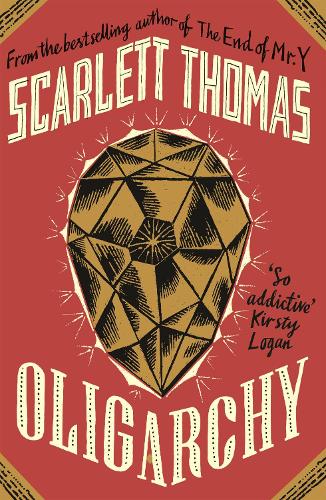
Oligarchy
Fiction, General Fiction
Scarlett Thomas (author)
Paperback Published on: 01/04/2021
Price: £8.99