

Reviews: Natives (22)
“Intriguing”
(Paperback)
So much history that we don’t get taught in school. Natives really opens your eyes to the bigger problems of racism and class divide. Akala explains it all thoroughly.
“A must-read”
(Paperback)
I’ve been the biggest fan of Alakla since I first heard Shakespeare, The Thieves Banquet and his Fire in the Booths and heard him debate and lecture at various universities, so I knew this book would be good. I would say that Natives is in the run for my favourite book for 2020 and I would 100% recommend this book to anyone! (if you know me I’ve been going on about this book for months).
Natives covers everything from the police, education and identity to politics, sexual objectification and the far right. It speaks directly to British denial and squeamishness when confronting issues of race and class that are at the heart of the legacy of Britain’s racialised empire. It is written from a highly personal perspective, and it is hard to come away from this book with the opinion that it has nothing to do with you. It provides a clear history of racism and stereotyping in the UK and how # systemic racism gives an unjust amount of resources, rights, and power to white people while deny them to people of colour. This book gives you a lot to think about and is extremely readable!
As Akala mentions again and again, Knowledge is Power! It is not enough to be silent on the inequalities that black populations have faced, and everyone should prepare themselves with the knowledge and tools to be able to argue and advocate for BLM and against white supremacy. Definitely a must read for everyone.
“Well written and accessible introduction to race in the UK in the 21st Century”
(Paperback)
Akala threads personal experiences through this well researched and thorough introduction to race in the UK in the 21st century. I learnt such a lot about aspects of UK history that have been hidden from most of us, and I felt my perspective and understanding deepening and expanding. Akala writes with clarity, energy and passion, and although sometimes the subject matter is challenging, I never lost interest. I would heartily recommend this book.
“Educationally eye opening!”
(Paperback)
I just need to you to read this book. It is incredibly educational and it exploits racial profiling and takes about race with hard facts.
Please note, this book is for all people to read.
Akala is highly intelligent - check his speeches on YouTube.
“Natives, by Akala”
(Paperback)
This is very much a meditation on what it was like to grow up Black in inner London during the rule of Margaret Thatcher. It is also very much a discussion of racism, class and the decline of the Anglo-Saxon Empire. I use that term, although Akala does not, to encompass both British and US imperialism. It is not an attempt to let the Scots, Irish and Welsh who participated in the imperialist project off the hook.
I approach this book from the perspective of a white man who has just turned 70 and who has spent the last 50 or so years of his life deeply involved in the anti-racist struggle and, especially, the Anti-Apartheid Movement I did not grow up black in Thatcher’s Britain. I grew up white and Welsh In north-east London during the 1950s. The racism was pervasive. The milkman’s horse, being black, was called “nigger”. The term “Yid” was in common currency. And yet, when Dr Chaudhuri died, the streets of Barkingside were lined by thousands of people wishing to pay their tribute as his coffin passed. This was probably because there was no significant Indian community in the area at the time. Yet, it is part of the contradiction that Akala discusses at some length in this book. British society is infinitely adaptable on the one hand, and on the other it is profoundly racist. It does seem that the areas of the country that are the most racist are also the areas that are thoroughly white, although I do not have any empirical evidence on which to base such a statement.
Each chapter of this book has something to say about the racism that exists in our country and in the USA, and also in the Caribbean, South Africa and elsewhere. Akala is well aware that the lightness of his skin means that he will be treated better in some countries, like Jamaica, Brazil and apartheid South Africa, than in others where he is racialised as Black. The chapter on his realisation that his mother is white is one that is especially moving. He leads us through his childhood, the confrontations with teachers who did not think that he should be so intelligent because of the colour of his skin. There is one astonishing chapter about a teacher who claimed that the Ku Klux Klan “stopped crime by killing black people”. This was the point at which my mind boggled. There is really no answer to such stupidity. It is not even worth attempting an answer because any answer my gives credence to the intellectual aridity, the sheer unadulterated prejudice, of such a premise in the first place. I asked myself “how could an educated person even think this, and then I remembered that it was Thatcher’s Britain and many people thought like this. In fact, it was the kind of thinking that the Prime Minister, with her “swamping” remark in a TV interview actually encouraged. It is the kind of thinking that Donald Trump and the alt. right are encouraging now.
The chapter headed “Police, Peers and Teenage Years” had a special resonance for me. I, of course as I am a white man, have never been stopped and searched by the police. I was, on one occasion, heading back home after having spoken at an anti-apartheid meeting in South London. I was waiting at a bus stop and a young black man was also waiting there. It was about 10.00pm. Suddenly, a police car screamed up and three or four officers poured out. One of them shouted something like “What are you doing here?” In my astonishment, I blurted out “We are waiting for the bus. What do you think we are doing?” This took the officers by surprise. They obviously assumed that we knew each other. One of them said “Let’s go” and they poured back into their car and drove off. The bus came and I never saw that young man again. If I had not been there, I am sure that the young man may have been searched and maybe arrested. I mention this tale to illustrate Akala’s point that it was quite normal for young black men to be stopped and searched by the police.
I was most interested in the chapter on Mandela and Castro, partly because of Akala’s argument and partly because this was at the heart of my own political life. Akala starts his analysis with the Battle of Cuito Cuanavale, in southern Angola, in 1987-1988.
I think we need to go back to 1975 when Angola won its independence by defeating the Portuguese fascist government and apartheid South Africa invaded to prevent the installation of a government sympathetic to the liberation of Namibia and South Africa. The South African army drove north and were only halted by the arrival of Cuban troops to assist the newly-independent government of Angola. The South African army retreated by organised constant attacks on Angola from its base in apartheid occupied Namibia.
The Reagan and Thatcher governments developed the policy objective of pressurising the Angolan government into asking the Cuban armed forces to leave Angola. In 1986, an international non-governmental conference on Namibia was held in Brussels. I was one of the delegates. Inevitably, a motion was put forward calling for the Cubans to withdraw from Angola and to be replaced by “an acceptable international force” as a prelude to talks on Namibian independence. I asked if the implication of this motion was that the Cubans were not an acceptable international force. This killed the motion stone dead.
Obviously, I am not saying that, but for my intervention, the Cubans would not have been in Angola when the South African apartheid army launched its attack on Cuito Cuanavale in 1987. I think it helped. What is important is that Reagan’s policy of “constructive engagement” did not work, that the South African army was defeated at Cuito Cuanavale and that talks for the independence of Namibia (which took place in 1990) started in circumstances that were not favourable to the apartheid state. This achievement was recognised at Mandela’s inauguration as President of South Africa in 1994 when the second longest cheer was for Fidel Castro.
Akala asks why Mandela is loved by whites and Castro is hated by conservatives. Mandela embarked on a policy of reconciliation. This was out of generosity of spirit, a realisation of the concept of “ubuntu” which translates roughly as “I am who I am because of other people”. I think that it was more than that. Mandela was aware that die-hard white South Africans had to be persuaded not to drown South Africa in a bloodbath, which was a real threat. He was also aware that the IMF and the World Bank had to be wooed into not pulling the plug on the South African economy, which was at the point of bankruptcy because of the sums that had been committed to the defence of apartheid. So, he gave what could have been an Oscar-winning performance as the conciliator, the genial elder statesman.
In anti-apartheid circles there had been long discussions about what would happen when the struggle for national liberation had been won in Southern Africa. That was a slow process that began with Angola and Mozambique (1975), Zimbabwe (1980), Namibia (1990) and South Africa (1994). Some of us argued that this was a two-stage process with stage one as national liberation and stage two as economic empowerment for the majority. This is essentially Akala’s argument, and it is right. Economic power had remained for the overwhelmingly most part in the hands of the white population in South Africa. That is the legacy that Cyril Ramaphosa has to deal with.
Why is Castro hated. Well, he has been the bogeyman of white, conservative US politicians since he overthrew the Baptista regime in Cuba in the late 1950s. The fact that he transformed education and healthcare in Cuba to make his country one of the best providers in the world is not something that they are interested in. The fact that he closed down Havana as a holiday ground for the Mafia has no interest for them. Castro is hated because he challenged the very basis of their politics. Akala makes this point very forcefully.
This is an inspirational book. It challenges all the ideas at the basis of white supremacy. Donald Trump will not want to read this book. That is the very reason why you should.
Page of 5
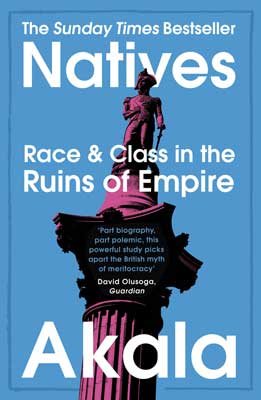
Natives: Race and Class in the Ruins of Empire
Non-Fiction, History , British History, 20th Century Britain
Akala (author)
Paperback Published on: 21/03/2019
Price: £12.99