

Reviews: Love is Blind (19)
“Impressions of Love is Blind, by William Boyd”
(Hardback)
I was initially in two minds about this book. I was slow to warm to it though in retrospect I am very glad that I read it and overall it is an interesting and intriguing story. I do have reservations about it though; especially the first half as I felt that the lynch pin of this book being the passion that Brodie Moncur has for Lydia a.k.a. Lika Blum was not as convincing to me as I felt it should be. I was in fact initially not convinced of the depth of passionate and sincere love between them. Towards the end I felt it more. Brodie to be sure is enamoured with Lydia Blum to the point of obsession, but it was not really until the end of the book that I grasped that in any way was this passion and love fully reciprocated. From the very beginning of Brodie having met with Lydia it is almost as if he falls captive to the gorgeous being that is Lydia Blum. He literally falls under her influence and is consumed by her.
With Brodie’s first sight of Lydia he views her as “a tall, fair-haired blur”. He is of course extremely short sighted with a necessity to wear bi-focal Franklin style glasses. Throughout the novel it becomes clear to us that his myopia is a metaphor for his being short sighted in a number of different ways. Lydia is at this early point unknowable to him but remains an enigma throughout if not always to him, then at least to my mind to us as readers. He is initially struck by
“a sense of something impending, unsure if it was good or bad”.
He invents a word to describe such feelings in the form of a noun viz impendingment. Next as if to give the perception verve the word becomes an adverb,impendingmently' With the Chekhovian quote at the front of the book before our story begins suggests the possibility that Brodie might do well to take hold of this feeling and its suggestion of impending doom and the play of fate and falsehood in relation to love and relationships.
We are first introduced to the character of Brodie in the first letter in the book that serves as the prologue as Page tells of the 'recent arrival of a new assistant, “a tall young Scotch-man, about thirty-five years old, called Brodie Moncur”.
Brodie Moncur we learn in chapter 1 is a Piano Tuner. He is handsome but very short sighted and I guess the Love is Blind of the title is a play upon the fact that a) many piano tuners are in fact physically blind (mine was when I was a child) and b) being in love can blind a person to the extent that he or she does not always see the reality of the person that they are in love with..Brodie once he has established a relationship with Lydia never changes his persistent and obsessive love for her. She has become his religion and he worships her. It does not seem to matter that she does not reply to his letters or give him any indication that she is thinking of him when she is apart from him. There is in fact a theme throughout of letters not being replied to. For example in the case of Brodie's brother Callum, he replies to the first letter from Brodie, but lapses somewhat as his own life spins out of control and he is on a downer of unemployment and alcoholism which ultimately he recovers from. Alcoholism is another theme in the book though not Brodie's problem. John Kilbarron is also an alcoholic which partly accounts for his erratic behaviour. There is also a suggestion that Brodie's father might also be an alcoholic.
Brodie for his part has other vices such as smoking which of course in the 19th and early 20th century would not have been seen as a vice at all, but even as having health benefits. All his Doctors share cigarettes with him and seem to encourage smoking which in turn also probably contributes to Brodie's early death.
Lydia Blum is Russian and there is something very Russian about all the relationships and the interplay between characters throughout the entire novel - as if Chekhov or even Tolstoy might have had a hand in the writing of the narrative. The subtitle of the book being The Rapture of Brodie Moncur has both sexual and religious overtones. His father is an overbearing bullish preacher and it is clear quite early on in the story that Brodie rejects religion and as events unfold his rapture we see is of a different kind. Brodie is certainly enraptured by Lydia Blum to the point of obsession reminding me a little of Anna Karenina and her overwhelming and obsessive love for Comte Vronski. Love can result in us elevating the beloved one onto a pedestal well beyond what the beloved actually is viz a human being with failings and frailties as well as strengths. This adoration following falling in love, can result in us not seeing the whole person only what our romantic selves want or even need to see. When Anna thinks she sees Vronski as having fallen out of love with her she kills herself. Brodie believes that Lydia is forever constant in her love for him even though she does not reply to his letters and we are never quite sure of just how much in love with him she actually is.
Up until the visit to Scotland late on in the story and the visit to Brodie's family, Lydia is still somewhat shadowy as a character. We are aware of her great beauty, elegance and style and of her sexuality, but not arguably of her personality and depth of character or even reciprocal love for Brodie. The attraction is for her without a doubt sexual..the one liner note that Lydia leaves for Brodie in St. Petersburg in Russian bears testimony to this with her expressed longing to have him inside her again with no other references....Whether her passion for him is more than this at this point is difficult to ascertain. I only felt that she had more depth of character and then only to an extent towards the middle of the book and at the end. This depth is perceived through another person's eyes as reflected in anthropologist Page Arbogast's 2nd and last letter to her sister Amelia. I think by the way, that it is a neat device to have the story sandwiched between the two letters to Page's sister.
As the story unfolds after Brodie and Lydia have escaped after the death of John Kilbarron at the hands of Brodie in self defence following the duel, Lydia leaves another note stating that she is leaving him to return to her husband Malachi...a man much like Brodie's father in his grotesqueness and need to control those close to him or those who threaten those close to him. 'You are my creatures'..he declares when he comes across Lydia and Brodie at the Ash Tree Pool at Maloe Nickolskoe in Russia just as Brodie's father, a preacher seeks to control his family and his congregation. Interestingly Brodie's father's name is very similar to Malachi's. Malki is his nickname as it could easily have been Malachi's. Words such as malcontent and maladjusted spring to mind. The mal of Malachi and Malki hint that they are the destructive characters. The Latin, "Male" used as a prefix means bad. Psychologically, I suppose Brodie sees his dead mother as an innocent destroyed by his bad father, and Lydia slots neatly into the role of an innocent as she is seemingly mistreated by Malachi as the parallel to Malki.
In her letter, Lydia to suggests that Malachi wants her, and not Brodie. If she leaves then Brodie will be saved. It is not to take revenge that Malachi has been following them because of his brother's death at Brodie's hands tracking them through Brodie's desire for tobacco (and a particular brand at that sent to him across Europe from Scotland to wherever he may pitch up) it is because he wants his wife back. Later, after Lydia has left it is not clear if Malachi is in pursuit of Brodie. There is some confusion here as Malachi is Irish and the man that Brodie understands is pursuing him is referred to as being 'English'.
This begs the question as whether it is true or not that Malachi wishes to destroy Brodie or is another aspect of his being 'blind'? Certainly at the end of this sad story when Brodie thinks he sees Malachi in O'Malley's in the hotel in the Andaman Islands it turns out that the man is in fact Polish.
In fact when Malachi is first described to us I was reminded of Verloc in Conrad's Secret Agent perhaps because very early on in the story the explosion of a bomb in Greenwich is referred to and so the seed was sown. (I think that this book is littered with allusions and some I get, though I dare say not all).
William Boyd's attention to detail is very precise, informative and interesting throughout such as for example his descriptions of music, art, architecture; of city and sea scapes and his perceptions of nature; of rivers and the ash tree pool.
Some of the references I see as signposts for the action such as the reference to the painting in the palace in St. Petersburg called The Gathering Storm....which might be viewed as prophetic and a metaphor of future events.
I liked some of the philosophical elements throughout and certain observations such as
Home is somewhere you never really know...
and by contrast:-
You may leave home, but home never leaves you
A kind of contradiction really.
(I often find myself dreaming about places that in the past have been my home – I believe it to be true that these places never leave us – well of course they don't as they live on in that enormous filing cabinet that is our mind)
The Ash Tree Pool is described poetically and as I usually respond well to a lyrical tone I enjoyed this aspect. It is at this point that at least for me that the book has more soul than was apparent in earlier chapters (p.216).
(I think if we had not identified this book as a shared reading venture then I may not have persevered even though I am now actually glad that we did select it).
The descriptions of technical piano, and of piano playing and tuning are throughout vivid and evocative of private chambers and concert halls. We can almost hear the Irish Liszt in the form of the dissolute John Kilbarron as he plays the piano fine tuned by Brodie. Music, art and architecture are constants throughout the novel suggesting an interlinking between art, life's meaning and of the interplay of fate and of how in a heartbeat circumstances in life can change.
Much of the writing is multilayered and very descriptive conjuring images and giving us readers a real sense of place showing us what a place looks like and its atmosphere.
This is necessary because of the broad sweep of travel and country that takes the narrative far from the borders of Scotland to Paris, Nice and Biarittz, Trieste and ultimately to the Andaman Islands...
The intertwining of place often links to a character's mood,; the pathetic fallacy. Lydia looks at the villages in Scottish borders and is reminded of Russia and of bleakness and death. It is all very Chekovian. Even Brodie, as he sports a beard reminds Lydia that he looks Russian. Sometimes the descriptions are light and airy such as in Trieste:
They decided to walk down from Cimiez to the town, drawn by the complicated embroidery of a city's lights shining brightly on its gentle way below them....As it seems to shine down on their love.
At other times descriptions border on the anthropomorphic as for instance when Brodie looks in the bath at the spider as it fails to identify its simple route to freedom I still feel that he is in some way identifying with the spider, though he does not acknowledge this as such, In fact he does refer to incident with the spider later.
At times Brodie does indeed feel trapped and yet it would seem not ever by his love for Lydia; only by the consequences of that love. Such as for example by characters such as John Kilbarron and his dastardly brother, Malachi. The latter turning out to be the husband of Lydia and her oppressor and ultimately Brodie's..whether ultimately real or imagined. Certainly as I mentioned before in the early stages he announces to them to be his creatures with the implication that he will at the very least manipulate them both and possibly seek to destroy this relationship. He does in effect go on to destroy Brodie along with Tuberculosis as even though he is not actually present at the end of Brodie's life the latter's obsession with the man that he is hunting him is one of the contributors to his demise.
Half way through the book I was beginning to think that Lika Blum might be a Nymphomaniac though as the story unfolded I realised that she was not. It was only with the second half of the book that I actually felt any warmth for any of the characters as they became more rounded.
Brodie and Lydia, I suppose that makes sense in terms of their relationship which was confined and limited before their visit to Scotland; Brodie's homeland and visit to his family and their life together in Edinburgh gives them a chance to be normalised and domestic. It is here that Lydia begins to bake and grow plants etc.. Brodie refers to her putting on weight....we are not sure if he sees this as a negative or not. It is here also that we begin to understand the relationship more..that it is not just about sex, but is in fact love. The love is blind of the title I thought might have made more sense if Lydia had been even more duplicitous than I first thought her to be.
On one level it seems brave of Lydia to leave Brodie and to return to her husband because she felt that by doing this she is saving Brodie's life. This is stated in her note of departure to him. At the time of reading this however I was even suspicious of her motivation for leaving. Was she bored or did she truly believe that by leaving she was saving Brodie's life?
I may have been wrong in questioning her motives. Lydia leaves her dog Caesar to Brodie; a living embodiment of their love. I understand that better now having read the whole book.
As seen through the anthropologist Page's eyes we glimpse the depth and perhaps the honesty of Lydia's feelings for Brodie. The inscription at his grave and on the wooden tombstone that she has erected with Page (even though it will not endure) is a neat twist to the fact that Brodie's rendition of the Scottish folk song although stolen from him by John Kilbarron – and possibly by Lydia herself - is dedicated to him albeit in death. It is as if Lydia is giving the music back to him..her own Bonny Man. (Is this an actual Scottish folk song? I could find no reference to it on line..)
It also however consolidates Lydia's morbid sense of death which as previously stated is very Russian and an aspect of her character that is in evidence when she is part of the action. At one point in the narrative she even wondered when Brodie would die and when she would die. A morbid preoccupation to be sure. When Lydia is in this mood she reminds me of Masha and how at the beginning of The Seagull she declares that she is “in mourning for her life”.I cannot help but wonder if she did not push her horrible husband as he tried to retrieve her hat, off that bridge in Paris. As readers we will never know.
Additional impressions:
One other thought I had was about the Irish brothers in Paris who Brodie meets on his return to Paris at the concert hall and later in a bar and his visit to their less then salubrious accommodation and where he tunes their battered old piano. Brodie tells them some of his problems and his fear that he is being followed and that he is under threat of death. I could not help but think with the rotating of the globe atlas and the close your eyes and pin prick approach to finding a destination to where he should go next that these men might possibly be the cohorts of Malachi...The plan being to get Brodie as far away as possibly from Lydia and Paris where the couple now appear to be living. Perhaps it is just that these men are Irish. They are not referred to again.
Even so the Andaman Islands is a very long way for Brodie to pitch up, especially if he felt that there was any chance that he might be with Lydia again. In fact when he is dead of course she does come to him, though to be fair she had thought that he was alive when she made the trip and it is only because Malachi is dead that she feels able to come.
The final chapters of the book, and the focus on an Anthropological expedition and Brodie's professional and personal relationship with Page is interesting though I am not convinced of how essential the level of details regarding the visit to the Nicobar Islands is. Perhaps it is to reveal Boyd's own knowledge of the sexual mores of the indigenous people of the islands. Viewed only from a young person's perspective I consider strange, though I get that this was Page Arbogast's focus for her academic study. I would have thought that if you wanted to fully understand the sexual and ritualistic mores of a people and a society it would be more telling to have a cross-generational focus, but who am I to say....Page clearly likes Brodie very much and invites him to live with her, but even had he been swayed..and ultimately he is not – it is any way too late.
He will not affiliate himself to any woman other than Lydia at this stage and the fates are about to catch up with him in the form of his tragic end.
Final thoughts:
I don't know what it is about this book that perplexes me. It is clearly well constructed and really quite brilliant in parts and yet in the final analysis I have to ask myself why is it that I do not engage fully with the characters not even with Brodie and his story as it unfolds? I did feel sad at the end, but that was the extent of it really. I have not read any other books by this author. I dare say if I were more conversant with William Boyd's universe I might have understood more and grasped more allusions and meanings harking back to previous works. Perhaps I might read something else by him in the future..not sure really. There is a great deal of moral ambiguity in this novel as to what a character's true intentions are and that in itself is very Russian yet also suggestive of the writing of R.L. Stevenson....The Strange Case of Dr. Jekyll and Mr. Hyde springs to mind...
It is interesting that Brodie throughout most of the book has been reading The Master of Ballantrae which is also about moral ambiguities and duplicitous behaviour. It to features a duel which in turn influences Brodie's perception of dueling but not enough to make him on his guard as it should have been for his own protection.. What did he think was going to happen. John Kilbarron is clearly unhinged and the duel was never going to end well. Brodie's duel with John Kilbarron is the beginning of the end for him, though this path was probably set for him the day he first saw Lydia...the duel however is the action the will pivot the fates out of control. If this is a love story I feel that the relationship between Brodie and Lydia is wanting in so many ways; but there again perhaps that is what is meant by the title of the novel i.e. that Love is Blind.......
Incidentally William Boyd has a house in the South of France – well it would be South wouldn't it......and as I understand lives there for part of the year...Quite early on the novel, Brodie when he is resident and working in Paris, references his fluency in French. He also mentions the fact that he still struggles with this language in terms of gender viz whether a word is masculine or feminine......I think that this may be something personal that Boyd himself albeit even though he is probably also fluent in the French lesson still struggles with...Living in France myself and often finding myself struggling with the language I empathise.
In the final reckoning this book probably meant more to me than I was aware when I was reading it as I have thought about its themes afterwards and that is always the mark of a good book isn't it. I also felt quite moved by the ending which was as to expected very 'Russian'.
Teresa Dolan
January, 2019
“Superior storytelling”
(Hardback)
William Boyd's latest novel Love is Blind is aptly named. It shows us what people will do for love, the secrets they keep and what they choose not to see. Like Any Human Heart, this epic takes us around the world as it emerges into the twentieth century. Horse-drawn carriages make way for motor cars, but love affairs are as complicated as ever.
Brodie Moncur is a gifted piano tuner and a romantic. He longs to leave his dour upbringing behind for a life of possibilities in Paris. Brodie goes to work for a piano manufacturer in Paris. His bright ideas bring success for the company but jealousy from his corrupt manager. A chance meeting with an opera singer will change his life forever, and not necessarily for the better. Hand in hand with love are terrible betrayals both artistic and romantic.
Love is Blind succeeds not just as a great story but as a social history. Hausmann is building the Paris we recognise today. Social unrest is unfolding across Europe. Old empires are fading away. As the world becomes more known, the old ways must be catalogued before they disappear.
Brodie's love causes him to travel the world, never settling for long. Through his eyes we see beautiful sights, and experience depths of emotion. Boyd's superior storytelling keeps us gripped until the end.
“An atmospheric love story”
(Hardback)
I was sent a copy of Love is Blind by William Boyd to read and review by NetGalley.
An Atmospheric love story with a real sense of time and place. The author conjures up quite vivid scenes with his descriptive and evocative prose. One of the things I loved was the way he used a lot of archaic words that were true to the era, making it so much more authentic. Definitely a book to get lost in.
“Another great read from Mr Boyd”
(Hardback)
Set at the end of the 19th century, we follow the young life of Scotsman Brodie Moncur. When Brodie, a piano tuner, is offered a job in Paris by a Scottish piano making company, he grabs the chance, however a meeting through his job with a famous pianist and his Russian girlfriend changes Brodies course and finds him in an intense love affair that has him fleeing for his life all over Europe.
Personally this book was never going to disappoint me. Mr Boyd can do no wrong and I have thoroughly enjoyed every book of his that I have read for some years now. Here again with this new novel, he has triumphed again. Such brilliant writing, you are drawn into this mans life straight away and follow Brodie on his journey with gripping writing and great story telling. I particularly like the parts in Boyd's books where the lone character is trapped in a corner, or a tight intense situation and reasons with their own thoughts and emotions. Go find a copy and read it now.
I received a copy of this book from Netgalley in exchange for an honest review.
I also went and brought a hard copy of this as I have tickets to see the man himself in conversation on his current book tour!!!!
“read it: you'll love it”
(Hardback)
There are few tales more satisfying to read than those where you find yourself firmly on the side of the protagonist. In every way, 'Love is Blind' is one of them.
Unhappy at home in Scotland and spurred on by his Godmother and benefactor Lady Darcastle, Brodie Moncur escapes to Paris. It is, however, not long before we realise that he; "may leave home, but home never leaves you."
Early on, our affable principal comments on his grasp of French as ; "comprehension virtually 10 per cent; with expression around 90." Yet despite this, and his admirable attempts and successes in acquiring Russian too, it transpires that his comprehension of those who surround him is actually quite limited. As he stumbles 'blindly' from one opportunity to the next, he struggles to identify the true intentions of his acquaintances and companions. Honest and open-hearted, he receives others in the manner in which he presents himself; "I'd believe you if you said the earth was flat and the moon was mad of cheese."
In fact, people lead him a merry dance as he travels from one concert hall to the next (from Brussels, Paris and Berlin, to Vienna, Milan, Rome and Geneva among others) always in someone's shadow and yet purportedly indispensable. This, combined with his need to convalesce in warmer climes, ensures the story develops in an engaging romp across Europe and still further. Brodie himself reflects: "It was astonishing how quickly life could change, how the ground moved beneath you and the landscape you were living in turned out to be entirely different."
Read it. You'll love it.
Page of 4
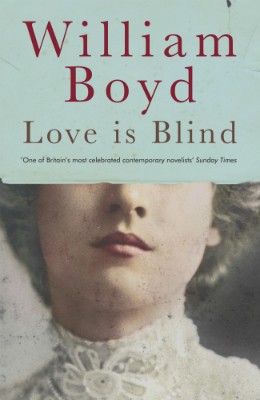
Love is Blind
Fiction, General Fiction
William Boyd (author)
Hardback Published on: 20/09/2018
Price: £18.99