

Reviews: Long Wave (3)
“Breathtaking & Beautiful”
(Hardback)
Daisy Johnson's 'The Long Wave' is a kaleidoscope like novel revolving around the life of Ruth who at a young age sees a woman walk into a river and disappear. This event influences events throughout Ruth's life and those around her. Wow. Just wow. This novel is truly breathtaking but honestly difficult to describe. While this novel is just under 300 pages its scope and emotional depth is so vast that I feel like I've been with these characters throughout their lives for at least 1000+ pages. Daisy's skill and threading these narratives together is nothing short of beautiful. She manages to touch on some very upsetting subjects of loss, grief and feelings of hopelessness with such raw unflinching compassion. The story unfolds like a stone dropped in water, the ripples and threads of stories growing out of one another. Each character's story is touching and plotted just right so that you fall in love with them. A tale that is filled with a lot of loss but also so much hope, hope of reaching somewhere safe, somewhere or someone that feels like home. Honestly breathtaking. I am here.
“Hypnotically beautiful”
(Hardback)
Long Wave is a novel of themes and imagery, adapting on thoughts and musings of motherhood, freedom, the river, the islands and the hares, its all arranged carefully, and precisely, lulling you into a sense of the unexpected.
It has a cyclical rhyme that pulses exactly as you expect it to but still breathtaking to behold.
Its precise. Its bold. Its mesmerising.
Watching the ripple effects of these characters through the years, the kaleidoscope effect each generation has on the next feels hypnotising.
A novel that will sit with you hours after you turn the final page.
“Elusive and littoral literary tale of leverets, lighthouses and (matri)lineal inheritance”
(Hardback)
Daisy Johnson’s debut novel “Everything Under” – which I described as a literary novel of the liminal, language, leaving and legend was longlisted for the 2018 Booker Prize and went on to be (my view) deservedly shortlisted – making the author the youngest author ever to have made the Booker shortlist. It drew on folklore, Greek myth (the latter perhaps too explicitly) and was heavily based around the rivers and canals (from the author’s adulthood) – with both the folklore and water influences also obvious in her earlier short story collection “Fen” (an Edgehill Prize winner) which drew on her East Anglian childhood. Her second novel “Sisters” was more of a Shirley Jackson inspired horror-literary mash up and perhaps a little less to my tastes.
This her third novel is said in the acknowledgements to have been born “out of grief and exhaustion” and is I think heavily inspired by her matrescence.
Carrying on my alliteration I would describe it as an elusive and littoral literary tale of leverets, lighthouses and (matri)lineal inheritance. Carrying on with the heavy influence of water on her writing (even “Sisters” had a coastal setting) a river is key to the novel – both as it passes near a town but also its eventual flow to the sea, and an Island located at its mouth.
The novel begins with Edith “mother of long gone Ruth” packing up her belongings in the soon to be vacated vicarage after the death of her husband (Ruth’s father) and coming across a folded page of an encyclopaedia with the entry for ISLAND and we are told “Edith does not know it but the fold bisecting the page, creating a sharp straight edge, resembles the river as it leaves the town and cuts up through the paper of the country until it reaches the end of the land and opens itself up into sea and sea and there, as with the word: an ISLAND.”
We then switch time and viewpoint to Ruth (ten years after she left home) and finally visiting the Island with which she was obsessed as a child, having left her own daughter Ori near a lighthouse and now walking back to her.
And then we are with Ori – waiting futilely for her mother and eventually rescued (and later we find implicitly adopted) by Min – a scientist researching the brain patterns of the hares on the Island (and how they both relate to day time activities and even seen to pass across generations).
Returning to Ruth’s childhood adolescence, we first find an incident when, as a ten year old, she sees a woman (with a baby in a sling) walking into the river – an incident that she is told she must have imagined (no trace of either can be found) but knows she did not. And when a few years later – via a fling with the older brother of a neighbour/friend – she becomes pregnant, Edith literally locks her in her room – Ruth eventually absconding with her friend/neighbour and having the baby Ori – eventually living in a form of hand to mouth communal living (with another single Mum Jupjaapun) from which one day she and Ori disappear (for it becomes clear the Island) never to reappear (although Jupjaapun – now a long haul driver – mounts a CB enabled search for her).
And we also spend time with Ori – post the disappearance of a mother she can barely remember – now in a same sex relationship and newly a mother, but struggling with what seems to be the solitary burden of motherhood (despite her partner Eva’s professed best intentions) as well as with her own memories.
The narrative spools across the three characters (as well as others like Min, Eva, Jupjaapun and the latter’s own son Leo) and across time – although time is a fluid concept in the novel as is place (the setting at the same time clearly England (for example with named motorways) but also more of a legendary location (particularly on the Island itself where the fantastical and history seem to meld to the factual present).
Images and themes recur across each of the storylines – the line (and associated fold) of the river, the lighthouse on the Island, some scattered fragments of paper like snow, regular signalling by knocking (for example in the wall between Ruth and her childhood neighbours, between Jupjaapun and her radio broadcasting daughter Nora) and in particular the idea of knocking two stones together to signal one’s location (including in a variation on the Marco Polo game).
The recurrence of these images across all three stories for me linked also to the way that Min believes that baby hares seem to have dreams replaying the experiences of their mothers (which cannot be known to them).
And the three storylines and generations converge in what I thought was a very strong ending by a river – in the same place where Ruth had her experience as a ten year old, and confirming to us the way in which birth is also a form of rebirth and generational experiences can meld.
Overall I thought this was a strong novel.
This reviewer received a free of charge product for review.
Page of 1
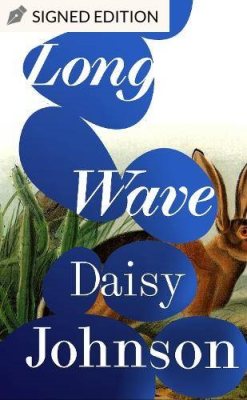
Long Wave: Signed Edition
Fiction, General Fiction
Daisy Johnson (author)
Hardback Published on: 02/07/2026
Price: £18.99