

Reviews: Jubilate (4)
“Stunningly sensitive”
(Paperback)
Whether you've been to Lourdes or not, this novel is a wonderful portrayal of faith in humanity and faith in miracles but these miracles aren't of the obvious kind. Yet again Arditti creates a beautifully sensitive story based around Gillian, a reluctant wife of a husband she was just about to leave because of his infidelities, before he became seriously brain-damaged. Her Catholic mother-in-law, superbly portrayed with all the prolonged resentment and dutiful facade that only an older woman, who could never entertain divorce (she too was betrayed by her husband's infidelities) can feel, brings a unique counterpoise to Gillian's personal journey. Vincent (a lapsed Catholic) who is making a TV documentary about Lourdes and its pilgrims creates the catalyst between both Gillian and her mother-in-law's reconciliation and through Gillian's new found love for Vincent and Vincent's new sense of purpose. This novel has many hilarious moments as well as offering fundamental questions about disability, illness and our prejudicial society towards those who need extensive care as well as those who are the carers. It is a salutary reminder of how little we have progressed in our attitudes towards the vulnerable but also reminds us how vulnerable we all are in very different ways. In this light, miracles are redefined and the ordinary becomes extraordinary. This novel should be compulsory reading for all of us who care about society and how we should treat each other.
“Gripping love story in Lourdes”
(Paperback)
This is a novel for the faithful and for nonbelievers alike. Michael Arditti's Lourdes gets to the core of the holy pilgrimage town in southwest France, with its inherent contradictions (a place of haunting spirituality and a promise of cures and miracles on the one hand, coupled with that of crass commercialism and some vulgarity on the other, with its plastic trinkets and religious souvenirs galore). Jubilate is also a moving love story, and a complicated one at that, and a tale of modern-day morality. I read it in one go and was left with the strong feeling of wanting a sequel. For Arditti fans, it's also quite unlike (in story line at least) earlier novels such as The Enemy of the Good or Easter, which won the Mardi Gras & Waterstone's Award. I was also intrigued to learn that it's the first literary novel since Zola's in 1894 to be set in Lourdes - quite a time span and interesting that the author chose this as his novelistic spark.
Now I'm reading Arditti's second novel, Pagan and Her Parents, about gay parenting, and it is just as gripping as Jubilate!
“Lourdes Into Temptation”
(Paperback)
RH Benson once wrote a splendidly barking fantasy called ‘Dawn of All’. By 2011, Lourdes is supposed to be a centre for the study of miracles, which are now a recognised part of medical treatment. There are no miracles in ‘Jubilate’. This is a novel about clinging to the tiny life raft of faith, all that is left of a once mighty vessel, now adrift and broken in a sea of doubt. You know the ship won’t reassemble itself. All you can really hope for is that the next wave will be a small one. How anyone can go to Lourdes with a sick relative and not start shouting obscenities at the shrine - happy now, are You? - is beyond me. Yet people can, and do, in their thousands. Those with least cause to thank the Almighty have always been His most grateful worshippers.
This profoundly touching and well-observed book follows just such a group: Tadeusz and Lucia, a young Polish couple with a handicapped child; Brenda, the testy spinster confined for twenty years to her wheelchair; Gillian, whose brain-damaged husband has the mind of a six-year old; and Vincent, TV producer and truculent atheist, filming them all for a documentary. He and Gillian have an affair. The narration switches from one to the other, and from the start of the pilgrimage to its end: a striking and effective technique. When I mentioned the plot to m’colleague, however, she was appalled. Perhaps I didn’t explain it very well. In one sense, of course, Gillian and Vincent’s actions are utterly disgraceful. If one of them were an MP, the headlines would not bear thinking about. Yet it’s a mark of Michael Arditti’s formidable skill that by the end of his book, even if you cannot bring yourself to approve of Gillian, and I must say that when it comes to brain-damaged spouses, the words ‘in sickness and in health’ should echo in our minds like a thunderous peel of bells, you will at least understand her predicament.
The main reason I get so evangelical about Arditti’s work - which is odd really, because in his books it’s usually the evangelicals who cause all the trouble - isn’t so much the ethics, lucid and engrossing as they always are. I wouldn’t want the poor man to be seen as Iris Murdoch in a dog collar. Rather, it’s the basics of novel-writing, which many of his peers seem to think are beneath them. Characterisation; plot; making the reader give a damn. Once you get those right, everything else follows as naturally as snowdrops in the springtime. He also has a fine flair for comedy. In one scene, Vincent has to buy some prophylactics . More difficult than you’d think in Lourdes, even in the 21st Century. Eventually, in desperation, he approaches a group of Swedish teenagers:
“You may think this odd, but do you happen to have any spare condoms?” They look at me blankly. “Condoms. You know: Durex, Johnnies”. I am rapidly running out of euphemisms. “French letters?”
“You wish to post your letters?” he asks. “You must make inquiries at the hotels”. Fearing that the language barrier is too great to surmount, I resort to gestures. “Do any of you have something to put on this?” I point to my crotch. “I’ll pay”.
This is not, Vincent learns, a very sensible proposal. He retreats under a barrage of empty beer cans and outraged Scandinavian rectitude. It’s hard to say what great spiritual truths we can draw from this episode. I doubt very much that ‘Don’t forget to bring a condom’ will ever rank alongside ‘Only connect’ or ‘Blessed are the peacemakers’. But that’s kind of the point with these immensely thoughtful, compassionate novels. You cannot reduce morality to a slogan. Look after each other, and the ethics will look after themselves.
“Lourdes into temptation”
(Paperback)
RH Benson once wrote a splendidly barking fantasy called ‘Dawn of All’. By 2011, Lourdes is supposed to be a centre for the study of miracles, which are now a recognised part of medical treatment. There are no miracles in ‘Jubilate’. This is a novel about clinging to the tiny life raft of faith, all that is left of a once mighty vessel, now adrift and broken in a sea of doubt. You know the ship won’t reassemble itself. All you can really hope for is that the next wave will be a small one. How anyone can go to Lourdes with a sick relative and not start shouting obscenities at the shrine - happy now, are You? - is beyond me. Yet people can, and do, in their thousands. Those with least cause to thank the Almighty have always been His most grateful worshippers.
This profoundly touching and well-observed book follows just such a group: Tadeusz and Lucia, a young Polish couple with a handicapped child; Brenda, a testy spinster confined for twenty years to her wheelchair; Gillian, whose brain-damaged husband has the mind of a six-year old; and Vincent, TV producer and truculent atheist, filming them all for a documentary. He and Gillian have an affair. The narration switches from one to the other, and from the start of the pilgrimage to its end: a striking and effective technique. When I mentioned the plot to m’colleague, however, she was appalled. Perhaps I didn’t explain it very well. In one sense, of course, Gillian and Vincent’s actions are utterly disgraceful. If one of them were an MP, the headlines would not bear thinking about. Yet it’s a mark of Michael Arditti’s skill that by the end of his book, even if you cannot bring yourself to approve of Gillian, and I must say that when it comes to brain-damaged spouses, the words ‘in sickness and in health’ should echo in our minds like a thunderous peel of bells, you will at least understand her predicament.
The main reason I get so evangelical about Arditti’s work - which is odd really, because in his books it’s usually the evangelicals who cause all the trouble - isn’t so much the ethics, lucid and engrossing as they always are. I wouldn’t want the poor man to be seen as Iris Murdoch in a dog collar. Rather, it’s the basics of novel-writing, which many of his peers seem to think are beneath them. Characterisation; plot; making the reader give a damn. Once you get those right, everything else follows as naturally as snowdrops in the springtime. He also has a fine flair for comedy. In one scene, Vincent has to buy some prophylactics . More difficult than you’d think in Lourdes, even in the 21st Century. Eventually, in desperation, he approaches a group of Swedish teenagers:
“You may think this odd, but do you happen to have any spare condoms?” They look at me blankly. “Condoms. You know: Durex, Johnnies”. I am rapidly running out of euphemisms. “French letters?”
“You wish to post your letters?” he asks. “You must make inquiries at the hotels”. Fearing that the language barrier is too great to surmount, I resort to gestures. “Do any of you have something to put on this?” I point to my crotch. “I’ll pay”.
This is not, Vincent learns, a very sensible proposal. He retreats under a barrage of empty beer cans and outraged Scandinavian rectitude. It’s hard to say what great spiritual truths we can draw from this episode. I doubt very much that ‘Don’t forget to bring a condom’ will ever rank alongside ‘Only connect’ or ‘Blessed are the peacemakers’. But that’s kind of the point with these immensely thoughtful, compassionate novels. You cannot reduce morality to a slogan.
Page of 1
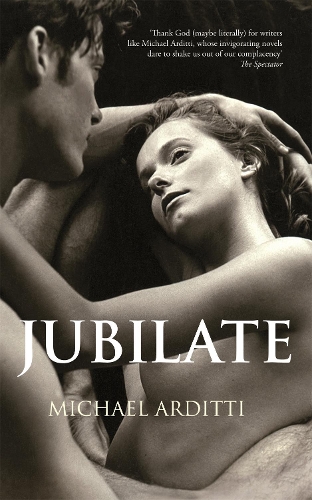
Jubilate
Fiction, General Fiction
Michael Arditti (author)
Paperback Published on: 19/04/2012
Price: £7.99