

Reviews: Jerusalem (7)
“Jerusalem”
(Paperback)
Having never been to Jersualem, this book has really brought it to life for me. I woudn't claim to have any great insight into the city and the friction that attaches itself to it, but I do feel I now have some context on why people get so excited about its value to them, their culture and religion.
The first half of the book was slow going for me, lots of info that set the scene for later, but i struggled to connect with it. And then my pace picked up and the end came too soon. I will leave aside the rose tinted view of the authors relatives as the only lack of balance in the book.
I have already told some friends, if you dont have the time or the patience to read the whole book, just go for the last few pages decsribing the day in Jerusalem from 4am onwards, its fabulous.
“Nor did their swords sleep in their hands”
(Hardback)
The words ‘epic’, ‘sweeping’, and ‘magisterial’ barely do justice to this book. It is an extraordinary achievement, all the more creditable for being so objective toward a subject as contentious as this. It is safe to say that none of the great religions emerges from Montefiore’s account with its reputation enhanced. The purer their motives - and there is nothing ignoble in seeking to tread the ground on which Solomon built his temple, Christ died for our sins, and the Prophet conversed with angels - the bloodier their deeds. It’s an unusual page in ‘Jerusalem: The Biography’ that does not have on it some atrocity, some cruel and unconscionable act that makes one ashamed to be a human being. As the books of Fada-il say, a sin committed in Jerusalem is the equivalent of a thousand sins, and a good work there equal to a thousand good works. It seems to me the proportions are slightly wrong there. A good work in Jerusalem is surely worth a million good works elsewhere, if only for its novelty value.
Montefiore starts as he means to go on, with a prologue describing the fall of Jerusalem in 70 AD. As the panic-stricken inhabitants fled the city, their stomachs swollen with unwisely swallowed coins, the Roman soldiers sliced them open and searched their guts for gold. The Jews, who had only held Jerusalem for a thousand years or so, after King David had kicked out the Jebusites and installed the Ark, were not to return for another two millennia. In their place came the legions of pagan Rome, Persia, Byzantium, Islam; and then the Crusaders, who eclipsed in outrage and slaughter all who had gone before. Interestingly, Juan Carlos of Spain still bears as one of his honorifics the title ‘King of Jerusalem’, although I expect he keeps very quiet about that during state visits. It’s the kind of thing that nobody, Israeli or Palestinian, would thank him for bringing up.
Even during its years of relative peace, Jerusalem could always be relied on to dishonour and soil the name of religion. Under the crumbling yet benign rule of the Ottomans, pilgrims would pay to spend the night in the Church of the Holy Sepulchre, certain that any child conceived in so sanctified a place would be especially blessed. It does not seem to have occurred to them that their Lord might not look kindly on His tomb being used as a sacred love shack. Fortunately, or not, Christianity then recedes from the picture, and Jerusalem becomes what we know it for today, the flash-point of the most bitter and intractable dispute of the modern age.
It’s a mark of Montefiore’s even-handedness that in spite of his family’s involvement in the Zionist movement - Sir Moses Montefiore was one of its leading figures in the 19th century - I could not tell which side he is rooting for, Arab or Jew. Extremists in both camps have all disgraced themselves at one point or another. Indeed, by the end of this vivid, enthralling book, I’m sorry to say I found myself agreeing with one of the last British administrators (Lloyd George had taken it at the end of the Great War, principally to annoy the French), who said “I dislike them all intensely. Beastly people”. Well, we were sent on our way in 1948, and now they will have to sort it out by themselves. I wish them luck. But I can’t help feeling, whatever Blake might have said on the matter, that it wasn’t necessarily a bad thing for Jerusalem to be built where it was. Our green and pleasant land certainly dodged a bullet that day.
“Satisfyingly Deep”
(Paperback)
If you thrive on detail, this account will not disappoint. All the players, great and small, seem to make their entrances and their exits. Sadly, hardly a page goes by without a large measure of human suffering, all too often 'justified' at the intolerant end of a religion's spectrum. I personally felt that coverage of the various religions' impact on the city and its people was balanced, 'good' and 'bad' clearly evident at times and at other times at the discretion of the reader. The (necessary) wealth of detail and number of characters was at times overwhelming but having finally reached the end of a very satisfying book, I can without hesitation recommend it to others interested in the history of the city and I will myself certainly be reading it again in the not too distant future.
“Nor did their swords sleep in their hands”
(Paperback)
The words ‘epic’, ‘sweeping’, and ‘magisterial’ barely do justice to this book. It is an extraordinary achievement, all the more creditable for being so un-biased toward a subject as contentious as this. It is safe to say that none of the great religions emerges from Montefiore’s account with its reputation enhanced. The purer their motives - and there is nothing ignoble in seeking to tread the ground on which Solomon built his temple, Christ died for our sins, and the Prophet conversed with angels - the bloodier their deeds. It’s an unusual page in ‘Jerusalem: The Biography’ that does not have on it some atrocity, some cruel and unconscionable act that makes one ashamed to be a human being. As the books of Fada-il say, a sin committed in Jerusalem is the equivalent of a thousand sins, and a good work there equal to a thousand good works. It seems to me the proportions are slightly wrong there. A good work in Jerusalem is surely worth a million good works elsewhere, if only for its novelty value.
Montefiore starts as he means to go on, with a prologue describing the fall of Jerusalem in 70 AD. As the panic-stricken Jewish inhabitants fled the city, their stomachs swollen with unwisely swallowed coins, the Roman soldiers sliced them open and searched their guts for gold. The Jews, who had only held Jerusalem for a thousand years or so, after King David had kicked out the Jebusites and installed the Ark, were not to return for another two millennia. In their place came the legions of pagan Rome, Persia, Byzantium, Islam; and then the Crusaders, who eclipsed in outrage and slaughter all who had gone before. Interestingly, Juan Carlos of Spain still bears as one of his honorifics the title ‘King of Jerusalem’, although I expect he keeps very quiet about that during state visits. It’s the kind of thing that nobody, Israeli or Palestinian, would thank him for bringing up.
Even during its years of relative peace, Jerusalem could always be relied on to dishonour and soil the name of religion. Under the crumbling yet benign rule of the Ottomans, pilgrims would pay to spend the night in the Church of the Holy Sepulchre, certain that any child conceived in so sanctified a place would be especially blessed. It does not seem to have occurred to them that their Lord might not look kindly on His tomb being used as a sacred love shack. Fortunately, or not, Christianity then recedes from the picture, and Jerusalem becomes what we know it for today, the flash-point of the most bitter and intractable dispute of the modern age.
It’s a mark of Montefiore’s even-handedness that in spite of his family’s involvement in the Zionist movement - Sir Moses Montefiore was one of its leading figures in the 19th century - I could not tell which side he is rooting for, Arab or Jew. Extremists in both camps have all disgraced themselves at one point or another. Indeed, by the end of this vivid, enthralling book, I’m sorry to say I found myself agreeing with one of the last British administrators (Lloyd George had taken it at the end of the Great War, principally to annoy the French), who said “I dislike them all intensely. Beastly people”. Well, we were sent on our way in 1948, and now they will have to sort it out by themselves. I wish them luck. But I can’t help feeling, whatever Blake might have said on the matter, that it wasn’t necessarily a bad thing for Jerusalem to be built where it was. Our green and pleasant land certainly dodged a bullet that day.
“Jerusalem”
(Hardback)
I found this books absolutely essential whilst working on a similarly themed project, presented as a biography it was so easy to read and absorb. The style of writing that Simon Sebag Montefiore uses was a key feature which made this book gripping and impossible to put down!
Page of 2
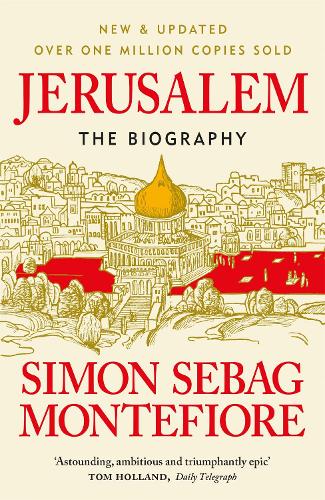
Jerusalem: The Biography – A History of the Middle East
Non-Fiction, History , World History , Middle Eastern History
Simon Sebag Montefiore (author)
Paperback Published on: 17/09/2020
Price: £14.99