

Reviews: In a Different Key (2)
“Got lots in it about how Autism / Asperger's has been researched”
(Paperback)
It’s divided into 46 chapters and so can be comfortably read in lots of short chunks. I have High-functioning Asperger’s and as is my particular wont I did it in two great chunks with a long gap in-between.
It is in a populist style, not ‘tabloidy’, but certainly not academic. I was definitely drawn into the story, the characters, and for once it is made clear who is doing what to whom, and why. Far too many writers, in all genres, write for normal people and make great assumptions about what readers can themselves assume. Some of us need to have other people’s motivations made explicit as that’s precisely what we can’t work out.
I fond the back stories to be a good read. This is unusual as I would normally be wanting to get on with the facts to the detriment of what I usually consider to be waffle. That I was actually interested says a great deal for the interesting stories and how well they are written. It compares favourable with “Operation Mincemeat” by Ben Macintyre in that respect.
This also explains why the narrative ‘jumps’. Each major section deals with a significant way in which autism / Asperger’s was / were treated. Major characters / players are introduced, and as such, one has to go back into their own personal timelines. I normally get confused when there are lots of people involved, hence I do not watch Game of Thrones, etc, but here I could keep up with each person / group of people being introduced with their back story. Given how many people participate, it would be even worse if this was written in a straight chronological sequence.
Wakefield and his MMR ‘research’ is thoroughly debunked in cool, calm, collected language, in which it becomes clear he had a hidden agenda and faked the results, causing a lot of mess and a lot of unnecessary suffering, especially among the children who caught preventable diseases because their parents were scared of immunisation. Yes, it is true that the cause(s) of autism is / are currently unknown, but that does not mean one can go around with an unnecessarily paranoid view of whatever is this week’s ‘fad’.
I did not experience any excessive rejection of other countries. Plenty of other British researchers are mentioned in positive ways, eg Lorna Wing, Uta Frith (who did some of her work here), and Prof S Baron-Cohen, as well as those on the European continent who did work in this area. If there is an emphasis on America then it is because the Americans have done more research that anyone else, not necessarily for the right reasons.
There is no clear statement of how autism / Asperger’s manifest itself, because this is a book about how the condition(s) have been discovered and treated, not a diagnosis book, of which there are many. It is also apparent that one of the major problems is how the condition(s) is / are described / diagnosed has varied considerably, not only over time, but also between doctors, researchers, etc at the same time.
What does come out towards the end is how much better it is for those with these conditions now that we are able to speak for ourselves, especially when we are properly *listened* to, and finally given the right conditions to live in, the support and jobs we need, etc. There is still much more work to be done in accommodating our needs, eg closed rooms at work, an end to internal politicking, and end to bullying, etc, but finally it seems the message of our potential is beginning to get through.
And as for the “Defeat Autism Now!” brigade, not all of us wish to be fixed / cured: a) how do you know the good bits won’t disappear too, b) given the anti-social tendencies of normal people, why would we want to be like some of you anyway ? This book reinforced my view that those parents who want their autistic children fixed / cured are the ones who resent having an autistic child, so it’s not about proper altruism: it’s rank selfishness that they didn’t get the child they wanted.
If there are criticisms to be made, they are the following :-
1) my copy is on cheap, nasty paper that will go yellow and brittle quickly,
2) the type is quite small,
3) at 600+ plages it can be difficult to hold, it really needs to be reformatted and issued as that format half-way between paper- and hard-back,
4) the notes are at the back, but how is one supposed to know there is a note for page X at the back when there is no indication on page X to that effect ? I’m so tempted to go “Silly normal people making assumptions of knowledge again”.
Please read this book, then please go and be more supportive of societal change that stops treating us so badly.
“Amazing, Intriguing and Absurd”
(Hardback)
ou know how too many Americans think that the US is the centre of the world? Well, to all intents and purposes this book makes similar assumptions and rarely ventures beyond North America. Despite being subtitled 'The Story of Autism' it is largely the story of autism amongst the English speaking nations, chief amongst those being the United States. This can make the book feel uncomfortably claustrophobic at times but don't let this put you off a surprising, joyous and enthralling piece of reportage. Parents of children with autism would certainly find this a useful and thought-provoking read but you can read this without any prior understanding or concern for the condition. It is a simply a complex story told exceptionally well by the two authors, that takes us from the earliest diagnoses of the disease to the contemporary issues that are vexing the 'autism community.' This is no dry history but a wonderfully rich tapestry of mistaken researchers, obstinate parents and a host of children and adults who have been diagnosed with autism. There is a good deal of scandal and shock that makes this a surprising page-turner. There is certainly a great deal of altruism amongst the doctors and scientists who have nurtured whole generations of those on the autistic spectrum and helped their parents to deal with the diagnosis. It often doesn't matter that the authors deal only with personalities from the US since autism is not defined by national boundaries. Unfortunately, clinical policy is and sometimes we are treated to the inner workings of the federal government which will be of little moment to readers in Australia or the UK even though they are often fascinating. The book does take a brief excursion across Britain, although it rarely leaves the confines of London but in this short section we discover just how much Britain has added to the science of autism for good and ill, since Andrew Wakefield, once a London researcher, turned the world of autism on its head by claiming that infamous link between vaccination and the condition. The early research into autism is fascinating and at times alarming but as we progress into the 80s and 90s there is a great deal about the politics of autism and the American societies that clashed over the direction of the research that strikes an absurdist note. This is a sad, and pretty dull interlude in an otherwise good book and demonstrates the problem of placing the US at the forefront of the narrative. Foreign readers, probably even US readers, will get bogged down in this section which should have been abbreviated. This is the book's biggest fault because the remainder is a fascinating story, well told. The other issue I have with the book is that it has too much North American optimism shining through. We are rarely given a negative story about a person with autism and when they appear they tend to quickly fade into the background. It isa not often we are exposed to some of the appalling consequences of the condition itself and the book ends suggesting continued progress and possibilities for those with autism. That is not necessarily going to be the case.
Page of 1
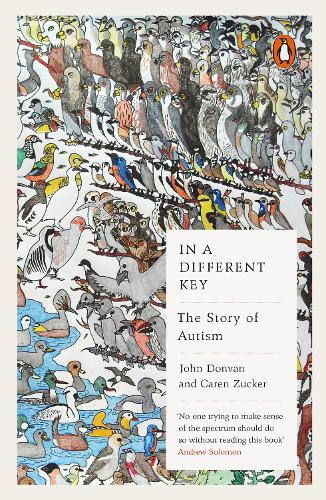
In a Different Key: The Story of Autism
Non-Fiction, Health & Lifestyle , Popular Medicine , Illness & Specific Conditions, Science, Study & Work
John Donvan (author) , Caren Zucker (author)
Paperback Published on: 30/03/2017
Price: £16.99