

Reviews: Illuminations (2)
“Really difficult book, but worth it”
(Paperback)
I picked up this book having only read "The Work of Art..." once in university, but soon I was drawn to other discussions and essays that he had. His concept of the Angel of History, his assessment of Kafka and his serene discussion of his library all strike a chord with me, and are life-changing for me personally. The sheer image of the Angel of History being swept away in the storm is powerfully moving, especially once I looked it up and saw the original painting. I wonder if the context of world history at the time had any influence on the way he saw history or not. Because what really is it, the Angel of History?
“Semiotic player of signs?”
(Paperback)
Hannah Arendt's arresting introduction explores the milieu of the German-Jewish authors predating Naziism but experiencing anti-Semitism; and some living through the Nazi era, attempting to escape. One person, who committed suicide at the border of France and Spain in 1940, is a case in point of how the German Nazi regime destroyed the essence of what one could name as a writer of 'mittel Europa'. It's not such a serious, lumpen, manner of description but if any critic saw a social mien then it could reasonably be the Jewish emigre or the Viennese context. Walter Benjamin's fine essays here reveal a reasonably thoughtful man and someone who exposes both his thought processes with an insight of sharp critical theory. Arendt fusses about his posthumous fame while saying it is an unjust form of fame; it is better than nothing. How can one man change his world and others if he should be alienated and expelled from his own context, thrown asunder via hatred and racial politics. Benjamin is someone I've known about for nearly 40 years. Reading his account of Kafka -it shows a critique of Kafka's shaping of narrative in his novels and the crucial element by which Kafka wrote to his friend-agent Max Brod telling him to destroy his writings upon his death. Brod never did and in later communication explained why (written about in the essay following Kafka). I believe that to contradict Franz Kafka's wishes, is, in this case, a positive outcome for the history of literature in Europe, and certainly in German speaking communities. There is discussion about the role of the author; the structure of narrative; and influence and legacy. Kafka wasn't a prophet Benjamin considers, and shows his writing (Kafka's) is fundamentally a writing of Kafka's own psychology in the setting of familial relationships. Why Kafka wanted his unpublished works destroying isn't explained. Benjamin has considered in another essay the reality, the effect, and the meanings of time and space as situated around Proust. A fine essay he analyses the makeup of the 7 part 'À la Recherché du temps perdu' settling upon the 'image' (or idea) of the French author. Can a writer be a cipher or mere semiotic player of signs? Proust is seen as a man who writes his own narrative because he is compelled to write everything about his own existence and yet also say that existence goes without writing a narrative. His overflowing pages on thoughts and themes dress a story about the capsule of time, there is disclosure against bourgeois morality and life as it is in a city, a place. Proust is Charles Swann, he also writes himself through a form of energetic madness (to paraphrase Benjamin). The heralded essays here are very interesting indeed. The least memorable one is about collecting books. His essay on Brecht's epic theatre is certainly evidence of great understanding and a true appreciation of Brecht's formula for communistic theatre. Brecht later lived in, and was celebrated by government, in East Germany. Benjamin was only 48 when he took his own life at the French/Spanish border (if he had waited one more day he would have been allowed into Spain and escaped the clutches of the Nazis). Certainly talented; his writing would fit nicely into a publication like The Times Literary Supplement. Or the Sunday Observer. I enjoyed his arguments and language (translated by the efficient Harry Zorn); the pursuit of truth or correct critical distance. 'Illuminations' certainly are. The mechanical reproduction of art is central to the thought processes of Benjamin; in this celebrated essay he argues that the political has entered art and that film, images, media, all have a mass to them. The masses will fight in mass wars; the reproduction of images tallies with the mechanisation of war. The notions of history and place also come under his aesthetic of scrutiny. Benjamin is a fine writer; tragically underused due to racial politics and a continent boiling in the madness of political totalitarian insanity and the struggle to balance democracy with existential societies.
Page of 1
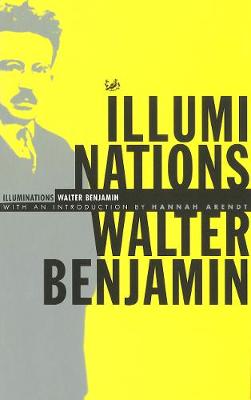
Illuminations
Walter Benjamin (author) , Hannah Arendt (volume editor) , Hannah Arendt (author of introduction) , Harry Zohn (translator)
Paperback Published on: 07/01/1999
Price: £12.99