

Reviews: Hunchback (37)
“Uncomfortable and thought-provoking”
(Paperback)
This may only be around 100 pages long but it's one of the most confronting 100 pages I've read. The narrator, Shaka, suffers from a debilitating muscle condition that has made her housebound with a severely twisted spine crushing her lungs and limiting her movement. She's not looking for pity but is angry about the way she and other disabled people have been written out of Japan's national narrative.
But this book is more complicated than that because Shaka also details her embodied experience, putting her body on display for the reader so that I was caught between a horrible sense of my own curiosity and a shameful feeling of voyeurism that is acutely unsettling.
To ramp up the discomfort, Shaka is immensely wealthy - she owns the care complex in which she lives and can afford the technology she needs for her online writing life and to enable her second degree. She gives away her profits in a philanthropical move - but is herself suddenly confronted by one of the care workers who is badly paid and who wants some of her cash. The whole issue of different forms of privilege and disadvantage thus explodes into the narrative and creates a transaction dynamic where it's really not clear who is abusing or exploiting whom.
I appreciated the whole way Ichikawa opens up this subject matter, not least the issue of sex and desire. She also makes disability individualised in a productive way, while making us think more widely about how it may react intersectionally with other forms of privilege or its lack.
This isn't a comfortable book - and nor should it have to be. But it is uncomfortable in the best, widening, thought-provoking way.
“Four stars!”
(Paperback)
Saou Ichikawa’s Hunchback is a groundbreaking novella that defies convention and challenges societal perceptions, offering a bold and unflinching portrait of desire, identity, and humanity. Written by the first disabled author to win Japan’s most prestigious literary award, this extraordinary work provides a unique and provocative perspective rarely explored in contemporary fiction.
The story follows Shaka Isawa, a middle-aged woman born with a congenital muscle disorder that severely curtails her physical mobility. Living in a care home, Shaka navigates life with an electric wheelchair and a ventilator. Yet, her life is anything but confined. Through her studies, irreverent tweets, and salacious posts on an erotica website, Shaka refuses to be defined solely by her disabilities. Her sharp wit, unfiltered thoughts, and unapologetic exploration of her sexuality reveal a character as complex and multifaceted as any other.
The narrative takes an unexpected turn when a new male carer admits to having read Shaka’s erotic stories. What ensues is an audacious and provocative proposal that forces both characters—and readers—to confront their assumptions about power, autonomy, and the intersection of vulnerability and desire.
Ichikawa’s writing is fearless, diving into the grotesque and the titillating to present Shaka not as a figure of pity but as a fully realised individual capable of difficult, uncomfortable, and deeply human thoughts and actions. By doing so, the author dismantles stereotypes about disability, pushing readers to see beyond the physical and confront their own biases.
The novella’s brevity enhances its impact, packing a powerful emotional punch in a succinct narrative. Ichikawa’s ability to weave complex themes—identity, desire, and societal marginalisation—into an engaging and thought-provoking story is remarkable.
Hunchback is not merely a tale of disability; it is a profound exploration of what it means to exist on the margins of society, and how one can assert their humanity in a world that often looks away. Shaka’s story is both unsettling and liberating, a testament to Ichikawa’s willingness to challenge boundaries and provoke thought.
This is an essential read for those interested in bold, unconventional narratives that illuminate perspectives often left unexplored. With its daring subject matter and deeply human themes, Hunchback secures its place as one of the most significant Japanese novels of the 21st century.
Read more at The Secret Book Review.
“A thought provoking book”
(Paperback)
Settled on 4 stars. Did I enjoy the book? Still not entirely sure. Am I glad I read the book? Yes, definitely. Reading I found the story has an interesting narrator and I suppose protagonist- a quadriplegic woman suffering from a degenerative congenital condition. You are dropped into her adult life which revolves around sexual escapism writing and blogging, and also her home life circumstances. She has plenty of money, but would give this up for a what she sees as a normal female life. I was forced to consider her perspective about quality of life for those with major disabilities. This point is even more interesting since the author is disabled; is this totally fiction or partly auto-biographical? Or is this question unfair since all authors put part of who they are into every book they write, disabled or not. Thank you to Penguin General Uk - Fig Tree, Hamish Hamilton, Viking, Penguin Life, Penguin Business and NetGalley for the ARC. The views expressed are all mine, freely given.
“Interesting and multifaceted novella”
(Paperback)
I wanted more, I loved Shaka. It gave such insights into the life of a disabled person, it is dark, funny, I felt uncomfortable, shocked and haven’t stopped thinking about it.
“Thought-provoking and honest”
(Paperback)
For a slim book, Hunchback by Saou Ichikwawa certainly has an unexpected impact. On completing it I was totally unsure about what I had read, but seem to have been thinking about it quite a lot today. It feels like a snapshot within the life of a woman who is severely physically disabled and living in a care home. Her life consists of the routines of care, and the limitations that this can bring. This is all presented with acceptance and practicality, almost challenging the reader to share in her intimate and uncomfortable details, as if to say “you can experience this through me”.
Her inner life is in contrast to the restraints of her body, as she studies, but also writes erotic articles and tweets her inner longings. I found there to be a humour in the writing of the sex scenes, and it certainly opened my eyes to some of the sub-sets of Japanese erotica! This is a woman with a rich inner life, and wealth to maintain her care, whilst craving experiences and a sense of normality.
The story certainly challenged me to think about the little things that I take for granted - such as reading a physical copy of a book, but to also make me think about those who are unable to fully participate in society, and whose physical needs remain unfulfilled. It may not have been a straightfowardly enjoyable read, but was provocative and thought-provoking. A great book to promote discussion at a Bookclub and translated by the wonderful Polly Barton.
Page of 8
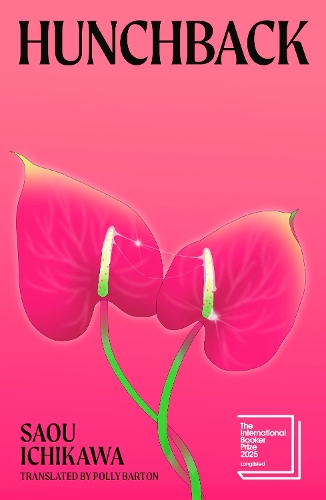
Hunchback
Fiction, General Fiction
Saou Ichikawa (author)
Paperback Published on: 06/03/2025
Price: £10.99