

Reviews: Hunchback (37)
“A strange read”
(Paperback)
This was quite an uncomfortable read which I think was a deliberate choice by the author. It’s a good book, but not plot driven, with a lot of the 100-ish pages taken up with descriptions of the protagonist’s day to day struggles as part of her disability. Some of the descriptions were quite visceral and off-putting to me, and I felt like it stopped just as it started. I did enjoy the writing style and the book challenges ableism, especially in academia and in the literary community, very well.
“Interesting but sometimes uncomfortable”
(Paperback)
Hunchback is a short novel featuring Shaka, a Japanese disabled woman in her forties, living in a care home and secretly writing erotic fiction. Shaka has an unusual position in the care home as, due to her rich parents, she actually owns the facility.
The novel is an interesting look at disabled people's place in society, and how others treat their agency and sexuality. I enjoyed it, although it made me quite uncomfortable at times.
“Uncompromising, unsettling but unforgettable.”
(Paperback)
Longlisted for the 2025 International Booker Prize
It is translated from the Japanese “Hanchibakku” (the author’s debut novel) by Polly Barton.
A novella (short even by the standard of this longlist, with less than 100 generously spaced, large typeface pages) – but one which while it may be very short in length but is long in defiance in its deliberate defiance of ableism in publishing, sexuality and wider society.
It opens provocatively with five pages of quickly dashed off soft-porn – but when we switch to its author (our first person narrator) – our orientation and understanding is immediately challenged when we read “While I’d been concentrating on getting to the end of the article, mucus had built up in my windpipe, and the alarm on my Trilogy ventilator was chirruping furiously”.
The author has said that the book is 30% autobiographical, 70% fictional – the autobiographical part reflecting that she and the book’s first party protagonist Shaka (the Japanese name for Buddha) Izawa both have congenital myotubular myopathy – a genetic disorder causing muscle weakness and leading to difficulties with general mobility, sustaining body posture and breathing (including the clearing of mucus) and which has lead both to have relied on a respirator since they were teenagers.
Shaka we quickly establish lives in a care home which her parents own (she is from a financially privileged background, although that does little to ease her physical inheritance).
As well as her posting of stories to a website – more for something to do than money she does not need – she also enjoys composing (and sometimes after reflection) posting provocative tweets about her condition.
One of these has her speculating on her ultimate dream of getting pregnant “like a normal woman” and then having an abortion given she could not carry a baby (and then ruminating on how abortion law had first lead to a conflict between women’s rights and disabled rights groups, before they came together)
And in terms of the confrontation of ableism, and as well as its clear aim at the disability-discriminatory aspect of Japanese society (frequently contrasted by her with other countries) the character reserves her particular ire (and I believe shares the author’s views) on the (Japanese) publishing industry and at readers complacent in their privilege:
To say too much more about the book would not be appropriate given its length, but when a male carer turns out to be effectively stalking her erotic stories and she-had-assumed-anonymous tweets, he offers to help with her wish which leads to as uncomfortable a scene as I have read in a prize winning and prize listed book.
Uncompromising, unsettling but unforgettable.
“One that I won't forget”
(Paperback)
Often when I read Japanese (translated) literature, I come away with a general feeling of detachment. This was anything but.
Confrontational and unsettling, Saou Ichikawa explores the complex stigma around disability and sexuality. With a provocative narrative you are forced to see Shaka as so much more than the label of disabled.
It's an uncomfortable read, purposely so, but it's definitely one that I won't forget.
“An interesting read”
(Paperback)
Longlisted for the International Booker Prize. Shaka has a congenital muscle disorder and uses a wheelchair and a ventilator. In her care home she studies and at one point she makes a comment about readers crushing the spines of books - a thing that her body is actually doing to her own spine. She also posts on an erotic website under a pseudonym. When a new carer tells her that he has read her posts, she has an indecent proposal for him. This story is set during the pandemic when contact with the outside was prohibited. There are graphic scenes of Shaka using medical equipment to ease her breathing as well as scenes of a sexual nature. Within the novel, the author, who herself has this same disorder, addresses the stigmas around disability and sexuality. It also looks at power and privilege and power, especially in the relationship between Shaka and her carer. In fact at one point there even seems to be a blurring so that you wonder who is the abused and who is the abuser. As for the ending - I think it is open to interpretation - it is ambiguous. An interesting, short read in which the author is showing us that she is fully human.
Page of 8
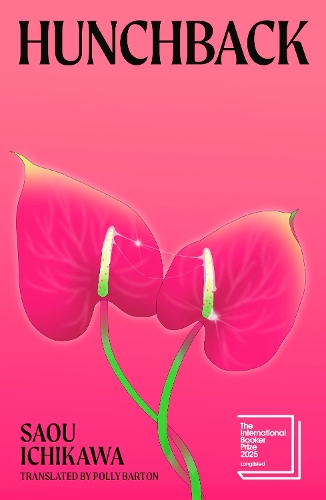
Hunchback
Fiction, General Fiction
Saou Ichikawa (author)
Paperback Published on: 06/03/2025
Price: £10.99