

Reviews: How to be Both (6)
“Stunning, wise - one of Ali Smith's best”
(Paperback)
Ali Smith is one of the most lauded and garlanded British authors working today, and this novel shows her at the height of her powers. Divided in half, and published roughly so that half of readers will read one side first, the others another, it's experimental and daring, without sacrificing warmth and humanity. The stories are radically different - one following a grieving teenager in present day Cambridge, the other a Renaissance fresco painter, but the stories glance at each other in unexpected ways. Impressive, challenging but moving - I urge you to read and savour it.
“An amazing book in an unusual format”
(Paperback)
Two stories, two points of view, two ways of looking at life in different times. This is a 2014 novel that has much to say about so many subjects, and famously switched the order of the halves in different copies. The copy I tackled had the 1460s section first, before the near contemporary section. Thus mine was in chronological order, but everything else was flexible. The 1460s section is a sort of stream of consciousness story of a painter, who is brought up to make the bricks that construct the buildings around them, but learns of the way they can be painted, can be used to capture something of a person, an angel, a creature. Not that it is easy; paints cost money or at least the colours to make them, and not every one appreciates their value, their true cost to a painter. “Cause that’s all the life of a painter is, the seen and gone disappearing into the air, rain seasons, years, the ravenous beaks of the ravens. All we are is eyes looking for the unbroken or the edges where the broken bits might fit each other.” The painter looks back on their life, not knowing the end or the beginning of it, recognizing people, places, paintings, emotions and so much more. The glimpse of a woman, the walls around them, the way that life and paint could flow. The episode where the painter is asked to paint walls in a palace, to capture gods, angels and people to avoid a boring blank space, and the vital question of whether someone who paints better should be paid more. This is a vivid insight into a world of art and uncertainty, and so much more.
The second half of the book in my edition features a teenager called George. It often features dialogue written to tell the story. It is a script – like construction, with digressions into George’s though or descriptions. This is appropriate in a way; George’s late mother is the main character and she was an avid internet user who created “Subverts”, small pieces that would pop up with slogans challenging the status quo, often based on art subjects. George has pictures, a tiny bit of film, and so many memories of unusual conversations with her mother, who challenged so many assertions made by her thoughtful teenager. Impulsive and brilliant, George’s mother tried to get George to think, to appreciate art, to think about her attitudes. George tries to recreate her dancing, her language, her concerns, but is aware that essentially her mother has gone. A big adventure is to see a piece of work, paintings, that depict strange challenging figures, non specific in their way, along with the moral question as whether an artist should be paid more if the paintings are better. “Is it me or is it the work that’s worth more? George says”. There are so many points to think about, some specific to George, some questions that are for the reader to think about, overall a touching portrait of a young woman trying to reconcile death, art and so many other questions.
This is an unusual and thought provoking book which challenges the reader throughout, not just in terms of format but also in terms of content, as both sections ask so many questions. Time, chronology and so much more is a slippery concept in this book. It is a memorable and intense book, a real triumph of the novel to challenge every boundary, and to create real reactions in every reader.
“A novel of many layers”
(Hardback)
Ali Smith is one of our most skilful writers, and my copy of 'How to be Both' says on the cover that it has been long-listed for the Booker Prize; since then, of course, it has made it on to the short list. Much has been made of the fact that this book exists in two editions, and it's up to chance (or a sneaky look) to determine which you purchase - the novel consists of two parts, Part 1 and Part 1, and the order of these parts varies between copies.
My copy of 'How to be Both' began with George, a teenage girl whose mother had recently died. The narrative in this part hops back and forth in time to give us many insights into George's former life with her mother, and raises questions about the multi-layered nature of life and experience and what it means when someone is no longer with us.
The second half (or first half, depending on your copy) deals with the life of 15th-century artist Francesco del Cossa, about whom little is known. There are lots of connections between del Cossa's story and George's, beginning with the fact that George's mother had been so inspired by seeing del Cossa's work in a magazine that she'd dragged George and her young brother to Italy to see the work properly. With del Cossa's story, Ali Smith again captures a profound sense of life in all its layers, with story upon story co-existing just like the detailed frieze paintings created by del Cossa.
As with all Ali Smith's writings, 'How to be Both' makes us think about and question all sorts of things - including, in this case, gender roles, life and death, love, surveillance and observation. That's not to say that the novel isn't engaging simply as a story - I found both tales very moving and I did feel invested in the people in the book and cared about what happened to them. In this sense, 'How to be Both' works in another multi-level way, serving both as a way of making us think about the grander concepts of life and connecting at an emotional level as a story about love and loss.
“A bit mixed but very good overall”
(Paperback)
Books which are written in an unconventional, experimental way are usually either brilliant or a load of unreadable nonsense. Frankly, I thought this had bits of both, but there was far more brilliance here. I enjoyed it a lot overall and there are some parts which will stay with me for a long time, I think.
As is well documented, the book's two halves are very different and it is a deliberate matter of chance which appears first in your edition. Mine began with the spirit of a female Renaissance artist slowly (and initally incomprehensibly) emerging into consciousness in the 21st Century and being somehow linked to a young woman who is looking at one of her paintings in a gallery, with the second half being the story of George, the young woman in question. The link emerges slowly and the stories themselves overlap only slightly, but they inform each other a great deal. It's a good idea, generally well done.
This is a book about a lot of things, including justice and feminism, friendship and really looking at what we see and how subjective our interpretation of it can be both in art and in the real world. Also, in George's story, there is a beautiful study of grief and bereavement with some genuinely moving moments. There is a finely evoked sense of the seemingly unending desolation of grief, and glimpses of the beginnings of healing with no nonsense about "closure." I thought this section was very good, and quite brilliant in parts.
I found Francesco the painter's section less successful, with a feeling that it got a little tricksy and self-regarding at times, especially early on, but it kept me reading, sometimes longer than I ought to have, which is always a good sign.
I'm not sure this is quite the wondrous masterpiece some have made it out to be, and I can understand why quite a lot of people absolutely hate it, but I enjoyed a lot of it and got a great deal out of it. I'm still there with the characters some of the time, and thinking about what the book has said to me so My advice is to give it a go, and persevere especially if you begin with Francesco. There's a lot of rewarding stuff here and I can recommend it.
“For "advanced" readers!”
(Paperback)
This book has been nominated for countless awards and even won a couple so I decided I wanted to do a little research on it before embarking on the reading. I discovered that this is 2 stories which are linked but can be read on their own, together and in any order. As such the book was published with 2 options, half began with George’s story and half began with Francescos. My copy begins with George’s which is commonly referred to as the easy way in.
The first couple of pages are dense and hard to get into but I never DNF before 30% except in exceptional circumstances so I ploughed on and felt pretty chuffed because I actually ended up really enjoying George’s story. It is told in stream of consciousness style, very reminiscent of Mrs Dalloway, which can be jarring but overall is a powerful narrative choice for this story of a teenager who is grieving the loss of her mother. I would say that this is a tougher stream of consciousness than Mrs Dalloway because of the questions over tense (whether she should be thinking in present tense or past tense) and what is before and what is after, it is all wrapped up together which makes the style both fitting but also a little harder to read.
The ending of that story felt a little flat to me, neither here nor there. But I moved excitedly into Francescos story thinking that I had cracked How To Be Both only to be slapped in the face with a very confusing narrative voice that sapped all the joy out of the reading experience. I carried on for a few pages but could physically feel myself loosing interest, I skipped ahead a little to try a page further down the line to see if it picks up into a narration that flows a little better (like George’s story) but it doesn't. And I hate to say it, but I couldn't be bothered, I couldn’t be bothered to wade through it.
So I DNFd at about the 60% mark. However, I think I am going to keep this on my shelf because I have a feeling that I may want to come back to this in the future and try again.
I would say that this is for experienced readers. Which feels like a weird thing to say but my reasoning is this - some of the books I hated in years gone by, I think I hated because they were difficult to read or poetically written or some such but the more I read the more I start to enjoy these more complex narratives. Equally, those who have studied literature may approach this book and find it utterly compelling and clever in its methods - maybe that is why it has won awards but I don’t think I am there yet. Perhaps the average reader is not the target audience and further that even experienced readers are not the intended audience, but those who have studied complex narratives and enjoy those things. If there are books aimed at beginner readers and the average reader - such as the type of fiction you would find in a Supermarket - why then should there not be books aimed at those who want something complex - after all there is a market for James Joyces’ Ulyses and Finnegan's Wake.
So my answer is this. I did not enjoy this book - I felt that it’s desire to be clever got in the way of an enjoyable read but that I can imagine there being an audience for this book. I do not desire to be the audience for this book, it’s not a goal I’m working towards but equally I would not be sad to find that one day I did enjoy it.
Page of 2
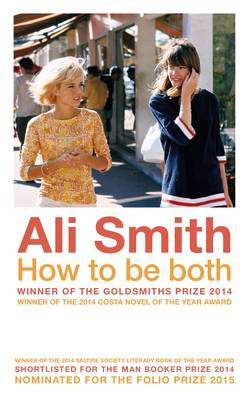
How to be Both
Fiction, General Fiction
Ali Smith (author)
Hardback Published on: 28/08/2014
Price: £16.99