

Reviews: Higgs Force (1)
“May the Force be with you!”
(Paperback)
Opening sentences: "One hundred metres beneath the ground on the outskirts of Geneva, two protons slam into each other in a mighty collision. The tremendous release of energy produces a new particle, the Higgs, unseen since the very earliest moments of the Universe."
Memorable sentence: "Although some of the concepts of modern physics may be strange and even shocking, it is possible to express them in ordinary language, as I intend to demonstrate."
That's the very challenge which author Nick Mee then sets out to meet - and, for my money, he succeeds. I'm no scientist - failed each of my chemistry, physics and biology O-Levels abysmally. Barely managed to scrape through maths. But I am fascinated by science, by the need to understand - at least at a basic level - what makes the sky blue, the grass green, the planets revolve around each other and, indeed, what holds the universe together. And Higgs Force had brought me closer to that understanding in a way that no other "popular science" book has been able since Carl Sagan.
At one level, it's a Bronowski-like historical account of the steps humanity has taken since the time of the Ancient Greeks to get to grips with science and nature, and the giants who made those discoveries... Euclid's Elements, Plato's Timaeus, Newton's Principia, Gilbert's De Magnete, etc. At the same time, the explanation of those discoveries helps us, through Nick Mee's imaginative use of simple English, to build a model of the universe in our heads with all of its constituent parts and their scale. We might all understand that matter is composed of atoms, but did we realise that "one hundred million carbon atoms in a line would stretch a distance of just two centimetres"? By the end, I even understood (a little) what "quantum mechanics" actually means - simply the way in which elementary particles interact.
I understood too that there are two basic categories of elementary particle - the Fermions (including protons and electrons) from which all matter is composed, and the Bosons (including photons) that pass between other particles to produce physical forces like electro-magnetism and thus gravity, etc.
Which brings us to the Higgs Boson. Named after Peter Higgs (born Newcastle-upon-Tyne, England, 1929) who calculated that "space" could not be the empty void that we all imagine but must, in fact, be filled with its own force, a "cosmic superconductor" (don't worry, Nick explains superconductors too!).
Nice theory, but how to prove it? And thus the author brings us, at last, to Switzerland, to CERN, and the Large Hadron Collider. But had the "God particle" really been discovered?
"The big day finally arrived on 4 July 2012. With excitement mounting, at the end of the two-hour long talks, Director General Rolf Heuer summed up with the words: 'If I was a layman, I would say I think we have it - you agree?', and the lecture theatre erupted with cheers and rapturous applause. Peter Higgs, who was in the audience, took off his glasses and appeared to brush away a tear."
Who knows? If Nick Mee had been my science teacher, there might have been hope for those O-Levels after all! There was an added bonus with the book too since, when my ordered copy arrived, it was signed by the author himself. Nice touch! And the message inside? May the Force be with you! said Nicholas Mee. Thanks, Nick. Great book!
Page of 1
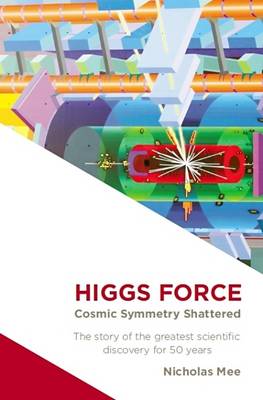
Higgs Force: Cosmic Symmetry Shattered
Non-Fiction, Science, Study & Work
Nicholas Mee (author)
Hardback Published on: 01/08/2012
Price: £19.99