

Reviews: Hamnet (127)
“The story behind Hamlet....”
(Hardback)
I’m always wary of reading books where authors imagine the story behind a real event/character or rewrite a story told many times before. Will they spoil my imagined story or tell a story told so many times before? Well, my worries were unfounded with Hamnet as I was drawn in to the story of Shakespeare’s son. I loved Shakespeare at school but have only dipped in and out since. I’ve been to Stratford a few times to see the house and this really helped me visualise this story.
O’Farrell did two things I really liked with this story. She took a story that is little known and put the son and Shakespeare’s wife at the focal point of it all. Shakespeare himself isn’t actually named in the whole book. This is very effective as the reader’s focus is quite clearly then on Hamnet himself. We are also reminded that Shakespeare was more than just a playright – he had the same family issues and worries we all have. Putting the wife and family at the heart of this story makes them stand out and have their voices heard.
The story of Hamnet is a fascinating one. I did find the non-linear plot a bit confusing though the courtship of Shakespeare and his wife then the story of Hamnet as it would have made more sense written as linear to me. However, overall, the story of grief was and the true behind the scenes look at a family of a famous man was what this novel achieved well for me. The setting, time and place were richly imagined but the story of one of the most famous plays and families in the world was a literary experience I enjoyed.
“Grief rendered in exquisite prose”
(Hardback)
Maggie O’Farrell’s Hamnet is a beautifully written, deeply moving reimagining of Shakespeare’s family life and the death of his only son. It blends historical fact with fiction in a way that feels both grounded and haunting. Some parts are hard to read because of the raw grief on the page, but that’s a testament to how powerfully it’s done. Heartbreaking and unforgettable.
“A book with potential that just didn't quite land for me”
(Hardback)
I am clearly in the minority on this one but Hamnet was just above OK for me. On paper, I should have loved this book - it's got a lyrical writing style with a focus on characters but, unfortunately, for me it failed on the execution. The first half of the book in particular was over-written. It relied heavily on long sentences with each clause expanding on the original idea until I felt I was being bashed over the head with it. I enjoyed the second half more than the first but by then the reading experience had already started to feel like a slog.
So what's the story about? It's mainly about Agnes - Shakespeare's wife. Shakespeare himself is never named in the book and we only learn about him from the perspective of other characters. With so little known about Agnes (more commonly referred to as Anne Hathaway), O'Farrell was free to use her creative license to create her own version of her. The character she created is an intriguing one who does not play by the rules of the society she lives in. However, one thing I found frustrating about O'Farrell's depiction of Agnes was the use of the wise woman/witch/healer trope. I was disappointed that in order to make Agnes powerful or to give her any kind of agency the supernatural had to be evoked.
The book is also the story of Hamnet - Agnes and Shakespeare's son - who died when he was just a child. 4 years on from Hamnet's death, Shakespeare wrote one of his most famous plays - Hamlet.
Hamnet is not always an easy read - death, marriage and grief are just some of the issues touched on but I never found it to be a morbid read which perhaps, on reflection, was the novel's greatest strength.
“Wonderful writing, but a shaky plot”
(Paperback)
I see many reviews of this book (and the film that is now out) which talk about it being the story of Shakespeare and his family. I would make the case strongly that it is no such thing. As the author says, she invented this work of fiction, inspired by the single fact that playwright William Shakespeare had a son called Hamnet who died in childhood.
The real Hamnet had a twin sister called Judith and an elder sister called Susanna. There is a play called Hamlet (a name that readers are told was interchangeable with the name Hamnet) that is attributed to the children’s father. These facts feature in the novel. The rest is pure fiction. I believe that Maggie O’Farrell has tried hard to underline this in two ways. Firstly, the mother of the children is called Agnes rather than Anne (the name by which Shakespeare’s wife is usually known). Maggie explains she made this choice because Shakespeare’s wife was called Agnes in her father’s will. This could easily have been a mistake, as so often happened in handwritten documents. I believe Maggie did this to deliberately separate the fictional Agnes, a wild spirit of nature, from the real Anne Hathaway of whom we know so little. Her maiden name, ‘Hathaway’ is never used in the novel. Secondly, the author makes the choice never to refer to the children’s father as ‘William’ or ‘Shakespeare’. In the early part of the novel he is referred to as ‘the Latin tutor’ or simply ‘the tutor’. Later he is identified as his father’s son, his wife’s husband or the children’s father. Again, I believe Maggie is reminding us that this story of a marriage – because that is what this novel is about for me – is pure invention.
I cannot speak highly enough of the lyrical, mesmerising beauty of the descriptive writing throughout this book. The author conjures up phrases that catapult us into the dirty, smelly, town streets and the fragrant and beautiful countryside of the Midlands in the 1500s. This novel has been meticulously researched and I cannot agree with people who say these passages slow down the book and required more editing. For me, they are the reason to read this book. Just as important are the passages where she describes those life events that we can all identify with in the 21st century: love, loss, birth and death. The searing descriptions of Agnes giving birth are the most powerful and realistic I have ever read. But I found the plot less impressive.
No-one knows Hamnet’s cause of death and very little is known about the Shakespeare marriage. We do know that William was 18 and Anne was 26 and pregnant with Susanna when they married in 1582. We know that William’s family was mired in disgrace and financial difficulty because of William’s father’s business dealings and that Anne’s family had good social standing and were financially secure. Maggie weaves a believable and compelling narrative about how their marriage comes about. At its core is a passionate, single-minded devotion to Agnes by her young husband. He is obsessed with her; completely and utterly lost in love. This makes me struggle with the plotline that sees him uproot himself (albeit at her subtle instigation) and live virtually all their married life far away from her and their children in London. The real-life marriage of William and Anne was spent apart in this way.
The fragility of 16th century life is reinforced by the early deaths of several Shakespeare and Hathaway close relatives, which have shaped the characters of the lovers by the time they meet. The structure of the novel takes us back and forward in time. It opens with a distraught Hamnet seeking help for his sick twin sister and each chapter alternates from that storyline to the back story of how their parents met and married and began their family. The use of present tense provides urgency and the back story chapters give us an opportunity to draw breath from the painful reality of Hamnet’s situation, which most readers will know is going to end in his death.
My first attempt to read this book was on Kindle. As a fan of the works of Hilary Mantel and other historical fiction, I expected to enjoy it. But I set it aside after 30 pages as I felt I was being manipulated to care for a brave, kind and often mistreated (by his grandfather) 11-year-old boy knowing he was going to die. I felt it wasn’t a story I needed to suffer through. However, much later, I was gifted a Folio Edition of the novel by someone I love deeply and who didn’t know of my failed attempt to read it. It is a beautiful hardback edition, with a handful of delightful, botanically-based illustrations by Becca Thorne, a gilded slipcase and illustrated drop caps at the start of each chapter. It cried out to be read, so I steeled myself and tried again. This time the beauty of the writing matched the physical beauty of the Foilo Edition and overcame my reluctance to be put through an emotional wringer.
But the shaky plot disappointed me. Apart from the husband’s sudden contentment to be apart from the woman he could not live without a few pages ago, there was the matter of the arrival of the plague. There is a powerful chapter that describes in heart-wrenching detail how an abused cabin boy acquires the plaque from infected fleas on an equally abused captive monkey in a distant land and brings the disease back on board his ship. Sailors, and the ship’s cats, are soon dying left, right and centre – as is the way with the bubonic plague. Soon, the plague lands and is carried on goods in many directions leaving death in its wake. In Stratford, young Judith is with a seamstress when she receives a box of beads from Venice, destined to adorn a commissioned dress. They have been carried on the plague-ridden ship and soon Judith is sick with the disease. Yet, we hear nothing of the plague affecting others in the town. Even in the family home, where Judith is nursed closely by her family and the servants, none of them contract the disease, not even the playwright’s parents, whose age should have made them more vulnerable. There is even a suggestion that Hamnet MAY have escaped it but for a selfless, mystical decision he made to fool death and take his twin’s place. After his death, neighbours flock to the house to show their support and sympathy when you might have expected them to stay well away.
The grief of mother and father is shaped with painful accuracy. Yet, it doesn’t stop the father from hot footing it back to London at the earliest opportunity and staying away for longer than ever before. This could be more easily accepted as a reaction to trauma and grief if he had not been absent so much previously.
Then we come to the troublesome matter, for me, of the play that appears to bear his dead son’s name which the real Shakespeare is said to have written some four years after his bereavement. In the novel, Agnes is furious to learn, by accident, of the play called Hamlet and heads to London to confront her husband. She ends up in the theatre watching the play where Hamlet junior meets the ghost of his father, also called Hamlet, a role her husband is playing that night, and she has a revelation: “Hamlet, here, on this stage, is two people, the young man alive, and the father, dead. He is both alive and dead. Her husband has brought him back to life, in the only way he can. As the ghost talks, she sees that her husband, in writing this, in taking the role of the ghost, has changed places with his son”.
The novel then comes to quite a speedy end. Agnes watches to the end and anticipates a loving and understanding reunion with her husband, but her reaction to the end of the play where young Hamlet dies after causing the deaths of his former love Ophelia, her father, and a few others, is unrecorded. It would rather spoil the hasty finale.
I definitely will not be going to watch the film as I feel that without the power of the lyrical writing it will be just a mawkish sob-fest where acting performances, incidental music and direction combine to wring every tear from the audience, despite the wobbly plot.
“3.5 stars”
(Paperback)
I must be the only person ever that did not enjoy this book. I personally thought it was mediocre and I found it extremely hard to connect or even like the main character.
Page of 26
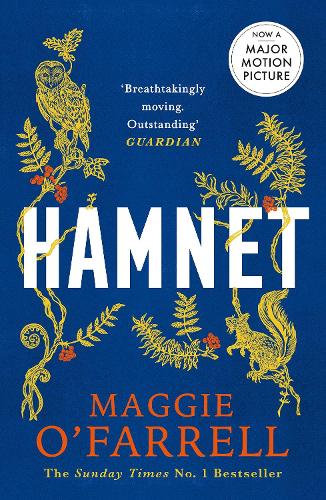
Hamnet
Fiction, General Fiction
Maggie O'Farrell (author)
Paperback Published on: 01/04/2021
Price: £10.99