

Reviews: Hamnet (127)
“Beautiful”
(Paperback)
A beautifully written and touching tale centred around the people who shaped William Shakespeare and one of his most famous plays. I fell in love with the characters in this novel and am still thinking about them weeks after reading the final chapter. I highly recommend Hamnet to any reader, especially those who enjoy historical fiction and classic literature. The writing is captivating and devastating.
“Extraordinary”
(Hardback)
I’m always a little wary about reviewing books as hyped as this one has been, and by authors as revered as Maggie O’Farrell. One wonders if the books, and indeed the authors, can ever live up to the advance accolades they receive, and whether, when the literary establishment is so in love with a novel or novelist, any positive review will be accepted at face value or perceived as just another acolyte toeing the party line. On the converse, would anyone dare post a negative review whilst anticipating the backlash that might ensue? After all, this book has been long listed for the Women’s Prize, a lot of people have rated it very highly. It might make one seriously consider whether just to keep one’s opinion to oneself.
I have to admit that I am not a devotee on this author’s work, simply because I have never previously got around to reading it. I have two of her titles on my TBR, but in the past three years madding rush of blog tours, they have remained there, untouched. So maybe I am ideally positioned to come at this with an open mind and no preconceptions, which is exactly what I did. I also had no expectations with regard to how this would compare to her previous work, I could judge this book purely on its own merits.
The author could not have foreseen when writing this book, which is a book she has said she has wanted to write for over thirty years, that it would arrive on the shelves at a time the world was being touched by a deadly pandemic, arousing in us the kind of fear and panic that is the mirrored in the family at the centre of the book, as they are touched in the same way by the plague in the sixteenth century. In fact, the vividness with which the author recreates this in the novel may strike too close to home for some to bear at this terrifying moment in this history. For others of us, what it manages to do is draw us close across the centuries to those who went before us and show us that, although much in the world has altered beyond recognition in those long, intervening years, human emotions of love, loss, grief, kinship, fear and fortitude are constant and unchanging. It allows us to relate to these long-dead people in a way we might otherwise be unable to do.
Of course, this is largely down to the skill of the author in the writing. The everyday world of Stratford at this time is brought to life in such detail, and with such incisive and graphic description that complete immersion in the story in unavoidable. I was totally transported, living and breathing this experience along with the characters, completely caught up in the emotions and events to the point where I resented being pulled back out to face the everyday. I wanted to stay there, living and breathing and feeling this story until I finished it, harrowing and difficult as that was in parts, because it became so important to me to know how it ended.
This is a very detailed book, full of languorous language, indulgent pacing and descriptions of the minutiae of life at this time. This is going to frustrate some readers, I know. We are used to life at a frenetic pace, we have no patience in the modern day. People’s attention span has been accustomed to sixty second sound bites, memes, instant fixes, instant gratification. We always want to move on, move on to the next thing, never satisfied. But life as we know it has stopped for a while. We have been forced to slow down, take a break, sit back and pause. Use this time to take in a book like this, when enjoying the language and indulgence of expression in this book to take you back to a time when life was slower, more considered and possibly more appreciative of the smaller, lesser pleasures, will pay off in spades with a deeper understanding of how people lived and worked and loved at that time. Allow yourself the space and time to feel the emotion that flows from the pages of this book and seeps in to your bones if you let it.
Anyone coming to this book expecting the story of Shakespeare is going to be disappointed. In fact, the author never mentions his name once throughout. He is referred to as tutor, son, brother, father, husband, playwright, and this is very deliberate, because this is not his story. He is not centre stage, he is not the main protagonist, he is off in the wings, a bit player, the occasional character who wanders in and out of the scene, even to the end where is is the supporting role in his own play, not the titular character. This is the story of his wife.
Anne Hathaway, known in this book as Agnes, as her father referred to her in his will, is the driving force in this novel. It is through her eyes that we see life in Stratford at this time, that we learn about the roles of the womenfolk who held the homes and families together as the men were away working and making the decisions. The heart of the story is in Stratford, where all the action takes place while Shakespeare is in London, and it is she who drives the plot, from the very first time they meet. She is portrayed as a remarkable woman with many skills that were underestimated by her peers, even treated with suspicion in some cases, skills of healing and understanding and uncanny intuition. She is also shown as possessing unbelievable strength of character, allowing her husband to leave her with two small children to go to London because she understands he needs to get away from the constraints of his family, the same family she is left to live within his absence, even though they are not her own. Maggie’s admiration for this unusual woman as she envisages her is apparent on every page. She uses her to show us intimate aspects of small town life in the sixteenth century and, more particularly, what life was like for women at that time. As a historical exploration, it is absolutely fascinating.
The main thing that makes this book so special though, is the portrayal of parental grief on the loss of a child. This is something of which I have personal experience and the depth of understanding the author displays for the thoughts and emotions a parent experiences in these circumstances was profound. Her descriptions aroused in me memories that remain painfully vivid but oddly treasured, it is very difficult to explain how reading something this accurate both hurts and is deeply comforting at the same time. To be so understood, to have such pain acknowledged and explored, explained and transmitted to that fortunate part of society that has never felt it, is oddly consoling. There were scenes in this book that rang so completely true with me that it both broke my heart and gave me succour at the same time. The passage detailing the procession to the churchyard in particular was like reliving a scene from my own life, it made me cry but also provided solace in the form of understanding by another person of this pain. This is what great writing can do, it can make us feel understood, it can make us feel less alone in a confusing and frightening world. Many of us are going to need much more of this in days to come.
I have waxed on at length in this review, I know, but I hope you have come to understand at the end why it is that I am telling you I have immeasurable love and appreciation for this book. Regardless of the hype, it has given me so much on so many different levels that I cannot praise it highly enough. As a historical text, as a celebration of the strength and fortitude of women, as an exploration and acknowledgement of grief and pain, of relationships between man and woman and parent and child, I adored every single thing about it. Every word, every feeling rewarded me beyond measure. It has moved me more profoundly than anything I have read in recent memory and I cannot recommend it highly enough. Read it, not because of who the author is, or because it is being feted high and low, or because it has been listed for prizes, but because it is a work of wonder and you deserve to give yourself the opportunity to experience it for yourself.
“Sumptuous novel set in 16th Century STRATFORD”
(Hardback)
The book opens with:
In the 1580s a couple living in Henley Street, Stratford, had three children: Susanna, then Hamnett and Judith, who were twins.
The boy, Hamnet, died in 1596, aged 11.
Four years or so later, the father wrote a play called Hamlet.
We are given the bare bones of the story in this short introduction and we know that the famous bard appears in the narrative. This allows the reader to just wallow in the storytelling. However, the bard remains nameless throughout, giving him a more shadowy presence. Had he been named, of course, he would probably have taken centre stage but this is not his story. This is the story of his wife, Agnes, who bears him his children and is the rock in the marriage, his enabler. With her tending to the home, he can expand his father’s business and start on the career for which he is known and venerated. The eponymous Hamnet of the title is their son and the glue between the couple, immortalised in the play that Shakespeare went on to write, namely Hamlet.
Agnes is a woman who has other-worldly gifts. She can sense the auras around others, she can somehow see into the future. She has her own kestrel. Others observe her and oftentimes do not feel comfortable around her. Her stepmother is a set piece character and runs her home with a rod of iron. It is not a happy place.
And it is to this woman, Agnes, that the Latin teacher – the Bard’s incarnation in his younger days – is drawn. His own Father is a fairly brutal man and Mary, his wife, is not favourably disposed towards her prospective daughter-in-law.
The story is richly told, of a marriage that is not overly made in heaven but one that works for the individuals at some level. The detail of their lives, their longings, their routines and inevitable losses unfold, but perhaps the overwhelming memory I have of this tale is of the people (and mainly of Agnes) who are very firmly set in the later 16th Century. It is a knife edge period, death is rampant. This is the period when the playhouses would periodically close because the bubonic plague would descend. London, with its dense population, was a dangerous and fundamentally unhealthy place. but the plague also travelled to more rural areas. This is a story of how humans interconnect and how a flea, that boarded a boat, attached to a human in Alexandria, caused mayhem and death around the world.
The novel is full of sumptuous descriptions of life and hardships, the detail of the countryside and interiors is exquisitely drawn. It is in fact quite painterly, as it lingers and sweeps from page to page with great literary brushstrokes. Agnes goes to enormous lengths to find the right medicinal herbs, the characters are caught up in their domestic chores – the scene is set and it all come to vibrant life in the hands of this hugely competent and lyrical writer. The novel is full of atmosphere and a real sense of era, imbued with the smells and bustle of the day.
A top read for 2020
“What a Book…”
(Paperback)
I’d never read anything by Maggie O’Farrell before. Whilst I’d read Shakespeare at school and picked up lots of references in novels set in Elizabethan times, this book was not one I would have rushed to read. One of the staff in my local Waterstones helpfully recommended it. It was such a lovely read. I was completely engrossed from first page to last. Such rich characters, wonderfully descriptive passages and a story that is both heart warming and heart breaking all at once. As soon as I’d finished I did 3 things - I gave the book to my daughter who had it on her wish list, I recommended it to my friend as a title for her book club and I ordered 4 other novels by Maggie O’Farrell.
“Uplifting and Moving”
(Paperback)
Hamnet is a wonderful, uplifting and moving novel, beautifully written and expertly crafted by a writer at the very top of her game. Maggie O'Farrell's depiction of a mother's grief is compelling and heart-rending and her characterisations powerful and pleasing. A work of historical fiction that will live with me forever. Stunning.
Page of 26
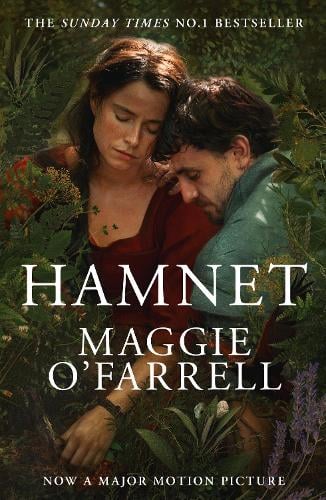
Hamnet
Fiction, General Fiction
Maggie O'Farrell (author)
Paperback Published on: 23/10/2025
Price: £10.99