

Reviews: Germania (2)
“Pass the Duchies on the Left Hand Side”
(Paperback)
It’s anyone’s guess why, but for some years now the words ‘fun’, ‘german’, and ‘history’ haven’t exactly been natural bedfellows. Never mind the same sentence, it comes as a shock to find them sharing the same dictionary. Well, if anyone can change that, it’s Simon Winder. His ‘Germania’, an exploration of the wackier corners of teutonic history and culture, is 440 pages of sheer joy. Wandering, anecdotal, and splendidly discursive, it’s like listening to the world’s most enthusiastic tour guide.
Rest assured though, this isn’t a ‘Come to Germany, Europe’s Last Undiscovered Paradise’ book. Winder admits that the countryside is often drab, and the food execrable. He seems to have visited every single schloss and municipal museum mainly so you don’t have to. ‘I’ve probably been in more Ratskellers than most people in the world’, he confesses at one point (they’re a kind of bar-restaurant-bunker safely hidden from tourists under town halls), ‘and sometimes I can almost feel myself metamorphosing into a fat-necked, glassy-eyed and complacent townsman in traditional costume, wiping the back of my head with a napkin as I launch, breathing heavily, into a further, monstrous plate of thick bacon, sauerkraut and pan-cooked potatoes, drained down and emulsified by vast bocks of lager or a candlelight-filled glass of Riesling’.
What really interests him are the duchies, margravates and bishoprics that made up Germany for so much of her history, and the glorious eccentricities of those who governed them. ‘There were simply so many of these rulers and with such wide interests that anything could happen. Even within each major Schloss there is often this same air of fevered diversity, of stylistic chaos, inadequate funds, fire damage and quixotic bequests that mirror the infinitely varied soap opera of princely rule’. He roams from the mightiest emperors, the Habsburgs and Hohenzollerns, to the likes of the Margraves of Brandenburg-Ansbach, lords of ‘a bizarre scattering of bits of territory, some pieces literally consisting of single fields, to the west and south-west of Nuremburg. Its inhabitants had the peculiar ignominy of simply being sold to Prussia by the last margrave, who in 1791 pocketed the money, married his mistress and capered off to Newbury’. Or the Senior and Junior Princes of Reuss, ‘rulers of a few valleys in Thuringia from at least the twelfth century … Every male member of the family was called Henry as a homage to the Emperor Henry VI’s patronage, which was crazy enough, but, even worse, every male member was issued with a number rather than just the ruling prince, throwing up such challenges to sanity as Henry LXVII’.
These wonderful anachronisms, alas, were overtaken by Bismarck and Hitler, zooming past in history’s fast lane. Readers will not need to be told the conclusion of that particular journey. Winder, sensibly, ends his book in 1933. The world will never starve for want of information about what happened next, so I don’t think anyone will quarrel will that decision. What he has given us instead, I’m glad to say, is one of the funniest, most enjoyable history books of the last few years.
“Bizzare and eccentric”
(Paperback)
After 220 pages, I finally gave up the ghost on this bizzare book . I really wanted to complete it as I had recently become interested in Germany but sadly the author made it so very difficult. Curiously this book was written by a professional editor but it is one of the most badly edited and random books I have come across. Sometimes the sentences were so long that the author appeared to have forgotten the point he had set out to make by the end of it. There were plenty of typos and inaccuracies: even some unforgivable geographical howlers (Munster is in north west not north eastern Germany). But what was really annoying was his eccentric and highly personal prose particularly his use of adjectives and adverbs-sometimes greatly at odds with the noun/verbs they was describing eg p63 "Germany's airless enthusiasm"; "antiquarian spookiness; p64 "the nave dimly ticking over.." p65 "...genial but essentially pointless little birds" p69 "....ecstatically kneeling at an altar in rapt and rather weedy contemplation" p70 "deathlessly spooky" p71: "solemn hysteria" And one of my favourites on p215 "I was on a series of aggressively local and slow trains" What on earth is an aggressively local train!! I could go on and on. I became so obsessed with these absurdities that I completely lost the plot-as I think the author did. I think it was the excessive use of the word "fun" that finally did it for : 4 times in 2 pages at one point. There is a very good book to be written about Germany but this isn't It. ps I bought this book for a Germanophile friend and he thought the same indeed some of the comments are his
Page of 1
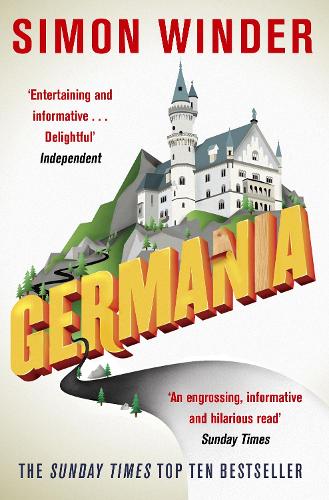
Germania: A Personal History of Germans Ancient and Modern
Non-Fiction, History , European History, German History
Simon Winder (author)
Paperback Published on: 04/02/2011
Price: £9.99