

Reviews: Freakonomics (10)
“Subversive in the most positive sense!”
(Paperback)
I wish i'd read this book when it was first published in 2005. By the time i'd finished reading it i felt so behind the curve but also in front of it at the same time!
Anything that lifts the lid as this book does should be in the national curriculum.
Not only informative but hilarious too. I wish Levitt was my mate!
“Very insightful”
(Paperback)
I really enjoyed this book. It made me consider things in a different way and see the bigger picture of a lot of the things that happen around us every day.
“Funny, educational, and thought provoking.”
(Paperback)
I was immersed in this book, Levitt really has a unique mind. Some ideas take you back a bit, but as you read on and allow yourself to be guided by his thoughts - you understand his way of thinking. I don’t think I’ve ever laughed and learned so much simultaneously. A must read in todays society.
“Freakonomics”
(Paperback)
A friend recommended that i took a look at this and i was hooked after 10 pages! The basic premise is to apply economic models to everyday questions. Why do drug dealers live with their Mums? One of many interesting questions Levitt and Dubner asks and answers. The authors apply their economic eye to many urban myths and mysteries and show you what is really going on. No economic jargon is used at all. My interest did fade a little towards the end, but its well worth the money and the time taken to read.
“A lesson in unconventional wisdom”
(Paperback)
Freakonomics is more a lesson in divergent thinking and the questioning of conventional wisdom than it is in economics. The reader is presented with a series of unrelated questions in which the authors seek to use data analysis to challenge the social status quo in beliefs. Thus we are asked to reflect upon the similarities between teachers and sumo wrestlers and the Ku Klux Klan and estate agents. Most controversially the reader is encouraged to reflect upon how abortion has significantly reduced crime.
The economics that does pervade the book is based on the notion that all human behaviour is influenced by incentives: monetary, social or moral. Consequently the authors claim that everything from the sexual behaviour of teenagers to arguments about augmenting organ donation can be explained in terms of the presence or lack of incentives.
At times the discourse can appear cold and lacking in empathy, notably the discussion relating to loss of tax revenues owing to a reduced adult population in the 1990s arising from increased abortion rates and the assigning of an economic cost to a human life.
In this respect psychology appears a more compassionate tool for investigating similar questions of motivation and behaviour. Latterly the authors do stray into some psychology territory in referring to Thaler and ‘anchoring’ theory in the appendix. Indeed economics is having an increasing impact on psychology as noted by Kahneman in ‘Thinking Fast and Slow.’
Like Kahneman a success of Freakonomics is to provide the reader with a lexicon of terms with which to refer to complex and not easily explained concepts, notably the neat notion of ‘information asymmetry’ and how this is used and abused by estate agents and car salespeople.
Perhaps the greatest strength of this unconventional book is to restate the importance of asking questions and the more obtuse the better.
Page of 2
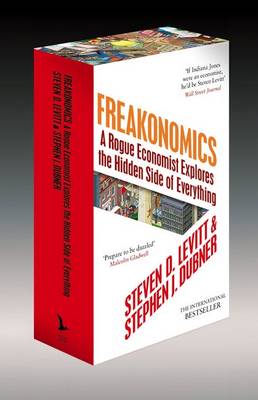
Freakonomics: A Rogue Economist Explores the Hidden Side of Everything
Non-Fiction, Business, Finance & Law , Economics
Steven D. Levitt (author) , Stephen J. Dubner (author)
Hardback Published on: 01/12/2011
Price: £30.00