

Reviews: First World War Trials and Executions (2)
“An Interesting Read”
(Hardback)
First World War Trials and Executions: Britain's Traitors, Spies and Killers 1914 – 1918 is a well researched book from the historian of Simon Webb. The book as it says in the title investigates all those the state put to death for various reasons and gives a short picture of the reason why and how they were executed.
What Webb does tell us that during World War 1 the number of executions fell, and that in all a total of 51 men were executed in England. Most of those executed were hanged, 80% of those were for murder, and a small number shot for espionage. Only one spy and one traitor were hanged during this period.
The book neatly brings those with similar crimes together in one chapter, so those that used cut-throat razors for example, seven men, told who they were, who the crime is committed against and where their execution was carried out. They do this for all the chapters, so you are able to dip in and out of the book.
There are also short chapters about the Executioners which is rather interesting and how they came to the position and why they left. For those of a gorier bent there is also a chapter on The Mechanics of Hanging.
This is an interesting, short history book that has been well research, well written and an ‘entertaining’ read that you can consume quickly. A book for all those interested in historic crimes and how things used to be.
“In a word - uninteresting.”
(Paperback)
This book is not so much bad as pointless. It is difficult to see what the author was hoping to achieve with it and, at least to me, he achieved absolutely nothing at all (aside from a pointless book, of course).
From the start, the title is misleading. On reading a title of 'First World War Trials and Executions', I would at least expect those trials and executions in the book to have some connection with the Great War. The only connection that most of them had was that they occupied the same period in history as did said conflict. Why such a narrow time period, if the fact of the concurrent conflict had no bearing on the actual cases selected for study? In fact, it appears the only thing that concentrating on this time period brought to the table was a paucity of interesting murders to include, since the majority of the cases presented were particularly uninteresting, and those actually connected with the war (wartime spy executions) were the least compelling.
The book begins with an introduction that could be considered a text-book example of an author who does not believe in 'show-don't-tell'. The author spends the whole section telling his readers how disturbing executions are, and how sure he is that his readers would find them so. Quite possibly, but why not allow us to come to such a conclusion for ourselves by actually showing us how disturbing they are in the case studies, rather than telling us that right from the get-go, as it were. As he launches into the terminally uninteresting case studies, for some reason the author adopts an insufferably lecturing, 'know-all' tone, which also had more than a hint of levity within, which was wholly inappropriate for a book of this type. Real-life murder is not a subject for levity, especially judicial murder.
The substance of the case studies presented - especially in the earlier sections, is clearly more the author's supposition that actual fact, and he evinces a marked tendency to sensationalise such plain facts as there are. He uses such phrases as "it surprised nobody" when a certain person was sentenced to death. In fact, it might have surprised everyone but we don't know because we weren't there, and neither was he! Again, we get him telling us how shocking these crimes are, rather than just showing us in his descriptions of the cases. At another time we get him telling us about "what seemed an interminable time" for one of the criminals. He just cannot seem to help injecting thoughts and feelings into the minds of these criminals. All well and good if he were writing fiction, but this is supposed to be a work of non-fiction, so in this case, a cardinal sin.
The book reads something like a schoolboy's answer to an exam question phrased something like 'give your opinion regarding...' All we get, after being told how shocking we ought to think a singularly uninteresting case study is, is how shocking the Author thinks it is. He is constantly inserting his own opinion, and he is far from impartial. Again, no question of letting the reader decide for himself what he thinks of the case. In one of the case studies the author himself seems to have lost the plot. He starts off relating a story about Sarah Wood, then a paragraph or two later we begin to hear about Sarah Metcalf who is clearly the same person, with nary an explanation of the change of name!
Not only were the crimes covered by the individual case studies dull in themselves, the anecdotal passages detailing the back-story of the executioners also lacked interest, as did the tedious detailing of the last days of the condemned men (all but one were men), and their various journeys from condemned cell to the scaffold, then through the trapdoor. A very harrowing experience I am sure, but one that was robbed of whatever pathos it might have had by the flaccid pen of this author.
I've read many a book of this type, and this is possibly the worst, both in content and style. The only reason I didn't consign it to the DNF pile is because I knew I had to review it and I didn't, in all conscience, think I could review a book I hadn't finished reading. I received a free copy of this book via Netgalley in return for a fair, unbiased review.
Page of 1
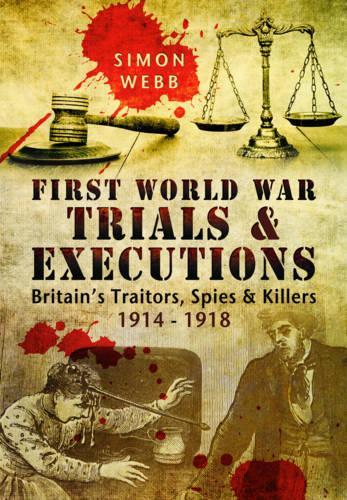
First World War Trials and Executions
Non-Fiction, History , Military History , Military Theory , First World War
Simon Webb (author)
Hardback Published on: 01/12/2015
Price: £19.99