

Reviews: Empireland (12)
“Empireland”
(Paperback)
Well written and researched book. My criticism is that it was written from an anti empire perspective with the negative aspects strongly outweighing the many positive aspects. It was an eye opener about some of the worst excesses. The chapter on the origins of our racism was a list of appalling events which made for uncomfortable reading. That same chapter on racial intolerance were the chapters to be about America, Africa, the Middle East, the Far East or Japan would perhaps show the British Empire in not such a bad light. We clearly did some awful things but were not uniquely bad people which I felt was, unfortunately, the underlying message of the book.
“I was hunting around for a book to take to INDIA...”
(Paperback)
I was hunting around for something to take with me on a trip to India, something that would inform and help me reflect on the experiences in the country that I would be having, and a text that would offer wider and different perspectives.
This book looks at what being part of the British Empire meant for individuals and organisations, politically, socially and economically and is clearly well researched, full of interesting detail and depressing reality. It is a huge subject to tackle and kudos to the author for taking on the task; there certainly is a need for greater awareness. I for one went to what was considered a good school and the only part of Empire taught to us were the Boer Wars and the relief of Ladysmith, which always raised a titter. That was it. Nothing about India, Tasmania, Australia… There is surely a clear need for formal and balanced teaching of empire in school.
The author hails from Wolverhampton and comes from Sikh heritage in the Punjab and therefore is well placed to bridge the two countries. He also includes other countries that came under British rule in this well written book. He moves between times, events and countries with a masterful fluidity and skilled writing that makes the whole subject approachable. He teases out events and conflicts to underline the point he makes, and outlines an incredible level of barbarism across the board, on every side. He also examines the nature of slavery across several countries and debates how redress could be made.
One of the subjects with which he is invariably accosted is the subject of the British building of the railway system in India, framed in positive terms of British endeavour. He points out that they weren’t built out of goodness of heart but essentially built for trade, to move troops around and transport many of the country’s riches back to Great Britain. The British brought all the engines from UK when they could have been built locally and just took stock and equipment back to Europe when the items were needed there during WW1, leaving people stranded without a fully functioning rail system.
We travelled through Southern India and it is interesting to understand how our guides approached the joint history of the two countries. In Chennai there was no beating about the bush when describing the actions of General Lord Cornwallis, who took the sons of Tipu Sultan (who was an enemy of the East India Company) in order to force him into submission. In the Fort in Chennai there is a statue of Cornwallis, which is housed indoors because its presence has enraged locals. He was a very ‘successful’ man, we were told, when exploiting the local assets for British gain. Another guide, in Madurai, was very positive about the British involvement in his country but may have adapted his narrative given our nationality.
Sanghera tells the colourful story of Sake Dean Mahomen, who married a white woman, lived for a while in Ireland and then relocated with his family to London. This was the turn of the 19th Century. There he opened London’s first curry house, which attracted people who had been living in India and did very well until it all failed. Not to be thwarted, he moved to Brighton and opened a bathing emporium with a distinctive Indian slant. It was his Indian heritage, he had now came to understand, that was his unique selling point. George IV at this point was building the Marine Pavilion, so it all resonated well with a country.
This is not remotely a dry read but a thoughtful look at Empire with the human experience at the heart. He details, for example, the new fashion accoutrement – the moustache – and how British officers copied the Indians to gain a more manly image.
This is an informative overview of a period in history that needs to be revisited and better understood. He also makes links between the deeply ingrained experience of Britain during the centuries of rule that have rattled down the generations. and how unconscious assimilation, combined with ignorance of the reality, now – in part – inform our current political trajectory. Key, he feels, is to look to the future rather than looking to the past, which seems an endemic trait in British society and seems to be proving in many ways unhelpful.
“..if we don’t confront the reality of what happened in British empire, we will never be able to work out who we are or who we want to be..”
“Fascinating and informative read”
(Paperback)
Highly recommended
“Thought provoking, engaging and insightful.”
(Paperback)
I really enjoyed this book about the history of empire and its effect on modern Britain.
The author covers a lot of ground, most of which relates to his experiences of, and perceptions of the legacy of empire, and how they have affected Britain. The writing is very objective and impartial which would be otherwise difficult to achieve with such a polarising and emotive subject. He assumes no in depth knowledge by the reader on the subject and only a broad awareness of issues such as race in Britain, and some key historical events such as the slave trade and an awareness of key historical personages. This keeps the book moving and his references and conclusions are cogent and provide lots of room for thought.
I liked the structure as it made the whole book flow and kept everything in perspective. The chapters on tourism (“Home and Away”) and economic / financial exploitation (“Dirty Money”) were very enlightening and brought alive many of the debates still ongoing about the legacy of empire.
The only thing I did not like about the book was the frankly stupid number of endorsements / puffs on the front, back and inside covers. There were 39 of these. I see the merit of recommendations from The Economist, Simon Schama and Andrew Marr, however having endorsements from Dom Joly, Caitlin Moran and Hugh Laurie… adds nothing and smacks of overreach. Other than trivial point, I think anyone interested in modern and colonial Britain, history in general and politics will enjoy this superbly written book.
“Beneficiaries and Outcomes...”
(Paperback)
This is a very confusing and conflicted book, whose author is torn between traditions and a country that he genuinely admires and its darker history, mostly hidden in the depths of a history of empire that no one apparently wants to talk about. There may be more reasons for this than he thinks, noting that in Britain itself the Industrial Revolution that took place across the period identified as the second period of empire was far more important and configuring of people's lives here than the doings of a few thousand civil servants trying their luck abroad, supported by an army of poverty-stricken Scots. Who were the beneficiaries of the Empire? Not the British: they were too busy down coal mines, up chimneys or going blind in pen factories and the like. Or leaving the place, as what Arendt called 'excess populations', the unwanted and penurious seeking better lives in colonies like Australia or Canada (not always there by choice, either).
The book focusses mostly on India, with some prominence given to the slave trade as a British original sin, not exculpated by its principled abolition and resolved badly but (in a rather British way) pragmatically by paying slaveowners to give up their slaves, without compensating the slaves with anything more than their manumission. This diverts into outright genocide in Australia, the dispossession of First nations is many places, the setting up of governments in Africa and the use of force in China to demand trade terms for opium. Conflating the issues seems to juxtapose quite separate issues as if there was a plan to take over the world (and Sanghera is pretty sure there wasn't, which only makes it more jumbled), rather than the piecemeal accidents of some greedy financiers in London with a powerful if blundering navy to back them up.
He notes his own ambivalence about the sick-making traditions of Empire as inculcated into proto-conservatives through Eton and Oxbridge, but again this represents such a small proportion of who we are as a nation that it is wrong to call this British and more accurately to call it out as the weird predilictions of the elites who seem to have set Empire up in order to keep themselves busy and important. No wonder the rest of us don't care so much and have happily forgotten idiots like Robert Clive who no one could possibly still think of as a national hero.
The best of the book points out the importance of seeing history in a balanced way, though as ever the balance is determined by who writes what about it. The Empire simply isn't representative of British history, but of the deeds of the rich elites that saw opportunities for profit and glory, so treating it as if it really should be standing as proxy for it doesn't seem quite right just to assuage a second and third generation immigrant population for whom empire was the route to a life in Britain. The other serious point he makes follows this: seeing 'decolonisation' or its binary opposite 'wokery' in entirely negative terms diminishes what can be understood from this history. In other words, our interpretation, that great reality of historical study, shifts over time, but ought not be used as a means to destroy the past but extend our engagement with it. At this point, we aren't doing history at all, but coming to terms with who we are today as a result of this unplanned and careless legacy.
Page of 3
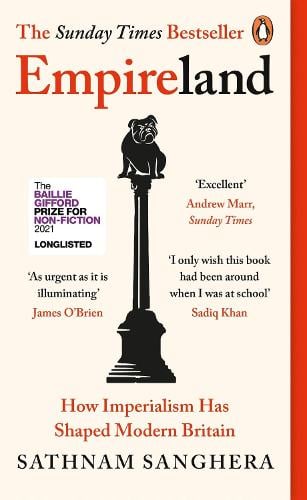
Empireland: How Imperialism Has Shaped Modern Britain
Non-Fiction, History , British History, 20th Century Britain, World History
Sathnam Sanghera (author)
Paperback Published on: 07/10/2021
Price: £10.99