

Reviews: David and Goliath (10)
“David and Goliath”
(Paperback)
In David and Goliath Malcolm Gladwell sets out to discover, through an interesting selection of case studies, whether having a perceived disadvantage can actually lead to a person (or interest group) being stronger/more successful in the long run. Through the life stories of a disparate collection of people (some you will have heard of, some you won’t) Gladwell attempts to determine just why some people are able to be incredibly successful while others seem to crash and burn at life. While it might seem obvious that adversity will spur some people on to improve their lot and achieve great things while others let circumstances overwhelm them, Gladwell’s case studies are illuminating as to how exactly success can be achieved and what behaviours can be best adopted to help make the best out of difficult situations. David and Goliath is an engaging, sometimes provocative, exploration of an intriguing topic and Malcolm Gladwell is, as ever, an informative and clear guide to his subject matter.
“Original and thought-provoking”
(Hardback)
Malcolm Gladwell’s David and Goliath offers a fascinating read into the world of underdogs that encourages a reassessment of common belief and perceived wisdom. Covering some amazing stories from a lowly teenage basketball team who played their way to national championships by working to their advantage, to the female police officer who transformed a neighbourhood, this book really highlights the power of the underdog. Inspirational, informative and powerful, the book testifies to the triumph of hard work, will and determination in the face of seeming defeat and reveals some of the ordinary people who have become extraordinary. A groundbreaking and thought-provoking read.
“A Brief Summary and Review”
(Hardback)
*A full executive summary of this book will be available at newbooksinbrief dot com, on or before Tuesday, October 22, 2013.
This book is not about underdogs and giants in any conventional sense of these terms. Rather, the book is about the curious nature of advantages and disadvantages, and how each can (under certain circumstances) become its opposite.
The first lesson to be learned is that the things we take to be advantages are often no such thing. Our greatest mistake here comes from the fact that we identify a certain quality or characteristic as being a benefit or advantage, and then assume that the more of it there is the better--when this is often not the case. Put another way, most of us recognize that it is possible to have too much of a good thing, and yet we fail to appreciate just how often and where this principle applies. For instance, we recognize that having a certain amount of money greatly facilitates raising children (it being very difficult to raise a family in a state of poverty), and yet we fail to recognize that beyond a certain point wealth also makes parenting increasingly difficult (for it becomes harder and harder to instill qualities of hard-work and self-control). Or we recognize that small class sizes are a good thing, and yet we fail to recognize that classes can actually begin to suffer once they become too small (since diversity and energy begin to disappear).
Another arena wherein an advantage can become a disadvantage is in power and authority. Power and authority is an advantage, of course; however, when it is wielded illegitimately and without fairness, it can actually cause more chaos, destruction and violence than it curbs. This is as true in the classroom as it is in community policing as it is in handling minority groups within a nation's borders.
The second lesson to be learned here is that certain disadvantages can sometimes drive people into positions of advantage. Take the disadvantage of being born with a disability, for example. Say dyslexia. In our modern world, where the ability to read is extremely important--and practically a requirement for success--having great difficulty with reading is a major disadvantage. And indeed the statistics indicate that the vast majority of those who are born dyslexic end up falling through the cracks and missing out on success.
Still, though, many dyslexics have gone on to become highly successful people; and it has also been noted that in certain fields (such as entrepreneurship) an inordinate proportion of the most successful individuals do, in fact, have dyslexia. So how can we explain these success stories? What we find in these cases is that these individuals have managed to compensate for their disability by developing skills that make up for their flaws (such as an improved memory or debating prowess). Thus, in a way, the successful dyslexic has actually benefited from his disability, because it has forced him into a position where he has had to develop other skills that have led him directly to success.
Also at play here is the fact that dyslexics tend to endure many failures when they are young. Repeated failures (especially at a young age) have the potential to crush the spirit. But they can also have the opposite effect: they can inure the individual to failure, thus making them more likely to take risks and try things that others wouldn't--which is often a sure path to success.
A similar phenomenon also sometimes touches trauma victims. Take the ultimate trauma of losing a parent in childhood, for example. This is one of the worse experiences imaginable, and the trauma of losing a parent in childhood does indeed crush the vast majority of those who have the misfortune of enduring it.
Again, though, it has been noted that a very high proportion of highly successful individuals across many fields (from science to art to politics) have in fact lost a parent in childhood. And what we find in these cases is that the experience has left these individuals with the mind-set that now that they have endured such a terrible event, that nothing could ever be so bad. And thus they are liberated from the fear of failure, and--like the successful dyslexic--are willing to try things and take risks that others are not (which often leads directly to success).
The same experience and logic can also apply to underdog groups. For example, when a group recognizes that it is severely over-matched in terms of skill or strength compared to its opponent, it can begin to feel liberated to try unconventional tactics and approaches. This is often for the best, for it turns out that unconventional tactics and approaches are frequently very effective against giants--in everything from sports, to politics to war--and are, in many cases, the only chance the underdog has to win anyway. Again, then, in both of these instances (the trauma victim and the underdog group) a disadvantage has driven the party into a position of advantage, and thus the disadvantage may itself be seen as a kind of boon.
Gladwell has done well to make us rethink the nature of advantages and disadvantages across many fields. The only major flaw in the book, in my view, is the third and final part. The theme of the part is that power becomes less effective (or even counter-productive) when it is wielded illegitimately. The problem with this argument is that it's a classic case of the straw-man: Gladwell has set up an opposition that is very easy to defeat, and then smashed it to pieces. What's worse is that the examples Gladwell uses to prove his point here are quite weak. Still, there is much of value in the first 2 parts of the book. A full executive summary of the book will be available at newbooksinbrief dot com, on or before Tuesday, October 22; a podcast discussion of the book will be available shortly thereafter.
“Thought provoking”
(Hardback)
Life is not always easy - but according to Gladwell, surviving the difficulties and tragedies can equip people with valuable skills that will help them as they go through life.
This book makes you think carefully about your pre-conceived notions of what an 'advantage' actually is.
I found the real life examples of people who have experienced struggles only to find them useful down the road fascinating.
Gladwell is a skilled storyteller and has a way of presenting statistics that doesn't seem daunting or boring.
A good read and a good book club choice.
“Entertaining - but helpful?”
(Hardback)
The long title of this: "David & Goliath: underdogs, Misfits and the Art of Battling Giants" really tells you all there is to know concerning what this is about. I am afraid that, though the storytelling was well written, I did not like or agree with the conclusions reached in the various chapters and ending. My rating only reached up to a three due to the fact that it did engage me, but it did something that no other book that I have yet read has ever done, and that was make me extremely angry. Any book that can make my blood boil in the way this has done has to be doing something right. Clearly, the premise is that the underdog can prevail, but by actually applauding (in some cases) law breaking, cheating and lying, I find it hard to warm to the theme.
I have to say that the first parts of the book were extremely American and used very American analogies, which, to me as an English reader, were a bit of a turn-off, even in these blurred boundaries between the US and the UK as they are today. I also found the parts regarding Northern Ireland as quite biased and frankly insulting in places. I agree that there were atrocities committed, but having lived through some of the sheer acts of terrorism perpetrated by the IRA, I found some of what was written hard top swallow.
This is very much an essay or a lecture and a personal take on what constitutes more recent David and Goliath acts. It could be argued equally that this is a self-help type of book, so if you are looking to overcome the odds (not necessarily with all your scruple intact) this may be the book for you.
Page of 2
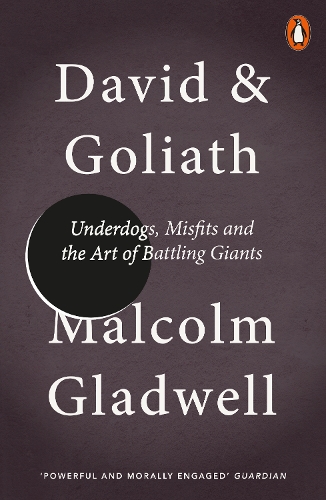
David and Goliath: Underdogs, Misfits and the Art of Battling Giants
Non-Fiction, Science, Study & Work, Smart Thinking
Malcolm Gladwell (author)
Paperback Published on: 01/06/2017
Price: £12.99