

Reviews: Cunning Folk (5)
“fascinating and well researched”
(Hardback)
A fascinating and well researched book about uses of and belief in magic in the 17th century. I was interested to find that, contrary to many things I've read, this was often a more benign magic than witch finders would have us believe and was used to find lost objects and maybe find love. Stories from contemporaneous records and court reports added poignancy and humanity to the text and I found it an enjoyable read. Maybe one to dip in and out of at leisure rather than reading in one go.
Thank you to netgalley and Random House for an advance copy of this book.
“An enjoyable book”
(Hardback)
I had hoped for something interesting to read and with Cunning Folk I was very pleased to have my wish fulfilled. The topic of magic was brought to life and each chapter was easy to read in a pleasing 'anecdotal' style. I would like to have given five stars but Tabitha's grammar slips up here and there (or perhaps it's her proof reader). She seems not to be able to use the subjunctive, so there are plenty of constructions like 'if it was.' But that does not really detract seriously from what is a well-researched book. For me, it was money well-spent.
“Help in the medieval age”
(Hardback)
In the late medieval and early modern eras a belief in certain parts of magic was part of everyday life. Love potions, finding lost objects, a change of luck? Then people would see their local 'wise woman' or 'wizard'. However sometimes the desire for help veers over into black magic, danger or debt and crosses the line into illegal activities. Here Stanmore recounts how 'practical magic' was part of the everyday for people in all levels of society. The level of research is fabulous and the writing is very engaging.
“A look at the use of practical magic in English history”
(Hardback)
A look at the use of magic in England from the fourteenth century onwards. So-called 'cunning folk' were used throughout these centuries to provide services such as finding missing items or people, providing love or fertility charms, curing illness, & even the odd get-rich-quick scheme. They were viewed as different to witches (who could also be either male or female), as witches were viewed as practising magic to do harm, whilst cunning folk were mainly thought to be trying to help.
This is an interesting & informative read with a lot of information packed into its pages. Personally, I felt that it became a little dry to read in places - the curse (pun intended) of academic work - but it always keeps the reader engaged enough to continue. The crossover with Catholicism & calling on the saints for aid was particularly interesting to me as was the evolution of the laws & societal viewpoints on magic which gradually shifted into something more malevolent & culminated in the witch trials. One slight let-down (which is not the author's fault) is that the records so often don't tell us what happened afterwards to the people involved in the cases discussed. Overall it was a very enjoyable read.
My thanks to NetGalley & publishers, Random House UK/Vintage/Bodley Head, for the opportunity to read an ARC. I am voluntarily giving an honest review.
“A fascinating look at medieval magic”
(Hardback)
This is an intriguing, well-researched and highly readable guide to the practice of magic in the early modern period. Each chapter covers a different area in which magic was used, ranging from love and finding a fortune to seizing power and retrieving lost objects. This provides a fantastic insight into the lives of ordinary people in this time period; their hopes, dreams, fears and the things they wanted more than anything else. While many of the examples given are humourous (such as the buttock bread love spell), the author avoids casting judgement on what were essentially average people with little agency over many aspects of their own lives. Many of the users were women or those from the lower classes, who would often have no choice but to resort to magic to obtain justice or a better life for themselves and their families. In fact, Stanmore's links between medieval magic and the superstitions many of us carry today demonstrate the persistence of these practices, correcting the harmful narrative that people of the past were somehow less intelligent or rational than we are now. This is a fascinating and often moving account perfect for anyone interested in the history of magic, or wanting to gain a fresh and unique perspective on Britain in the early modern period.
Page of 1
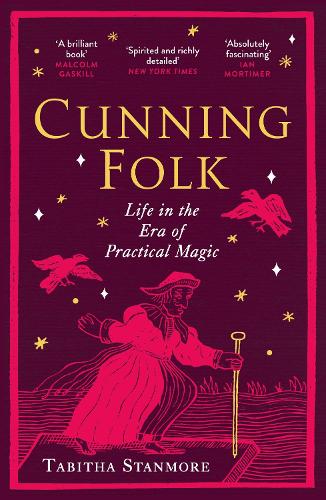
Cunning Folk: Life in the Era of Practical Magic
Non-Fiction, History , European History, Medieval Europe
Tabitha Stanmore (author)
Paperback Published on: 29/05/2025
Price: £10.99