

Reviews: Creation (5)
“A layperson’s guide to DNA and genetics.”
(Paperback)
It starts with a papercut.
The book that is, not the origin of life. Rutherford starts by breaking down exactly what happens when you cut your finger in a jaw-dropping three-page extravaganza of cells, electrical signals and scintillating prose that puts you in a state of awe. Awesome is a word that is regularly overused, but one that really does apply here when we are talking about such astounding ideas and realisations, with this minute level of detail illustrating just how finely tuned every little aspect of our body is. Awe is the perfect state of being to be in when preparing to read about the genesis of existence.
Creation neatly sections off the world of evolutionary biology into two literal (and flippable) halves. The first, The Origin of Life, lays down the chemical and biological basics as we travel through time meeting the scientists who developed them. Early attempts to create a “primordial soup” are informative and impressive – one experiment involving a simple glass jar in the 1950’s amazingly yielding some of the building blocks of life out of a simple combination of gasses. The second half, The Future of Life, looks at the work scientists are doing today and where those ideas can take us, talking about DNA magicians working in synthetic biology. Often maligned in the press, Rutherford is even-handed and almost philosophical in his handling of this somewhat controversial subject. All this is topped off by little Pratchett-esque footnotes spread liberally among the pages, offering more information or clarification. These are often wry and entertaining anecdotes, with the occasional sprinkling of biology-based jokes.
Newcomers to the world of DNA will find it easy to follow, as it progresses in a calm and collected way, slowly going into more and more detail; while readers well versed in the sciences will find Rutherford’s style and perspective refreshing. It’s a brilliantly entertaining run down of a good four billion years’ worth of life, and a perfect introduction to DNA and the art of genetic engineering. The Future section of the book was perhaps my favourite part, just edging out into science fiction as we look at some of the amazing things that might be possible when co-opting the structure of life, even if that potential is only just beginning to be explored, let alone realised. Both sections celebrate the ingenuity of scientists across the ages, and it’s hard not to come away enthused about the great thinkers of the past and the prospects of the future.
“Astonishing triumph for science!”
(Hardback)
Having previously read books by Daniel Dennet and Richard Dawkins, I was already aware of the amazing explanatory power of evolutionary theory, but I wasn't convinced that scientists would ever be able to satisfactorily account for the origins of life. Natural selection needs something to work on, after all. This book thoroughly shatters any remaining doubts, however, and in a very entertaining and witty manner! The anecdotes about the lives of the pioneers in this area of research are fascinating, but it's the science itself that steals the show, as every part of the process of life's formation is covered. Although there are details to fill in, and some parts of the early history of life remain speculative, the overall picture is clear. No "...and then a miracle occurs..." steps are required! My favourite insight from the book is that the murky philosophical issue of where the dividing line between non-life and life lies can be replaced with the more pragmatic one of describing the path from one to the other. As long as this can be done, science can indeed claim to be the arbiter of all knowledge. This book shows decisively that it can. Very exciting stuff!
“Creation”
(Paperback)
Creation is split into two parts - one discussing the origins of life, the other exploring what lies ahead in biology (written on flip sides "like a double helix" so that either can be read first).
The 'Origin of Life' segment is a brilliant, concise introduction to the basic units of life: cells, DNA etc. Rutherford attempts to explain how life started in the first place and how various primitive functions developed. While he achieves this with some success, there is a lot about the origins of life which science itself still doesn't understand, never mind a layperson.
The 'Future of Life' is a fascinating insight into the revolutionary potential of biology in the 21st century with synthetic lifeforms, genetic engineering (see Spiderweb producing Goats) & manipulation of DNA, as well as the potential pitfalls and dangers of these new technologies.
All round, a highly readable and interesting introduction to these concepts and a great Popular Science book.
“Highly Recommended”
(Hardback)
I was always a bit rubbish at science when I was at school so have been trying to remedy the situation by reading lots of books about the subject and this book really grabbed my attention.
It is in two parts, one being the history of how we came to be and the discovery of DNA and, this is the bit I really love, when you get to the end of the first part, you turn the book upside down and start at the other end- I’m so easily pleased- to get to the theoretical future of the uses of DNA and synthetic biology to help shape our future survival.
I’m not a boffin and so Adam Rutherford’s easy style and a few comic asides make this a highly interesting and understandable read and one I do recommend.
“A Brief Summary and Review”
(Hardback)
*A full executive summary of this book will be available at newbooksinbrief dot com, on or before Tuesday, July 9, 2013.
As the blueprint of all that lives, DNA may be said to be the key to understanding life itself. It is incredible to think, then, that the structure of DNA was only discovered some 60 years ago (thanks especially to the work of James Watson and Francis Crick). Since that time, many significant advances in genetics have been made--including the deciphering of the genomes of numerous species (including our own); and, even more impressively, the successful manipulation of the genetic code to introduce the features of one species to another (for example, having a goat produce spider's silk out of its milk).
As impressive as these feats are, though, they are but the beginning of what promises to come from the study of genetics. Indeed, compared with other sciences, such as physics and chemistry, genetics is still in its infancy, and we can be assured that the most significant discoveries and applications are yet to come. Even now, geneticists are making significant progress in uncovering the origin of life--meaning answering the question of just how life may have sprung out of lifeless chemistry--and are also making advancements in turning genetic manipulation into a standardized engineering science that is capable of churning out technological solutions in everything from food production to energy to medicine (a field that has been dubbed `synthetic biology'). It is these recent advances in genetics that are the main topic of Creation: How Science is Reinveinting Life Itself by science writer Adam Rutherford.
Rutherford begins by way of giving us a refresher in basic cell biology (that includes a recapping of how many of the major discoveries here were made). From here we are led into a discussion about the somewhat thorny issue of just how to define life (the author eventually settles on the functional definition--widely accepted in biology--of `replication with variation'). This then prepares us for answering the question of how life began in the first place.
A living organism requires both a structure that can be replicated, and some energy to carry out this replication; and thus the question of the origin of life comes down to the question of how this structure originally came to be organized, and where the energy came from to allow for the replication. With regards to the first part of this question, scientists have been able to trace out the likely original constituents of the first organism, and have also established that many of these original constituents readily self-organize into the form that they take when the right molecules and conditions are present--thus while the question of the original structure of life has not yet been entirely solved, geneticists are hot on the trail of doing just this.
Second, with regards to the energy problem, it has been established that, originally, the energy needed for replication could well have come from outside of the biologic structure itself--the most likely candidate at this point being the energy from geothermal vents at the bottom of the ocean. Experiments are currently underway that recreate the conditions at the bottom of the ocean near geothermal vents, and feature some basic chemicals needed to procure life--but the hit and miss nature of this procedure means that there are no guarantees these experiments will be successful.
When it comes to creating life from scratch, the better bet might be that this will come from synthesizing the basic biological parts and manipulating them into the organization that is needed for them to carry on into perpetuity. This is the domain of a new science called synthetic biology--the second line of recent research that Rutherford is concerned with in the book. Of this domain we learn that geneticists have already been able to synthesize many biological structures--and have even synthesized DNA and introduced it into living organisms where it functions normally, like any other DNA. This is a significant step in geneticists attempt to take full control of genetic information that it may be used for any number of purposes, from incapacitating viruses, to creating synthetic biofuel, to fabricating food stuffs that carry any biological feature we may want.
Scientists have in fact already made considerable progress in these areas. However, they are also running into some significant barriers along the way--largely having to do with the sheer complexity of biological systems. Still there is hope that this complexity will ultimately be tamed, and attempts are already underway to standardize genetic structures in order that they might be more easily controlled.
The spirit of this enterprise is captured in the iGEM competition--an international competition that brings together teams of university students from every corner of the planet with one goal: to demonstrate a unique biological function using standard genetic parts, called `BioBricks' (drawn from a library of these BioBricks that the students are themselves encouraged to add to in the course of their projects). The iGEM competition has already churned out some very impressive applications, and the speed of progress is very encouraging.
Rutherford does a very good job of covering some of the most significant recent advances in genetics, and of explaining the science behind it. The author also does well to capture the promise of the recent advances, while at the same time acknowledging the significant obstacles that stand in the way of future progress. The offering is certainly more readable than George Church's latest book Regenesis: How Synthetic Biology Will Reinvent Nature and Ourselves--to which this book will rightly be compared. However, Rutherford (despite having a solid background in biology himself) does not have quite the insider's perspective that someone like Church does, which is the only drawback I see here. All in all a very good popular science book on a very important topic. A full executive summary of the book will be available at newbooksinbrief dot com, on or before Tuesday, July 9. A podcast discussion of the book will be available shortly thereafter.
Page of 1
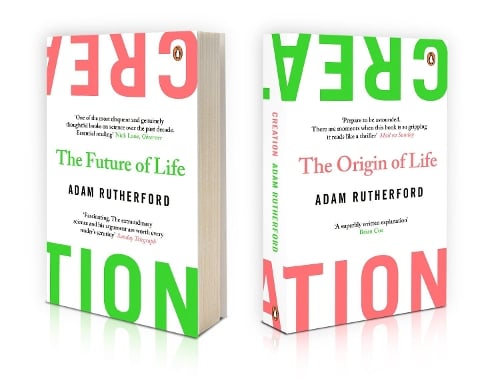
Creation: The Origin of Life / The Future of Life
Non-Fiction, Language & Reference, Science, Study & Work, Popular Science
Adam Rutherford (author)
Paperback Published on: 06/02/2014
Price: £10.99