

Reviews: Cop Hater (3)
“Good”
(Paperback)
Ed Mcbain is the name most familiar to his fans although he used several other pseudonyms as well. This is a generic review due to the amount of books he wrote. Little bit about the author, then some of the series he did. The star rating will indicate my opinion of individual books.
I started reading his books in the late 1980's and continued until his sad death from throat cancer in 2005. I did find he went through a very dark period with his books. I found them unpleasant to read as the female police characters were treated harshly. Not so much as a deliberate anti-female jibe but more as a storyline shock but I didn't like it. It was interesting reading his autobiography as it explained some of the darkness. He was going through a dreadful divorce, several heart attacks and cancer. But towards the end the books became better as his life with his new wife seemed to lighten his outlook. The final books he wrote were back to form for me and it was very sad when he died. I enjoyed a lot of his work. The writing is crisp, with a strong sense of humour. The plots are generally good but there are a few misses along the way.
Evan hunter.
This bit will deal with the hunter books individually. The blackboard jungle was hunter/Mcbain's first novel. It's very well written with good characters. It's a tough story set in a tough location, a vocational school for troubled students. It's not a happy book though it's still good.
The 87th precinct.
This is his most famous series. Running from 1956 until his death in 2005 it follows the lives of the men and women in a police precinct house. Best read in order as the story lines of the various police officers are a major element it's unusual in that the officers age in accordance with the passage of the books. Some rise through the ranks, some are killed in the line of duty, some retire. The stories are good. They tend to be about real life crime rather than convoluted murderers. The books go through a period of darkness which I found hard to read. To much misery for me as I suffer from depression which was constantly flaring up during this period so my views of these stories may be coloured by that. Thankfully the books picked up towards the end of the series again. Overall an impressive set of books.
The matthew hope stories.
A set of stories featuring a lawyer. I didn't enjoy these as much as the 87th precinct books. They were all well written but I didn't take to the lead character that much. A friend of mine loved them though, so as always I'd urge people to make up their own minds really.
General novels.
Some very good standalone novels were published under pseudonyms then reprinted under the Mcbain name. Favourites were the excellent death of a nurse and sentries.
In general I enjoyed the ed Mcbain books. Some opinions were affected by my health but I would definitely recommend him as a good crime writer.
“i good read. will read it again and again”
(Paperback)
“A grand if flawed, series opener”
(Paperback)
Cophater' is spread across the end of July/beginning of August 1954, mid heatwave. Tensions are rife within, and without the 87th Precinct which at that time, numbered 16 detectives under the eye of Lieutant Byrnes. Until there were only 15...
As the police try to work out whodunnit, and why someone is gunning for detectives with a .45, there are glimpses into the personal lives of the to-be-central characters such as Steve Carella and Bert Kling.
''He had been a cop for twelve years now,and he had learned to stomach the sheer,overwhlming,physical impact of death-but he would never get used to the other thing about death,the reduction of pulsating life to a pile of bloody,fleshy rubbish.''
It is a taut, short, merciless and sometimes humorous police procedural where finding a cophater is like shooting fish in a barrel. Even one of the detectives themselves announces that being a 'bull' is not necessarily a profession for a smart fella.
''All you need to be a detective is a strong pair of legs and a stubborn streak.The legs take you around to all the various dumps you have to go to,and the stubborn streak keeps you from quitting.You follow each seperate trail mechanically and,if you're lucky, one of the trails pays off.If you're unlucky,it doesn't.Period.''
The first time I read this book I was in my teens and working my way through the 87th stories in whatever order they happened to appear in the local library so it was interesting seeing Steve introduced for the first time. Something I was concerned about, was the description of him in pretty much every novel as having 'downward slanting eyes' which give him an 'Oriental appearance'. Oh boy.
I am unsure whether this was intentional as later in the book his appearance is used as the butt of a joke when a woman appears at the station saying she knows who killed the cops. She demands to speak to an American policeman after Steve offers to take her statement-he wryly assures her that he learnt the English language from the natives. However, I am pretty sure that every time he is introduced in any of the stories, he is referred to in this way, which I am not certain if I can say , unequivecably, that this is racist.Is it merely of the time and can that ever be used as an excuse? I guess it is up to the individual reader. As a teen I took that as a cue to really visualise Steve, but now it just left me feeling a bit awks.
Women fare less well-they are described in terms of 'winks of thighs', spilling breasts' ,having their 'fanny slapped' and so on. They are split into the femme fatale or ingenue stereotype.You have Alice Bush, police widow, who oozes seduction in spite of her husband's recent death- 'The femaleness reached out to envelop him in a cloying, embrace'-or, you have Teddy Franklin, Steve's deaf mute girlfriend-'she looked up at him, wishing she could speak because she could not trust her eyes now, wondering why someone as beautiful as Steve Carella, as wonderful as Steve Carella,as brave and strong as Steve Carella would want to marry a girl like her, a girl who could never say,'I love you darling,I adore you.'
Ohhhh boy!
Teddy gets the added insult of being called 'a dummy'(thought not by Steve, phew!)
A later discourse between Carella and Byrnes offers the following-
''These women never cut the umbilical cord.We get raised by one woman and then when we're ripe,we get turned over to another woman.''
Carella smiled.''It's a conspiracy,'' he said.
''Sometimes I think so,''Byrnes said.''But what would we do without them,huh?''He shook his head sadly,a man trapped in the labial folds of a society structure.''
Noice!
And then, when questioning a suspect-
''A woman like that gets under your skin.Some women are like that.Listen,I've been around plenty.I had me more dames than you coudl count.But this one-different.Different right from the beginning.She just got under my skin.Right under it.When it gets you like that,you just can't eat,you can't sleep,nothing.You just think about her all day long.''
There are 2 ways of looking at this-outrage at the sexist stereotypes employed by a man of his time, cranking out a police procedural to be sold, at cost, in the place of Ironside books. Or, you can see that this is a woman using the only wiles she has at her disposal in order to extricate herself from a loveless marriage.
McBain paints swiftly with a small brush, all the details of his fictional Isola, introducing her as sentient city which is fed on the drama, the sweat and even the blood of her inhabitants. She inspires a love/hate relationship with her people,amongst whom, the all male detective force is intrumental in cleaning up the streets.
Apart from this, and the description of a black detective as having 'chocolate coloured skin', the story itself does not feel dated. The lack of mention of any type of technology does not age the story, instead you have the old fashioned police work-shaking down confidential informers,or 'stool pigeon', like series regular, Danny the Gimp or the gangs. The tech is fascinating, the way they take a shoeprint from dog faeces is a standout moment!
The social aspect of the book is what McBain does so well, his construction of the people of Isola-which I don't believe is named in 'Cophater'-ranges from the Puerto Ricans and the Irish to the Jewish and the Germanic. A real melting pot on the brink of sizzling over. The brilliant descriptions of the effects of the heat, the way that the cops and the media are pitted against each other, could be read in a novel of today. What I did notice as Carella and Bush go to shake down a pub where ne'er do wells gather, is that the barman remembers precisely the last time that anyone used/brought a gun out in his bar. It had been 4 years prior to being questioned-I don't think there are many bar owners today who can say that such a long period has gone since the last act of violence was committed in their property.
So, to recap, casual sexism aside -which is sadly still an issue which is being fought daily-, potential racism and shock at an isolated gun crime-this makes big news as if the cops aren't safe,then who is?-'Cophater' reflects its times and to some extent, our own, so many decades later. The police aren't as trusted on either side of the Atlantic due to institutionalised racism , as they would like to be, and whilst the death of a cop is seen by the public as the loss of a public servant, in the book, even their fellow cops don't seem to be burning with a rage for vengeance, as say a modern cop like Harry Bosch would have. In fact, their Lieutenant reminds the bulls as they are about to go pound the streets for clues, they need to remember that the dead cops were men. It is about justice, less than a sense of brotherhood.
'Cophater' is a pretty quick read, ending with a trademark Ed McBain flourish, a reminder that wrongdoers get the death penalty-a throwaway line in the text, but one that still makes me wince that this was considered, and still is thought of as, not a cruel and unusal punishment but a fit and just end to a life. And in introducing the 87th Precinct, he has given us a playground and let us loose in it-he creates the stage and presents the facts ma'am, just the facts, we , the reader, brings our emotions into play whilst he sits backs and awaits our reaction. And this is what I love about the series, the mix of cultural, political and social with the police as not distinct from society , but an integral part of it.
Page of 1
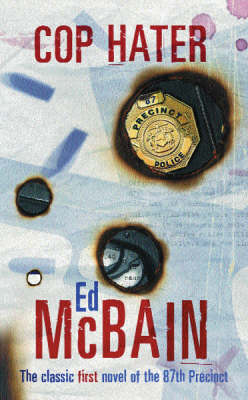
Cop Hater
Ed McBain (author) , Ed McBain (author)
Paperback Published on: 03/07/2003
Price: £6.99