

Reviews: Consequential Macroeconomics (2)
“At Last, Macroeconomics is a True Science!”
(Paperback)
The aim of this book is to correct this situation and to provide a logical and compact, but sufficiently complete, theoretical presentation about of what our macroeconomics system comprises and how it actually works. The attitude taken here is about viewing the system from sufficient a distance, so as to envisage it as a whole as well as its components. It aims to provide an improved and better perception and understanding of the complete macroeconomics structure. It also introduces some original aspects of analysis into the subsequent methodology.
We start from scratch. After a review of the overall problem of complexity in representing our social system, a series of assumptions and early considerations are provided, along with the many necessary definitions. From this standing, there is built up a base model that is logical in its development and which is virtually complete, whilst not being any more complicated than is absolutely necessary—in order to provide for the subsequent analysis, in a formal scientific manner. This model is necessary and sufficient to cover what our social system does.
This model contains 6 entities: Landlords, Government, House-Holders, Producers, Capitalists and Finance Institutions (banks). They are connected by 19 double flows, consisting of money which opposes the various kinds of goods, services and valuable legal documents that are uniquely provided by each entity. The model is expressed in three ways, by a diagram, by a set of algebraic identity equations and by using W. Leontief’s input/output matrix. (The latter is subsequently used in the development stages of this work.) The various entities, as parts of the model, are described and used for explanation about the circulation of money, goods, etc. This leads an examination of the matters of general equilibrium and stability of the system.
The 320 page book has 6 sections with titles: "Getting Started", "The Model", "Analysis", "Decisions", "Money", and "Consequences". The model is based on a strictly minimal approach to the need for including the whole system in a minimum of the influencing factors or role-playing entities.
In the fifth section theories about the development of money and banking are given, as well as the use of interest on borrowing. This leads to a discussion about the functions of governmental control over longer periods of time. There follows a development about the possible factors affecting the limitations to growth of the general system. The last chapter of the book concludes with a long summary, which takes into account the particular perspectives used in this work. The topological properties of the system are noted. Past confusion between the macro- and micro- aspects of economics are described and inhibited. This viewpoint provides a better and somewhat original understanding about what theoretical macroeconomics really is all about. Matters missed out are noted at the end.
Due to a need for continuity, 7 appendices are included instead of writing them within the main text.
“The need for using the correct Author's name”
(Paperback)
My full name has been reversed. I am David Harold Chester. Nothing else will do.
Page of 1
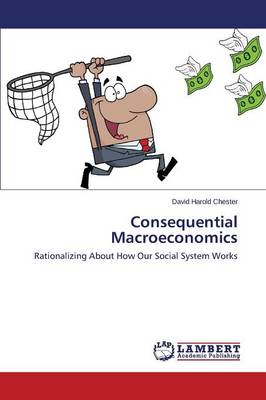
Consequential Macroeconomics
Chester David Harold (author)
Paperback Published on: 02/02/2015
Price: £59.00