

Reviews: Communion (7)
“Phenomenal storytelling!”
(Hardback)
I would place good money on this book winning multiple awards. The writing is quietly masterful, and Doyle brings his setting and characters to life in an immersive, authentically Welsh tale I didn’t want to end. Feels like an instant classic.
“Delicate but Dense Exploration of a Young Man Adrift”
(Hardback)
This is a subtle and moving novel about a young man with a good heart who cannot find his place. The story of the gradual unravelling of a man who just wants to do good. Against the backdrop of the staging of the Passion Play the parallels with Judas are evident. Cormac (Mack) joined the seminary more from a desire to serve the community that a deep-rooted vocation. He has left(did he jump or was he pushed?) and returned home to Port Talbot a town faced with having its heart ripped out by the threats to the steelworks. The town is hosting a Passion Play fronted by a local boy made good (clear echoes of Martin Sheen) and this serves to focus wider media attention on the town and the upcoming strike. The steelworks which dominates the town is threatened and with it the sense of self of many of the (male) workers. There are environmental tensions bubbling beneath and a dose of family strain. In all it is a complex situation but subtly delineated and held together by the character of Mack. The town and the works are described in gritty yet luminous prose. The atmosphere of toxic masculinity and the tentative connections between characters are beautifully described. The scenes are so vivid I found myself thinking this is a fabulous book but it would also make an amazing movie.
It raises questions of service, faith and connection and a novel which makes you think is the best sort. I really enjoyed reading this debut and will eagerly await another from Jon Doyle. A brief shout out too for the cover design one of the most beautiful and striking I have seen in ages. It will make readers pick up the novel and they will be glad they did.
Thanks to Atlantic Books for a review copy in exchange for an honest opinion.
“Fantastic Debut!”
(Hardback)
Thank you to the publishers for this early review copy.
It arrived yesterday afternoon and I devoured it straight away - the blurb sounded brilliant and it was compared to two of my favourite books - Close to Home by Michael Magee and Trespasses by Louise Kennedy so it obviously couldn't join the to be read towers.
The writing is superb, the plotting is tense and well paced.
Adored the characters, honestly at no point could I put the book down.
Sign me up now please for whatever Jon Doyle writes next.
Highly recommended.
“Extremely good”
(Hardback)
Mack O'Brien didn't anticipate returning ten years later, unordained and at odds with his faith, when he left his Port Talbot home as a youngster to attend the seminary. He is still devoted to the concept of living a virtuous life back in his childhood bedroom, but he isn't quite sure what that entails. He accepts a position as a security guard at the nearby steelworks and embarks on an uncomfortable journey into the world of business, fraternity, and community that he previously despised. What follows brilliantly captures life in a small town and a character returning back into it whether he wants to or not.
This reviewer received a free of charge product for review.
“Intelligent examination of some complex themes”
(Hardback)
This book featured in the 2026 version of the influential and frequently literary-prize-prescient annual Observer Best Debut Novelist feature.
Interestingly it is one of the top books on the eight strong list to centre in effect a Catholic Priest and in a way very different to is typical in say Irish literary fiction where Catholic Priests or Nuns are portrayed as part of an oppressive/abusive/backward looking society (as one novel recorded it in effect moving the colonisation of Ireland from England to Rome) – here instead featuring men struggling to reconcile the strict demands of priesthood with their personal convictions and passions.
Here the close third party narrator is Mack (Cormac O’Brien) – who some years before the novel’s setting in Holy Week 2011 in Wales’s steel-plant industrial town of Port Talbot (famously and crucially the crucible for three famous actors – Anthony Hopkins, Richard Burton and featuring as an unnamed character in the novel Michael Sheen) – as a teenager went to a nearby seminary for a decade or so to train as a Catholic Priest rather to the bafflement of his steelworker father Jackie and the quiet pride of his mother.
However things at the seminary did not work out – Mack’s increasing focus on faith-driven activism causes the seminary authorities to question the motivations for his calling – and now he is back and has taken a job as a security guard at the steel plant. And the week itself is a momentous one – the famous actor is staging an interactive Passion play as an interactive community event (as did actually occur) and this also coincides with a strike at the plant to protest against the overseas owners plans to make the production more environmentally but less employment friendly (these actions did and still are occurring although I don’t think there was a strike that weekend – more that the play itself told the Gospel story as one where the Romans were in effect the overseas plant owners).
Mack has an unclear involvement in both – a reluctant (and inconsistent) apostle in the play co-opted by his father, and under conflicting pressure from the steelworkers and from his employer (and fellow security guards tempted by a bribe of extra pay – thirty pieces of silver perhaps) as to whether to join the strike.
In a further piece of narrative action – perhaps the most impactful for Mack – shortly before he quit the seminary he was visited by Siwan. He and Siwan had an odd relationship as children – subject to weekly trips to the town’s cinema, and arrangement connected (in ways the young Mack never quite worked out) with some issue with Siwan’s Mum (perhaps only now realising it was effectively his mother offering a childcaring break). In the seminary however Siwan wants to confess to him – but an odd confession with he not yet (or likely to become) a priest and she confessing to something she is about to do ……. Mack then finding in another conflict as to what to do with the information given he feels, despite his lack of vows, bound by a seal of silence. And this week Siwan re-appears and Mack finds himself even more implicated in her proposed action.
And there are many other strands to the novel: the local Priest is about to retire with ill-health, a retirement that he had always assumed would have a ready made replacement in the newly ordained Mack, and the Priest seems to be closer to Siwan and possibly her actions than Mack would expect; Mack and Siwan find themselves drawn back to the now boarded up and derelict cinema – the only real place they historically encountered each other; Mack’s mother prays for souls in purgatory – but not friends or fellow congregants but for example 9-11 victims – watching videos obsessively; Mack has some odd encounters – one with a man apparently contemplating suicide, a closing one with a man dressed as a Roman Centurion who may or may not be a very convincing extra from the passion play – and against all of this the strike, the passion play (scenes of which we glimpse or are immersed in) and the church events of Holy Week play out.
This is not a novel for those who want clear answers and plot resolutions – little is spelt out (the seal of silence Mack took giving I think an excellent literary motivation for why we never hear what Siwan confessed to him albeit we can work it out) and the novel ends with more of a sense of mystery than closure.
It is instead one for those who want intelligent examination of ambiguous themes: what does it mean to have to live under expectations (of carrying on the traditions of a working class industrial community or the even more ancient traditions of the Catholic church) – and (linking to the play) what roles and parts are we required to play; how does one reconcile the strictures of institutional faith with the apparent activism of the Gospels; how does the free market interact with community cohesion and in particularly how are the livelihoods of working class industrial communities reconciled with environmentalism (some of the discussions here resonate even more strongly today) – or in other words how can the traditions of the past be reconciled with the emergencies of the future (which again links to the way in which the Passion play is retold as well as to Mack’s seminary struggles).
Returning to my introductory remark I will be interested to see how literary fiction readers react to the faith aspect – one of the various aspects of the relatively narrow world view of such readers (and the editing/writing community) is view to Western religion somewhere between antipathy and apathy – to perhaps put it another way their catholic tastes do not typically extend to Catholicism. However – this year a Booker judge famously wrote a memoir about her married Catholic Priest father (and someone who has written on the origins of Christianity as an institutional Roman religion) – so this novel has to be in strong Booker contention and would I think be a fascinating inclusion.
This reviewer received a free of charge product for review.
Page of 2
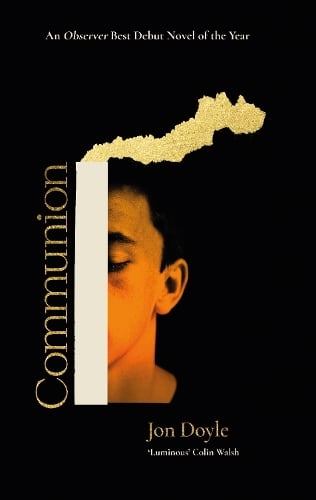
Communion
Fiction, General Fiction
Jon Doyle (author)
Hardback Published on: 02/04/2026
Price: £17.99