

Reviews: Collapse (1)
“Good, but a little dated now”
(Paperback)
Diamond is well qualified to write this as he is Professor of Geography at the University of California. In this book he looks at the reasons why some societies survive and others fail.
The first chapter of the book considers Montana, it seems slightly odd as this is still a functioning state, but it has dropped to 49th in the state income chart from one of the top earners. It has always been a mining and logging state and is blessed with some of the most beautiful landscape. And yet there are underlying problems there; mine owners that have extracted the ore and have not considered the costs incurred with clean up; forests fires that proper management would reduce but that the local population won’t consider; invasion of non native species that have in certain case devastated local species, and so on. Part of the reason for the decline is people who live there temporarily and are not prepared to be part of the local community by paying taxes, but still want the landscape to remain as it is. Montana is dependent upon external monies coming in now, and if those were to dry up, then its circumstances will become perilous.
Diamond looks at the evidence for Easter Island that suggests the reason for its decline was that the local population had eaten all the native animals and felled all the trees. This led to rapid erosion of the soils and further degradation of the landscape. By this time the natives had been contacted by Europeans, who bought with the diseases such as small pox, and their fate was sealed.
Diamond then expands these theories of societies collapsing by looking at The Pitcairn Islands, The Chaco and the Maya. All of these had substantial populations in their time, and either had consumed most or all or their resources locally, or were living at the limit of what the environment could sustain. All it took was a shock of some form, i.e. a drought, and the population would take a dip, either temporarily or permanently.
The next three chapters look at the Vikings. Most people know of the violent expansion of these Scandinavian people into England and France, but they also established settlements in Iceland and Greenland. They arrived there just as the climate was favourable, and brought with them their farming techniques from Europe. The environment there is very fragile, and with the import of livestock to the land stripped back the trees and the grass. This led to significant erosion of the landscape and made a perilous existence even more susceptible to shock. They failed to learn from the Inuit people, who used the local resources sustainably. The Norse are still there in Iceland, but parts of the landscape there have been devastated.
The third section of the book looks at the state that some modern societies are in; China, Australia, Rwanda, Haiti and the Dominican Republic. Each of these have particular problems from over population to corruption to serious environmental issues. For each there is a detailed description of the problems that they have got, either of their own making, or because of external factors like weather.
The final section is about how we as a planet can deal with these problems. He gives examples of oil companies who now routinely start with the best environmental methods as they know it saves them money in the long term, gives them credibility and more opportunities. He compares these to mining companies who frankly couldn’t give a monkeys, and who use all the political clout they have to pass all the cleanup costs to the state, even to the point of declaring bankruptcy to avoid these costs and staring a new company soon after.
He then list the twelve points that he thinks will have to be resolved, note not solved, as he thinks that these may be resolved by violence and war. He detail two of the organizations that are trying to put in place sustainable organizations, and showed that consumers are aware of them, and what they are trying to achieve.
He sees see some hope though. Humanity would not have got this far if we had always eradicated ourselves at each stage. That said, he does realise that we are at the point where our action will affect millions of people unless we do something soon.
This was an interesting read. Diamond has written a comprehensive book detailing all manner of reason why a society fades or suddenly ends. Even though I found it fascinating, I have only given it three stars as it is now out of date, and I feel could not do with being re written. I have one of his other books on my shelf, and I aim o read that soon.
The book can be summed up though by the American Indian quote: “When the Last Tree Is Cut Down, the Last Fish Eaten, and the Last Stream Poisoned, You Will Realize That You Cannot Eat Money”
Page of 1
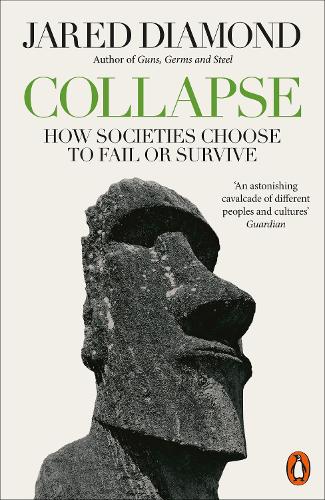
Collapse: How Societies Choose to Fail or Survive
Non-Fiction, History , General History
Jared Diamond (author)
Paperback Published on: 30/06/2011
Price: £18.99