

Reviews: Citizen Clem (1)
“The Sheep that Roared”
(Hardback)
Clement Attlee over the years, not only since his death in 1967, but also throughout his life time has been underappreciated, even by his own biographers, who either damned him with faint praise, or attacked his record, or the person ‘a sheep in sheep’s clothing’. The Labour Party itself has always had an ambiguous relationship with Attlee, despite the great electoral and legislative successes he presided over. Frank Field MP rightly stated in 2009 that the political class in Britain ‘have a too limited an appreciation of Attlee’s values’.
John Bew shows why he is not only a highly regarded professor of history and an award winning writer with Citizen Clem. Unlike previous biographies Clem, Bew does not just focus on Attlee the politician but also Attlee the man and has not be held prisoner to view him via the prism of 1945. Bew shows that Attlee was one of the Labour Party’s formative pilgrims, who from a position of privilege, used that to fight for the people of the East End, whom he lived and served amongst from 1906.
Bew also shows that the attack that usually came from the left that used to say Attlee had no hidden depths, had no intellectual substance or serious political thought and that he was nothing but an empty vessel, were vacuous. Through excellent scholarship he consciously gets to the depths of Attlee the person which were the foundation of Attlee the politician, and shows the depths of Attlee others either ignore or never bothered to investigate.
Before Attlee even entered Parliament he came to recognise that there needed to be two principles that guided the Labour Party, patience and tolerance, something the Party has always had problems with. Rather Attlee found that Kier Hardie’s approach to achieving socialism was far more appealing than that of utopianism or intellectualism. Having worked with the Webbs, he came to understand that the Fabian approach to politics showed the inherent limitations of intellectualism. Attlee also found that a mistake socialist intellectuals made (and still make e.g. Brexit) was assuming that something they found distasteful would be equally so to others.
Bew shows that not only being a soldier in the First World War, as well as being a social worker in Stepney and the east end, deeply affected everything that Attlee did in later years. Bew shows that from his work in the east end the recognition that improving conditions for workers, such as wages and work hours, insurance and healthcare was the first battle the labour movement and the Party not only needed to fight and win, ran deep within Attlee.
Bew also reminds us that Attlee began his career as Ramsey McDonalds PPS and supported him in 1924, even in the General Strike in 1926, it was MacDonald’s betrayal of the Party in 1931 which was one of the bitterest blows for Attlee. But Attlee remained a loyal Party man, whereas people forget that Herbert Morrison was offered a job in the National Government as was that great left-winger who joined the Labour Party in 1930, Stafford Cripps, both prevaricated for a week, before finally turning MacDonald down.
When Attlee became leader in 1935 Bew reminds us that at no time had he ever lobbied for the position, and even the Daily Mail struggled to paint the Labour Party as dangerous. What must be remembered that it was Attlee that led the attacks on appeasement and that it was Attlee who would later place Churchill in Downing Street. Even when war came not only did Attlee have to lead the Party he still had to fight his own MPs!
Citizen Clem reminds us that we still live in a world that is heavily influenced by the works of Attlee, and that the post-war consensus with both the United Nations and Nato came about through his work and determination after the war. But in Britain when we look what was created under Attlee’s guidance, the National Health Service, the Welfare State, National Insurance. We are reminded that no British Government since Attlee led, has been as active in terms of legislation passed, especially when it came to changing the relationship between the state on society.
One thing that is clear from this excellent biography is that Attlee was very adept in the arts of modern elections, probably more so than many of his critics, and that he was always held in high esteem by the public. One thing Attlee did fear, and this was in 1955, that the political leaders were less in touch with the man in the street than they were 50 years prior, despite the populism of mass media and broadcasting, somethings do not change clearly.
John Bew makes it clear that throughout his life Attlee never saw himself as a hero, never claimed credit, for what others did within his government. What comes through is that something that Attlee was proud of was the fulfilment of three main strands in politics; one to atone for the betrayal of those who sacrificed themselves in World War One. It was a mission fulfilled that the promises made to those in World War Two were kept in 1945; secondly, that his government had fulfilled its mission on social legislation; finally, mission fulfilled was to bring an end to Queen Victoria’s British Empire and turn it in to the Commonwealth.
The story of the Labour Party in the 20th Century, is not defined by what Tony Blair, Harold Wilson or Jim Callaghan did, but by pioneers such as Attlee. Much of what we British hold dear about our society a quiet, somewhat shy and unassuming man got on with the job and proved that a sheep can roar, and that roar has left its mark on British politics today.
The number of books on Churchill has created an imbalance in many people’s understanding of the twentieth century, its wars and its governments. It was in a debate with Attlee that Churchill declared that history would be kind to him, because he intended to write it. Attlee was an equal to Churchill, who has delivered a lasting change for the many, rather than the few.
John Bew has written one of the best political and historical biographies, that deals with all aspects of Clement Attlee’s life, good and bad. This is one of the most honest, and balanced accounts of Attlee’s life that I have read and uses a wide range of sources to give plenty of colour to a Prime Minister often over looked. As the Labour Party fights amongst itself once again, as Morrison referred to it as a suicide club, Attlee knew that the Labour Party needed to compromise and that the purism of Morris and Marx was incompatible with delivering a better Britain.
Simply a stunning and brilliant biography of Clement Attlee, a socialist who delivered for the people of Britain.
Page of 1
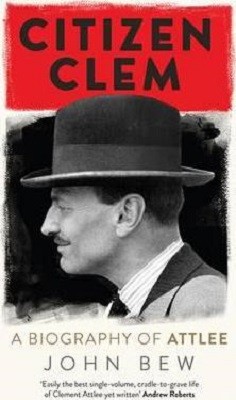
Citizen Clem: A Biography of Attlee: Winner of the Orwell Prize
Non-Fiction, Biography & True Stories, Literary Biographies
John Bew (author)
Hardback Published on: 01/09/2016
Price: £30.00