

Reviews: Case Study (7)
“thought-provoking, funny and utterly brilliant.”
(Hardback)
Case Study is the fourth novel by best-selling award-winning Scottish author, Graeme Macrae Burnet. Two years after her older sister suicides by throwing herself off a railway overpass in Camden, a young woman becomes convinced that notorious psychotherapist A. Collins Braithwaite is responsible for her death. Determined to prove his guilt, she poses as a patient, writing detailed notes of her sessions with him.
Over fifty years later, her cousin Martin “Grey” discovers the five notebooks and offers them to the author, who happens to be researching the psychotherapist with a view to writing a biography of this now-forgotten, disgraced character. At first sceptical, the author eventually decides to supplement his own material with the notebooks because, if nothing else, they tell an interesting story.
The young woman does not reveal her identity in her notebooks. For the purpose of her visits to Braithwaite, she adopts a persona she names Rebecca Smyth, creating for Rebecca an alternate life quite different from her own strictly controlled existence. Rebecca’s life is so attractive, she begins to inhabit it, rather losing sight of her initial objective as she is swept up in Braithwaite’s “therapy”.
This unnamed protagonist is clearly unworldly, her scheme evidence of a naïve arrogance. She is immature with a childlike self-absorption, admitting about herself: “I have understood from an early age that I am an unpleasant and spiteful person. I am unable to see events in any terms other than their benefit or injuriousness to myself.” Her thought processes often prove darkly funny.
With later visits, it’s clear she is losing touch with reality, having conversations and arguments with Rebecca; at one stage she records an exchange with Braithwaite thus:
“’I don’t believe I’ve ever encountered anyone quite as hollow as you. I’m beginning to wonder if you really are who you say you are.’
‘I often wonder the same thing,’ Rebecca responded, rather deftly, I thought. (She is so much brighter than me; I sometimes wonder whether I shouldn’t let her take over completely)”
The last notebook offers no clue as to the young woman’s ultimate fate, but her “progress” during the first four sessions with this unconventional man don’t suggest a promising future. Braithwaite, from the author’s research, is variously described as a “cheerleader for suicide” (having written a book titled Kill Your Self) and a “dangerous charlatan” who, throughout his life, never faltered in his conviction of his own genius.
While readers generally don’t skip over the prologue, many are tempted to ignore any post-script, but, as with previous Macrae Burnet novels, this is unwise as the Post Script forms an integral part of the whole. Once again, very cleverly written, Macrae Burnet’s latest work is thought-provoking, funny and utterly brilliant.
This unbiased review is from a copy provided by NetGalley and Text Publishing.
“Self-abnegation”
(Hardback)
A woman throws herself off a railway bridge after yet another visit to her psychiatrist. This is the journey her sister makes while trying to discover why she committed suicide.
A well written novel that has lots of twists and turns. Also, filled with interesting insights into the science of the mind and views about the self. These are woven into an excellent piece of fiction. I recommend this read.
“In a Name”
(Paperback)
Graeme Macrae Burnet has delivered an oddly fascinating book in “Case Study” which will have you trying to keep things balanced as you strive to lock down what is real. This is a book of fiction… probably. The characters are fabrications… probably. The narrators are reliable…well, not really. And so it goes.
“GMB” has contemplated writing a biography of Collins Braithwaite, a flakey, flamboyant psychoanalyst who was once the toast of 1960’s London. Braithwaite could boast celebrity clients and anti-psychiatric best selling books with titles of “Untherapy” and “Kill Your Self.” One day GMB is presented with journals of an unnamed woman whose mission was to prove Braithwaite’s direct responsibility for the suicide of her sister, Veronica. This woman’s strategy was to become a patient under an assumed name, Rebecca Whyte, with a completely different identity– this so she could avoid any connection to her late sister.
We see Braithwaite for the cad he is. He is cruel to women, dangerous and manipulative with the lives of those who put their trust in him. Meanwhile we see the created character of Rebecca, who began merely as a cloaking device, evolving into a “self” fulfilling needs her original personality craves and has never allowed herself to indulge.
“Case Study” poses a number of questions regarding psychiatry and the search for one’s true “self,” but keeps you off-guard with unreliable sources throughout. Its humor and utterly original characters earned it a spot on the Longlist for the 2022 Booker Prize. Highly recommended.
“‘But what’s the point in being someone you’re not?’ I said. ‘What’s the point in being whoever it is you think you are?’” – Unnamed… or, was that Rebecca?
I received an advance review copy for free, and I am leaving this review voluntarily.
“Very Clever idea,well writtem”
(Paperback)
Clever book, a young naive women believes a notorious psychotherapist, Collins Braithwaite, is to blame for her sisters suicide. She adopts the name Rebecca Smyth and creates a character that she is a woman if the world.
Collins is charismatic and a borderline con man. He plays on his notoriety and listens to 'Rebecca' and her problems. He doesn't help but listens, making her uncomfortable.
The young woman's character begins to take over her life and she appears to be descending into madness.
Some of the book is a fictional account of Braithwaite life and very well done.
I found parts quite slow but the difference between the two characters is well written.
“Disarmingly Charming And Deliciously Nasty”
(Paperback)
It’s to Graeme Macrae Burnet’s credit that, even after Googling to double-check, I’m still only 95% certain that both his main characters are fictional.
The book intersperses the journals of an anonymous woman (“Rebeca Smyth with a Y” to the people she meets in her retelling) with Burnett’s ‘biographical research’ into Collins Braithwaite, a famous psychotherapist working in 1960’s Camden Town.
I was totally into Rebecca’s deeply antisocial behaviour - she’s fragile and nasty and brilliantly inappropriate. We’re not laughing at her, but the absolute lack of concern for others, and her transparently warped view of herself that Burnet creates, has an uncomfortable and slightly cruel humour to it that I really relished.
Not a guilty pleasure as such, but a licence to revel in someone else’s bad behaviour that I found very satisfying.
Braithwaite is an equally monstrous creation, but the brutish charm and charisma that makes him so appealing ‘in-world’ absolutely translates to the reader’s experience. He is reprehensible but appealing.
My engagement with both of the characters was not unlike the sick appeal of a slow-motion car crash.
I read this in a day and wondered where the time had gone - that’s how engaging Burnet’s writing is.
I was so sucked in that, as the characters’ sense of what is real unravelled, and as the ideas of identity, persona and self got mixed and muddled and twisted out of shape, I felt genuinely set off-centre looking up at the real world off the page. (It probably added to the experience that I chose to take myself up to Primrose Hill once I realised that is where a big chunk of the story is set)
Deceptively accessible, mischievous, perverse and gleefully nasty, this was, for me, a spiteful and selfish delight.
Unanchor your mind and let Graeme Macrae Burnet mess with it for a bit. You can pretend you didn’t enjoy it later.
Page of 2
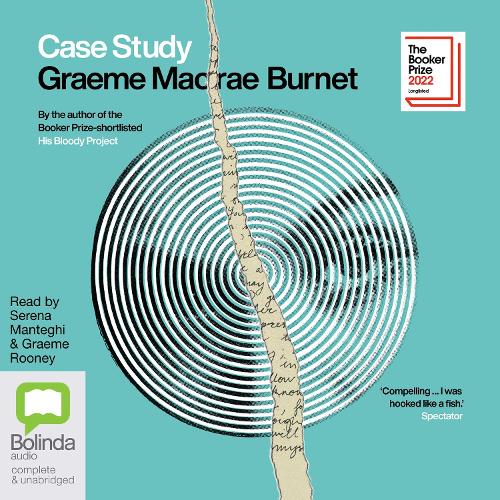
Case Study
Graeme Macrae Burnet (author) , Serena Manteghi (read by) , Graeme Rooney (read by)
CD Published on: 07/10/2021
Price: £20.98