

Reviews: Bizarre (2)
“An Utterly Captivating Look At The Oddities Associated With Brain Function”
(Paperback)
Bizarre is a fascinating and unputdownable book on the weird and wonderful oddities and miracles of our brains. As someone who has a whole shelf dedicated to everything written by the illustrious Oliver Sacks, I knew that I was on to a winner if this could come anywhere close to as intriguing and entertaining as each of those; let's just say, it didn't disappoint. In fact, rarely have I discovered neuroscience covered in such an eminently readable style - Dingman has toed the line perfectly between keeping the backbone, depth and detail of what he's talking about and not introducing too much terminology that a layman may have trouble understanding. I feel anyone from teenagers right through to elder generations would find this both accessible and comprehensible.
The chapters titles, which give you an idea what will be discussed, are as follows: Identification; Physicality; Obsessions; Exceptionalism; Intimacy; Personality; Belief; Communication; Suggestibility; Absence; Disconnection; and Reality. In each chapter, several related illnesses or syndromes presumed through research to be precipitated or caused by brain abnormalities are explained, and examined and the narrative liberally and enthusiastically infused with a plethora of real-world examples of patients suffering from those conditions. They cover more widely known disorders such as Obsessive Compulsive Disorder (OCD), hoarding behaviours and lycanthropy through to those that are lesser known, which goes for 99.9% of disorders in these pages. A must-read for anyone interested in neuroscience and how the human brain functions.
“Fascinating”
(Paperback)
I’m fascinated by why humans do the strange things we do. This book answered some of the questions I’ve had, as well as some I didn’t have until I started reading.
While I have an interest in neuroscience, I don’t have a scientific background so am usually hesitant to dive into books that explore it. The blurb made this one sound like it would be accessible without a bunch of prior knowledge so I took a chance. I loved it so much that I practically inhaled it.
I have so much more appreciation for the complexities of the brain and how much we still don’t know about how it works. Given how many of its parts are involved in tasks that we often do without a second thought, it’s astounding that we function at all.
“Just speaking a simple sentence, for example, requires the successful execution of operations such as word retrieval, the application of syntax (i.e., the rules used to properly arrange words in a sentence), coordinating the activity of the muscles involved in speech, sprinkling in appropriate changes in tone and pitch, and so on. Each of these tasks might require the contribution of different parts of the brain, causing language to be reliant on a large number of functioning brain regions for it to be fully operational.”
This book explains how the different parts of the brain work but I’m also much more aware now of the many ways that things can go wrong. Illness, trauma and other unexpected bumps in the road that affect even one part of the brain can have life changing consequences.
Each chapter covers a different area of behaviour: identification, physicality, obsessions, exceptionalism, intimacy, personality, belief, communication, suggestibility, absence, disconnection and reality.
There are so many disorders and syndromes covered in this book, some I’d already heard of but others that were new to me. There’s Cotard’s syndrome, where you’re convinced you’re dead or have lost organs, blood or body parts, and Capgras syndrome, where you believe people close to you have been replaced by imposters. There’s clinical lycanthropy/zoanthropy, pica, hoarding, objectophilia, dissociative identity disorder, the placebo effect, folie à deux, agnosia, alien hand syndrome, Alice in Wonderland syndrome and more.
“Despite how strange some of them may seem, they often just represent the extremes of the spectrum of normal human tendencies - and they are not completely foreign to us.”
A lot of the stories will stay with me but probably none more so than that of Kim Peek, who had a condition called an encephalocele, “where an incompletely developed cranium allows part of the brain to bulge outside the skull - potentially twisting, distorting, and damaging brain tissue in the process.” Despite considerable brain damage, Kim was able to do something extraordinary.
“He eventually could read a page in 8 to 10 seconds while memorizing all the information on it. He even began reading and comprehending the right and left pages of a book simultaneously (with his right and left eyes).
By the time he died in 2009 at the age of 58, Kim had read - and memorized - more than 12,000 books.”
Morbid curiosity may make you want to read this book but, thanks to the author’s approach, you never lose sight of the fact that these are real people you’re reading about, people who have often suffered greatly as a result of what’s happening in their brain.
This book did what I’m always looking for in non-fiction. I learned plenty of interesting new things. It held my attention. It made me think. It made me want to learn more.
Content warnings are included on my blog.
Thank you so much to NetGalley and Nicholas Brealey Publishing, an imprint of John Murray Press, for the opportunity to read this book.
Page of 1
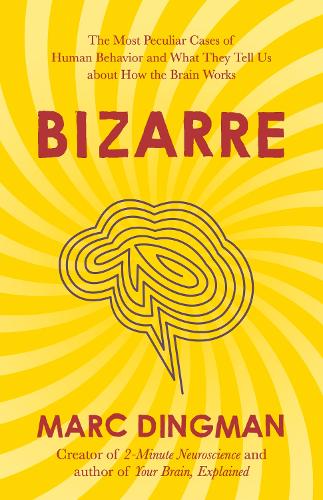
Bizarre: The Most Peculiar Cases of Human Behavior and What They Tell Us about How the Brain Works
Non-Fiction, Science, Study & Work, Smart Thinking
Marc Dingman (author)
Paperback Published on: 08/06/2023
Price: £14.99