

Reviews: Big Meg (7)
“interesting and sometimes gob-smacking, informative, entertaining and even amusing.”
(Hardback)
4.5★s
Big Meg is a non-fiction book by Australian palaeontologist, explorer, conservationist, and climate change writer, Tim Flannery, and his daughter, scientist and writer, Emma Flannery. The Megalodon tooth that seventeen-year-old Tim finds after a flood initiates a life-long fascination with the world’s largest-ever predator.
But, being a shark, the only fossil finds are teeth and some vertebra with growth bands that offer some idea of growth rate and age; there are no bones, so scientists can only speculate on its physical form and shape.
What is known about Megalodon is that it had a lifespan of up to 100 years, was probably warm-blooded, born at up to two metres long (probably aided by voracious intrauterine cannibalism of siblings) and a fast growth rate to an adult length of fifteen to possibly twenty metres.
Their diet is known, to some extent, from their tooth marks on the fossilised bones of their prey. Comparison to other sharks indicates that they’re not descended from, or ancestors of, the great whites, a comparison that will see readers knowing more than they ever thought possible about sharks without getting bored. One of those many sharks mentioned, still living in our times, is the cookie-cutter shark: from the description of how they feed, definitely one to avoid!!
The large birth size and rapid growth rate are possibly what allowed the Megalodon to become a gigantic super-predator, preying on other large predators, likely including other Megalodon. Members of the lineage thrived for fifty million years, and Megalodon was around for 20 million years, then, in the space of about two million years, were extinct: a mystery.
Scientists employ many sophisticated techniques to try to pin down the when of that extinction, hoping thereby to discover the why, but not all are useful. Theories on the why include the Earth’s cooling possibly affection food availability, the reduction in nursery grounds, sea level changes affecting migration routes, and I creased competition from other predators.
The abundance of Megalodon tooth fossils, weighing up to 1.4kg, can be attributed to the fact that many sharks completely replace their dentition every few weeks. Humans put those plentiful fossils to numerous uses: as jewellery, protection against evils, as hunting charms and as tools. In the 17th Century, the Megalodon tooth was believed to detect poison, to turn the evil eye.
Flannery describes the people who chase these fossils and the lengths to which they will go, diving in dangerous conditions, losing their lives. He describes how poachers frustrate researchers; how movies and TV have changed attitudes to sharks; how deterrents are of questionable efficacy.
Chapter 10: Shark Eats Man describes the many encounters that humans have with sharks and quantifies the risk: “The risk of death from attack by any shark is very small – around 1 in 3.7 million. That is minute when compared with the risk of being shot and killed in the USA (which in 2020 was about 16 in 100,000) or being killed in a car accident.” But it also warns that even in the Amazon River, when there are already many potential dangers, attack from a bull shark can occur 4200km inland. Chapter 11: Man Eats Shark comments on shark nets and the particular cruelty that goes into making shark fin soup.
The authors’ extensive academic credentials certainly lend weight to whatever conclusions they draw about this enigmatic creature. There are four colour plates to enhance the text, a handy index and four pages of comprehensive references. Flannery has a talent for taking a potentially dry topic and keeping it interesting and sometimes gob-smacking, informative, entertaining and even amusing.
This unbiased review is from a copy provided by Text Publishing.
“Big Meg, Big Fun”
(Hardback)
As someone who is already fascinated by the ocean and, in particular, sharks, I couldn’t wait to read this and it didn’t disappoint! Full of amazing facts and stories about what may have been the largest marine predator that has ever lived, this is a captivating read.
“An exhilarating dive into the life and times of an oceanic leviathan”
(Hardback)
Thanks to Penguin for sending me a proof copy in exchange for an honest review, which you can find below.
4.5
As someone who never really grew out of the mandatory childhood dinosaur phase, any book about an enormous prehistoric shark was always going to be right up my street. However, Big Meg was even better than I anticipated. As well as all of the expected details on probably the largest carnivore in Earth's history, this book also contains fascinating meditations on sharks and their roles in history. Both of the authors' experiences are added to discussions on topics as diverse as the collection and usage of fossil shark teeth, the roles played by sharks in a wide variety of ecosystems and even the often-problematic relationship between humans and sharks (Jaws certainly has a lot to answer for). The volume is fairly short but manages to cover an impressive amount of ground. Sections such as that on the status of Malta as a haven for Megalodon teeth definitely inspired me to carry out further research. In contrast, the sobering details on the decline of many modern species of sharks are moving and provide a powerful testament to the destruction wrought by humanity, a far more mindless and efficient killing machine than any villainous B-movie Megalodon. It is a testament to the skill of both writers that a book covering such a mysterious subject still manages to be so gripping, and Big Meg is certainly an essential read for anyone interested in biology or palaeontology, or those simply wanted to read about 20-metre long sharks (this author falls into both sides of that Venn diagram).
“Interesting to a point...”
(Hardback)
For a book about the megalodon shark there is remarkably little about the megalodon shark in the book. This is not a surprise as very little is genuinely known. The authors present what facts are know clearly and concisely. But be aware there is a lot of speculation and the last half of the book features very little about the megalodon at all. The second half details the locations of the megalodon shark tooth discoveries and talks more on the modern world rather than the era of the megalodon with chapters dealing with shark attacks and humanity's impact on sharks. I know this review may seem negative but I was not expecting a book going into great detail about megalodon sharks. Their biology is largely unknown as in their behaviour in terms of both hunting and interaction with it's own kind. The book is interesting though. Its engagingly written and goes give us the latest facts about the megalodon. One shame is that there is a lack of illustrations in the book. It would have been useful to have drawings of the various teeth of different species that are compared in the text along with biological potential body shapes and jaw structures though. Overall a decent read.
“My Megatooth Imagination Went Wild. Such Fascinating Insights Given Alongside Research & Recent Findings”
(Hardback)
I read Meg, The Trench & Goliath by Steve Alten when they first came out & ever since I've been obsessed with how a creature as large as the Megalodon could have existed. Jaws scared me silly but the meg was different for some reason, same but different, I needed to know more. Where & how did we find evidence? How could one have survived under so much pressure? Where did they fit in the ecosystem?
Why were they so big?
Through the evolution of sharks, discoveries of teeth & historical research, I found myself wishing to have seen these beasts in all their terrifying glory, preferably from afar, & wondering if we might ever discover a full-bodied fossil.
Not many pictures, just a couple in print at the front but the descriptions of those teeth Tim Flannery has found or had opportunity to visit lit up my imagination.
I got so many answers from this small but informative tome. I was fascinated by the stories, I didn't know Peter Benchley had a species named after him, & there is still more research about megatooth sharks to be found with technology constantly updating.
I had no idea how many people obsess over these teeth, the history of their meaning, how many types there are.
If you didn't have the bug before, Big Meg will set your eyes & fingers again to those sharp looking, strange coloured smooth edges on fossil beaches & barren wastes. I know I will.
Thank you to Doubleday for my gifted early copy.
Page of 2
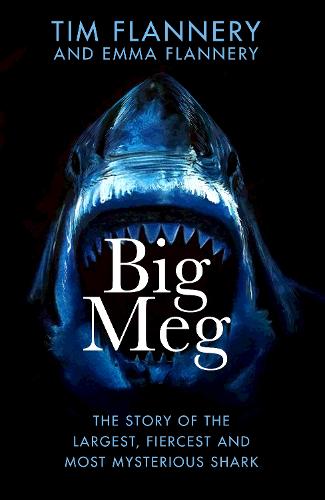
Big Meg: The Story of the Largest, Fiercest and Most Mysterious Shark
Non-Fiction, Language & Reference, Nature Writing
Tim Flannery (author) , Emma Flannery (author)
Hardback Published on: 07/09/2023
Price: £16.99