

Reviews: Baumgartner (12)
“Brilliant and Frustrating”
(Hardback)
I'm torn about this book. I loved it, right up until the very end. It reminded me of Anne Tyler's work when she is at her best, focussing as it does on someone on the margins of life and exploring with great tenderness and nuance their experience. Baumgartner is still in mourning for his wife, ten years after she died in a freak accident. Aware of his own ageing, he starts making friends and reconnecting with the world after an accident. As he moves forwards he looks back. It was perfect, subtle, charming, funny and sad. Baumgartner is a great character and I was completely invested in the story. When it finished the way it did, I was so mad I actually shouted. It's not that it's a bad ending. It's just that I don't really know what it is. I need other people to read it so I can talk to them about it is what I need. Then I will have some kind of closure. As it is, I find myself thinking about this at least once a day since I finished it.
“Perfection”
(Hardback)
Ah the joy of reading Paul Auster where do I start......the quality of the prose, the character of Baumgartner, the cleverness of his ideas, how easy the reader moves from one thought process to another....and there's so much more.
Baumgartner looks at the life of Sy Baumgartner, he is a philosopher/lecturer and author and is now coming to the latter stages of his life (he's 72). Moving around through time the novel picks moments of time in Baumgartner's life, in particular his dead wife Anna who he lost a decade earlier and has grieved ever since. His thoughts are always interconnected with his wife's memory and he dwells upon her, memory keeps her alive. His thoughts go to his mother and father and their immigrant past and looks at what is going on in America and the world today.
This feels like a memoir of sorts, there are connections to be made with Auster and his character Baumgartner and one wonders how much personal experience has gone into this novel. This is a utterly moving, compelling read, one the reader should slow down, enjoy and meditate upon its ideas. (less)
“Short, sharp - memorable.”
(Hardback)
A wonderful book. I thoroughly loved this short, thoughtful, humorous and tremendously entertaining to boot narrative. In the first chapter we are introduced to the narrator (a 71 year old philosopher) in a catastrophic day filled with some of the indignities of body ageing.... the novel moves on to other pastures around our Baumgartner professor - intellectual, personal, political... in a deft, surprising and totally captivating manner. We are made to reflect on marriage, work, family, what keeps as going and alive... The narrative is both lineal and collage-like. I loved the different voices and spaces evoked. The final chapter kept me totally hooked and on tenterhooks... a masterful ending. Poignant, life-enhancing. A small masterpiece in my opinion.
“Auster's writing style as always superb, and so emotive.”
(Hardback)
Many thanks to the publisher for an early copy of this excellent book to read and review. This is the story of Sy Baumgartner, philosophy professor and author, living alone. When we first encounter him he is reflecting on his life and still mourning the loss of his beloved Anna some 10 years previous. In his 72nd year his memory is fading as he reminisces and recalls the events both sad and happy of a life well lived. As always Auster's style of writing is easy on the eye, Anna's voice and presence is everywhere as Baumgartner recalls the moments, and the passion of the 40 years they shared together....." She was the one person in the world I've ever loved, and now I have to find a way to go on living without her"...."For such are the powers of memory bestowed on a man who has listened to the voice of his dead wife talking to him through the disconnected wires of a defunct telephone"......"A person has no life without being connected to others, and if you're lucky enough to be deeply connected to another person, so connected that the other person is as important to you as you are to yourself, then life becomes more than possible, it becomes good.".........Highly recommended.
“Psychologically precise prose”
(Hardback)
The previous Paul Auster novel I read was the eventually 2017 Booker shortlisted 4321 – which I had read on a 12-hour plane flight, five months prior to the longlist being announced and (on the whole) enjoyed but did not feel at inclined to revisit at either longlist or shortlist stage. Ultimately the book, for all its excellent writing, had two main flaws – the author seeming to think he had come up with a new fictional concept of parallel lives (when he really had not) and its excessive and seemingly self-indulgent length.
This book is his soon to be published next novel. Its close third person protagonist (although at times we also have a fourth wall breaking omniscient narrator) is Sy Baumgartner, in his early seventies at the book’s opening, “noted author of nine books and numerous shorter works on philosophical, aesthetic, and political matters, beloved member of the Princeton faculty” but also a near-ten-year widower after the death of his life long love and wife Anna (a posthumously published poet) in a swimming accident in 2008, a death from which he has not really recovered.
The book’s opening was for me perhaps its relatively weakest point, although narratively necessary to set up the rest of the book. In quick succession Sy burns his hand on a scorched pot, before falling down his cellar stairs – but then his mind turns, prompted by the pot which is one of the only household items from his married life he has kept, back to the past which is where we spend much of the book as Sy decides to re-examine the process of mourning (one he realises he has until now “thoroughly .. bungled”):
In his own fictional and non-fictional writing (for example in the examination of how the phantom limb concept might apply to loss of a person);
In his dreams (one particularly vivid one where Anna calls him on the disconnected phone in her study)
In his memories (the patchwork nature of these and the why as well as the what he can recall -however seemingly incidental - in almost perfect detail and what has completely faded, is a, probably the, key part of the novel)
In revisiting both his and Anna’s writings (a number of which are reproduced in the text – again which fragments have meaning for his mourning is important to the novel)
In another relationship which he starts (where he realises that the way his mourning makes him inclined towards re-marriage is very different from how his lover’s eventual split from her husband has left her impacted)
And towards the book’s ends in a proposed project from a research student to re-examine Anna’s unpublished work – one which gives the book a satisfyingly open ending.
Given my experience of 4321, it was a surprise to me that I was able to read this in the lounge awaiting a flight, and even more so that if there was an author I was reminded of it was Claire Keegan in the psychological precision of the prose – enabling a whole life, as well as an insightful treatment of memory as filtered through grief, to be set out in 202 generously spaced pages.
Overall recommended.
Page of 3
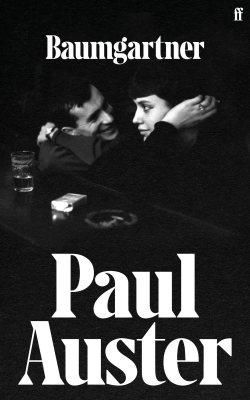
Baumgartner
Fiction, General Fiction
Paul Auster (author)
Hardback Published on: 07/11/2023
Price: £18.99