

Reviews: Austerlitz (1)
““I remember, Vera told me, said Austerlitz …””
(Paperback)
“Austerlitz”, by W.G. Sebald (1944-2001), took me a long time to read. However, the melancholy last few pages, with the unnamed male narrator drawn deeper into Jacques Austerlitz’s story, even after Austerlitz, himself, has undemonstratively left Paris to continue a search for his past, was so affecting and so convinced me that I had just finished a remarkable novel that I went back to the beginning again. I confess that I also re-read “Austerlitz” because, in late June, 2016, in the UK, I wanted to hang on to this most European of books, a book in which the inestimable value of Britain in the 1930s and 1940s as a refuge for those who experienced the rise of extreme nationalism and xenophobia in Germany gradually occurs to one, as does the importance of a shared European civilization in which the narrator is meeting with Austerlitz in such London locations as the Great Eastern hotel at Liverpool Street station or the Greenwich Observatory in one sentence and a sentence later we are in Prague or Paris or Antwerp or provincial towns, such as Marienbad and Terneuzen.
For those interested, this is also a railway book -- from the great urban stations to branch-lines to the tracks leading to the concentration camps – and a book of buildings and their embodiment of the past or their attempt to deny the past; for instance, the fortress of Breendonk through to its occupation by the Germans in 1940; or, following a visit to the old National Library of France in Paris, a tour of the Cartesian monumentalism that is the new Bibliotheque National on the banks of the Seine not far from the Gare de l'Austerlitz. By this point, Austerlitz is suffering both physical and mental trials, and the tour is an assault upon his mind. I can't think of many novels - though the ten or so pages of architectural observations in the Bibliotheque National may make readers question what it is he or she is reading -- that could accommodate such a detailed description, even including a photograph of the central esplanade taken from one of the four glass towers.
Over 400 plus pages, this book has no paragraphs, though there are occasional typographical divides, and this has two contrasting consequences for readers. It prompts an apprehension of the continuity of geography and time; this in a book about Austerlitz’s loss of his own past after he is sent, aged five, on a Kindertransport to live in Balla, North Wales, with foster parents who re-name him and separate him from a past that, in 1939, was already about to become tragic for his own parents. Surprisingly, though, the absence of paragraph divisions, chapters and the other narrative conventions that encourage readers to look ahead, seeking an ending or at least provisional endings, also keeps one concentrated on a single sentence – and this book has some compelling sentences.
Sebald’s other main formal device arises from Austerlitz’s excess of reticence and reserve, before opening up. Accordingly, Austerlitz tells his story to the narrator over a series of meetings in different places, beginning, in Antwerp railway station, in 1967 and coming up to 1997. Each conversation induces a slowly increasing melancholy that engulfs the reserved narrator as well, to the point that, at the end, he returns to an architectural site visited first in 1967 but with Austerlitz’s story pressing upon him. We are reminded of the resulting crucial delay in the story of Austerlitz awaking to his past reaching us, as readers, by interjections; for instance, “I remember, Vera told me, said Austerlitz …” at a point when Austerlitz is retrieving part of what happened after 1939 from a close friend of his parents, before relating it to the narrator who shares the knowledge with his readers. These mediations in the story getting told initially keep us at a distance, only to build up the terror that Austerlitz encounters and that affects the narrator – yet without the terrors being directly described, though Austerlitz draws on H. G. Alder’s account, from 1945-47, of the organization of the Theresienstadt ghetto. After decades of deadening himself to his own past, Austerlitz comes to a heightened, almost physical, sensitivity to his environment and its historical, collective memory. “Documentary fiction” was Sebald’s own definition of a book that also includes photographs, apparently bequeathed to the narrator by Austerlitz.
Finally, it is the almost impassive tone of the narration, Austerlitz’s and the narrator’s, that makes it difficult to let go of the book. I read two obituaries of W. G. Sebald on-line and although I am accustomed to ads and video flashing up on screen, I winced at the contrast with Sebald’s ruminative writing, elaborate not in the decorative sense of the word but extended and discursive. It is such a deeply European and early- to mid-20C novel that a reference to the narrator and Austerlitz waiting in McDonald's at Liverpool Street strikes one as a location from another world.
Page of 1
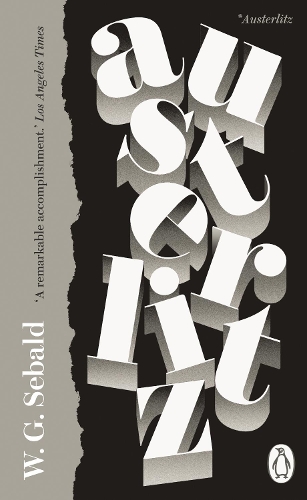
Austerlitz
Fiction, General Fiction
W. G. Sebald (author) , James Wood (author of introduction) , Anthea Bell (translator)
Paperback Published on: 07/06/2018
Price: £10.99