

Reviews: Almost Catholic (1)
“Habemus Pap”
(Hardback)
Stap me, but this is feeble stuff. The sub-title bills it as ‘An appreciation of the history, practice and mystery of ancient faith’. But how can one appreciate what one gives every impression of having failed to understand? It’s not enough to hide the difficult parts in a cloud of metaphysical nonsense and then settle for calling it a mystery. That is the lazy approach; it is the cheap approach; it deserves only hoots and jeers.
If Catholic theology serves any purpose, it is to show that the difficult parts are not so difficult after all, that they rest on a solid foundation of reason and logic and truth. For Jon Sweeney, however, who describes himself as an ‘evolved protestant’, it’s all about the mystery. ‘A Catholic worldview’, he tells us, ‘is one where physical appearances do not exactly explain themselves’. Poppycock! Thomas Aquinas proved that physical appearances do indeed explain themselves - precisely because they are physical. Call it quiddity, or being-ness, or Ens: it is, therefore it is. Mr Sweeney continues: ‘Catholics naturally accept mysteries - in fact, they are plentiful. There is an essence to each thing that it strives to become in purer and purer forms … To be Catholic is to see things that others miss’. And, later, ‘To be Catholic is to live in the largest of all possible worlds. This includes spanning time, reorienting space, and changing within’. Odd’s bodikins, you would think he was talking about Jedi knights, not one sixth of the human race.
Mr Sweeney then turns his appreciation to the discrete and visible aspects of Catholic faith. Here he demonstrates yet again his unerring capacity to grab the wrong end of any stick within reach. Yes, rosaries and icons and incense are very lovely, but to say that they ‘release synapses of connection to the Divine in our lives’ seems to me to introduce an almost Dawkins-esque theme of neurological determinism, as bad in its own way as Calvin’s monstrous denial of free will. If there really is a ‘God gene’, as Mr Sweeney suggests, what hope does that give those of us who lack it? Statues of Apollo are very lovely too, but few people fall to their knees at the sight of them and convert to sun-worship. What we need even more than loveliness, what the Catholic Church so abundantly provides, is doctrine, clarity, and certitude. This book, by contrast, is more like a guided tour of a sweetshop.
To clear the air, I should explain at this point that I am not myself Catholic. The best I can manage is the occasional twitch of evolved atheism. Since Mr Sweeney is not Catholic either, I was rather hoping that he and I might share the same path for a while, or at any rate glance once or twice at the same map. But I honestly do not see - Mr Sweeney would doubtless call it a mystery, although in my case it is simple confusion - how anyone can go round proclaiming himself ‘almost Catholic’ and then say that he has ‘never been a big fan of religious authority’. Take away authority, apostolic or scriptural, and what are you left with? Superstition and riddles. Dress it up all you like, Mr Sweeney, with as much appreciation as you can muster: a protestant you were, and a protestant you remain.
Page of 1
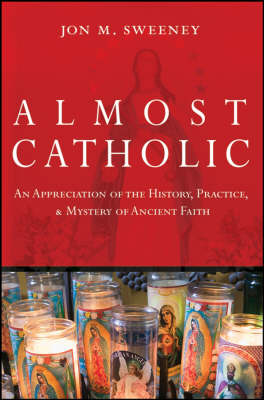
Almost Catholic: An Appreciation of the History, Practice, and Mystery of Ancient Faith
Non-Fiction, Religion, Christianity
Jon Sweeney (author)
Hardback Published on: 07/03/2008
Price: £15.99